
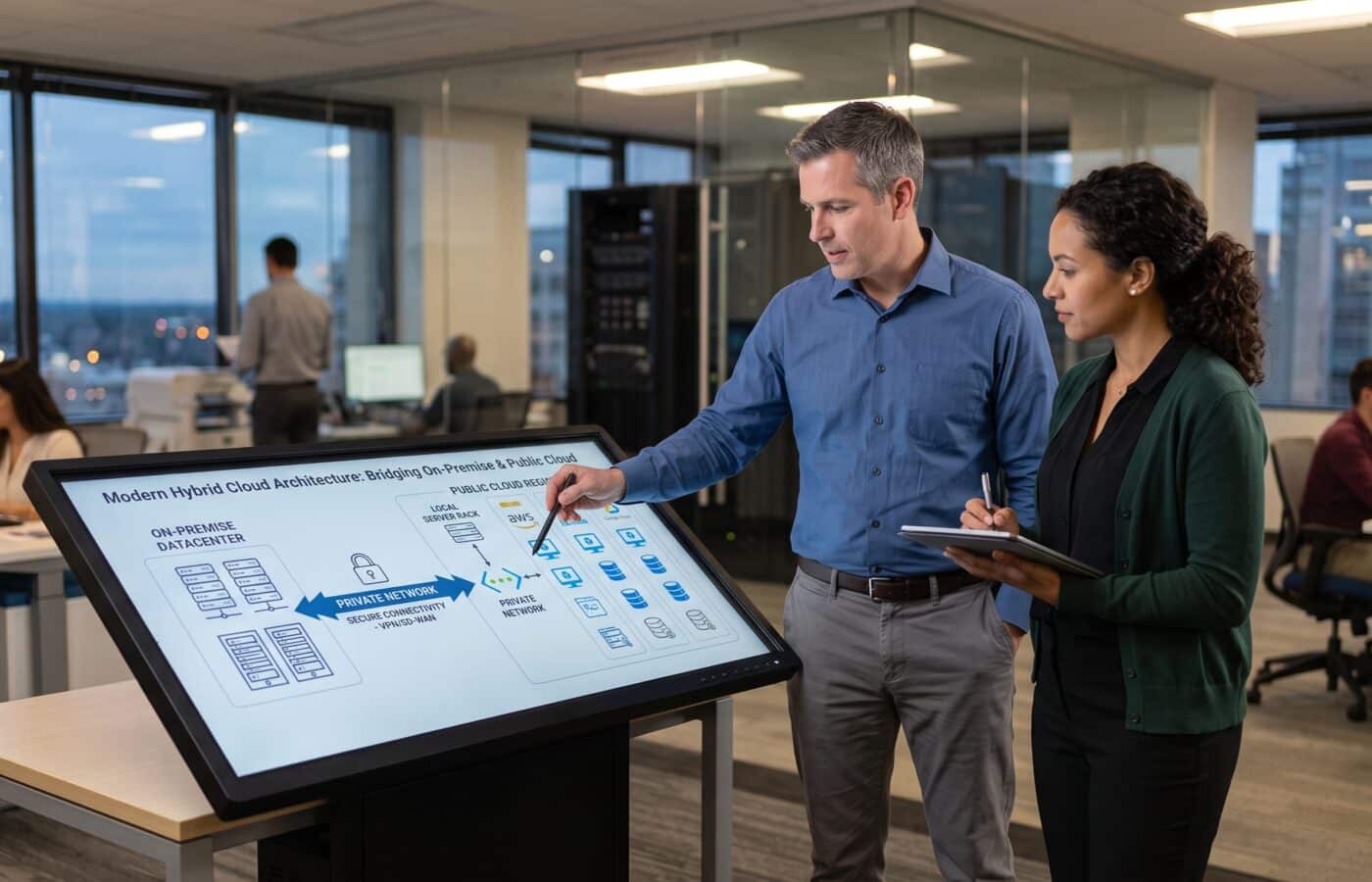
Bridging On-Premise and Public Cloud: A Guide to Modern Hybrid Cloud Architecture

Twenty years into infrastructure work, I’ve stopped believing in the clean slate. Every enterprise I’ve walked into — banking, manufacturing, healthcare, logistics — has some mainframe, some SAN, some legacy application nobody wants to touch, sitting a few racks away from a growing footprint in AWS, Azure, or Google Cloud. That coexistence isn’t a phase on the way to “full cloud.” For most organizations, it’s the destination. Hybrid cloud architecture is what you get when you stop pretending the data center is going away and start designing for the fact that it isn’t.
This article is written from that vantage point: the enterprise architect’s desk, where the job isn’t picking a cloud provider, it’s making two (or three, or five) environments behave like one coherent system without pretending the seams don’t exist.
What Hybrid Cloud Architecture Actually Means
Vendors love to sell hybrid cloud as a checkbox — connect a VPN, install an agent, call it done. That’s not architecture, that’s plumbing. Hybrid cloud architecture is the deliberate design of workload placement, data flow, identity, networking, and governance across on-premises infrastructure and one or more public cloud environments, such that the boundary between them stops being a decision point for every new application.
The distinction matters because most hybrid failures I’ve been called in to fix weren’t caused by bad technology choices. They were caused by treating the on-prem estate and the public cloud as two separate projects that happened to share a network link. You end up with duplicated identity providers, inconsistent security policies, and application teams who have no idea which environment a workload is even supposed to live in. A real hybrid cloud architecture treats placement as a design output, not a starting assumption.
Why On-Premises Still Anchors Hybrid Cloud Architecture
I still get asked, usually by someone two years into their career, why we don’t “just move everything.” Three reasons keep showing up in nearly every engagement I’ve run, and all three are the reason hybrid cloud architecture exists as a discipline rather than a transitional phase.
Data gravity is the first. Once a dataset grows past a certain size and gets woven into a dozen downstream systems, moving it costs more — in time, risk, and egress fees — than the business case can justify. I’ve seen a 40-terabyte claims database anchor an entire insurance platform on-prem for years after everything around it had already moved.
Regulatory and latency constraints are the second. Financial services firms bound by data residency rules, hospitals under HIPAA, manufacturers running deterministic control systems on the shop floor — these aren’t hypothetical edge cases, they’re the majority of my client base. A control loop that tolerates 5 milliseconds of jitter doesn’t care how elegant your cloud region failover is.
Sunk capital is the third, and the least discussed. A company that spent eight figures on a data center refresh three years ago isn’t writing that off because a cloud vendor’s sales team promised elasticity. Depreciation schedules are a real architectural constraint, whether or not anyone puts them in the design document.
Gartner’s infrastructure research has made a version of this same point for years, projecting that a substantial share of enterprise workloads will keep running outside centralized public cloud regions well into the back half of this decade. My own field experience lines up with that: hybrid isn’t a transitional state, it’s a steady one.
I’d add a fourth reason that rarely makes it into vendor pitch decks: organizational readiness. A cloud migration isn’t just a technical lift, it’s a change in how a company staffs, budgets, and troubleshoots its systems. I’ve worked with operations teams who could diagnose a storage array failure blind, at 3 a.m., from memory — and who needed six months of retraining before they trusted a cloud-native monitoring stack the same way. Rushing that transition doesn’t save time. It just moves the cost from the migration budget to the incident log.
Five Pillars of Hybrid Cloud Architecture I Evaluate on Every Engagement
When I’m asked to assess or redesign a hybrid cloud architecture, I work through five structural layers before I touch a single workload migration plan. Skipping any one of them is how you end up rebuilding the whole thing eighteen months later.
Connectivity and network fabric. Dedicated interconnects — AWS Direct Connect, Azure ExpressRoute, or an equivalent — paired with a software-defined WAN layer that can route intelligently between sites. I’ve watched teams try to run production traffic over a site-to-site VPN meant for disaster recovery failover. It works, until the day it doesn’t.
Identity as a single fabric, not two directories. If your on-prem Active Directory and your cloud identity provider are synchronized but not truly federated, you don’t have unified identity — you have two systems that occasionally agree with each other. Every credential, every service account, every conditional access policy needs one source of truth.
Data placement and movement. Where does data land first, how does it replicate, and what’s the actual recovery point objective if a link goes down for six hours? This has to be decided per data class, not per application, because most applications touch more than one data class.
Workload orchestration and placement logic. Kubernetes running consistently across environments — through something like Red Hat OpenShift, Azure Arc, or Anthos — gives you a placement layer that isn’t hard-coded into each team’s deployment scripts. Without it, “where should this run” becomes a Slack conversation instead of a policy.
Unified observability and governance. One pane of glass is a cliché, but the underlying need is real: consistent logging, consistent cost tagging, consistent security posture across both estates. I’ve audited environments where the cloud side had mature FinOps tooling and the on-prem side had none, which made every cross-environment cost comparison fiction.
Get these five right and workload migration decisions become almost mechanical. Get them wrong and every migration is a bespoke, expensive negotiation.
Hybrid Cloud Architecture Mistakes I See More Than I’d Like
These are the mistakes that undermine a hybrid cloud architecture more often than any specific technology choice does. The most common one is treating the public cloud as a bigger data center rather than a fundamentally different operating model. Teams lift and shift a virtual machine, keep the same patching cadence, the same manual change process, and wonder why costs balloon without any of the elasticity benefits showing up.
The second is under-investing in network design because it’s the least glamorous part of the build. I’ve reviewed hybrid architectures where the entire cross-environment strategy was “we’ll figure out bandwidth later.” Later always arrives during a peak load event.
The third — and this one costs real money — is skipping a data classification exercise before deciding what moves where. Without it, sensitive data ends up replicated somewhere it shouldn’t be, purely because nobody drew the boundary before the migration started.
The fourth is assuming security policy translates automatically between environments. A firewall rule set that’s been tuned for a decade on-prem doesn’t map cleanly onto cloud-native security groups, and pretending it does is how misconfigurations slip through.
The fifth, and probably the one I argue about most in steering committee meetings, is picking the architecture around a single application instead of the portfolio. I’ve sat through plenty of proposals built entirely around one high-visibility workload, with every design decision optimized for it. Six months later, the next fifteen applications that need to move don’t fit the pattern at all, and the team is left retrofitting a bespoke design into something that was never meant to generalize. Architecture built for one app is a pilot. Architecture built for a portfolio is a platform, and those are two very different documents.
A Practical Hybrid Cloud Architecture Management Strategy
Architecture gets you the design. Management strategy is what keeps a hybrid cloud architecture from decaying six months after go-live, and this is the part that gets neglected most.
Governance has to be codified, not documented. Policy-as-code — using tools like Terraform, Open Policy Agent, or cloud-native equivalents — means the rules about where data can live and what configurations are allowed get enforced automatically, rather than living in a wiki page nobody reads after the first quarter.
Cost visibility needs to span both estates from day one. FinOps practices that only cover the cloud portion of spend give you half a budget picture, and half a budget picture is worse than none because it creates false confidence.
Security operations need a single incident response process that doesn’t care which environment triggered the alert. I’ve seen organizations run two separate SOC workflows — one for cloud, one for on-prem — and lose critical minutes during an incident because the two teams weren’t even using the same severity taxonomy.
Skills investment matters more than most budgets reflect. Your best VMware administrator and your best cloud engineer need enough overlapping knowledge to have the same conversation about a workload’s requirements. Cross-training isn’t a nice-to-have here, it’s operational risk reduction.
Finally, review the architecture on a fixed cadence — I recommend every 12 months at minimum, sooner if a major platform shift is underway. Hybrid cloud architecture isn’t a project with an end date. It’s an operating model, and operating models need maintenance.
Where Hybrid Cloud Architecture Is Heading
The distinction between “on-prem” and “cloud” is already blurring at the infrastructure layer, and that shift is reshaping what hybrid cloud architecture even means at the hardware level. Services like AWS Outposts and Azure Local bring public cloud APIs and control planes directly into your own data center, which changes the question from “which environment” to “which control plane,” even when the hardware never leaves your building. Edge computing is pulling workloads back toward physical proximity for latency-sensitive use cases, which is, in its own way, a return to distributed on-premises thinking, just with cloud-native tooling wrapped around it.
None of this eliminates the fundamentals I’ve laid out above. It just means the boundary keeps moving, which is exactly why architecture — deliberate, documented, revisited — matters more than any single vendor’s roadmap.
Closing Thoughts
Hybrid cloud architecture isn’t a compromise you settle for until a full migration finishes. For most organizations I work with, it’s the permanent, correct answer to a set of constraints that aren’t going away: regulatory boundaries, latency requirements, sunk infrastructure, and the simple reality that not every workload benefits from living in someone else’s data center. The organizations that get this right aren’t the ones with the most cloud services provisioned. They’re the ones who treated the boundary between environments as a design problem worth solving properly, once, rather than patching around it application by application.
Hybrid Cloud Architecture FAQ
What is hybrid cloud architecture, in plain terms?
It’s an infrastructure design where on-premises systems and one or more public cloud environments are connected and managed as a coordinated whole — shared identity, consistent networking, and deliberate rules for where each workload and dataset lives — rather than as two separate environments that happen to be linked.
How is hybrid cloud different from multi-cloud?
Hybrid cloud specifically combines private infrastructure (on-prem or a private data center) with public cloud. Multi-cloud refers to using more than one public cloud provider, with or without an on-premises component. An organization can be both at once.
Is hybrid cloud more expensive than going fully cloud-native?
It depends entirely on the workload mix. For data-gravity-bound applications or steady, predictable workloads, keeping infrastructure on-prem is often cheaper long-term than paying for elastic capacity you don’t need. The expensive outcome is an unmanaged hybrid environment, not hybrid itself.
What’s the biggest security risk in a hybrid cloud architecture?
Inconsistent policy enforcement between environments. A security control that’s well-tuned on-prem rarely translates automatically to cloud-native tooling, and that gap is where most hybrid security incidents originate.
How long does a hybrid cloud architecture project typically take?
For a mid-size enterprise, expect somewhere between 9 and 18 months for the foundational layers — connectivity, identity federation, and governance — before workload migrations can move at real speed. Organizations that rush this phase almost always pay for it later in rework.
Do I need Kubernetes to run a hybrid cloud architecture?
No, but a consistent orchestration layer makes workload portability dramatically easier. It’s not a requirement for hybrid cloud, but it removes a lot of the manual placement decisions that otherwise fall on individual application teams.
References
-
Gartner — Press release on enterprise applications residing outside centralized public cloud locations
-
Gartner — Blueprint for Designing Your Hybrid Cloud Strategy
-
Link: Gartner Document 6097627
-
-
AWS Prescriptive Guidance — Best practices for building a hybrid cloud architecture with AWS services
-
Microsoft Learn, Azure Architecture Center — Hybrid architecture design guidance
-
National Institute of Standards and Technology — NIST Cloud Computing Reference Architecture, Special Publication 500-292
-
PDF Direct Download: DOI: 10.6028/NIST.SP.500-292 (PDF)
-
IBM — Hybrid cloud strategy and Red Hat OpenShift resources