
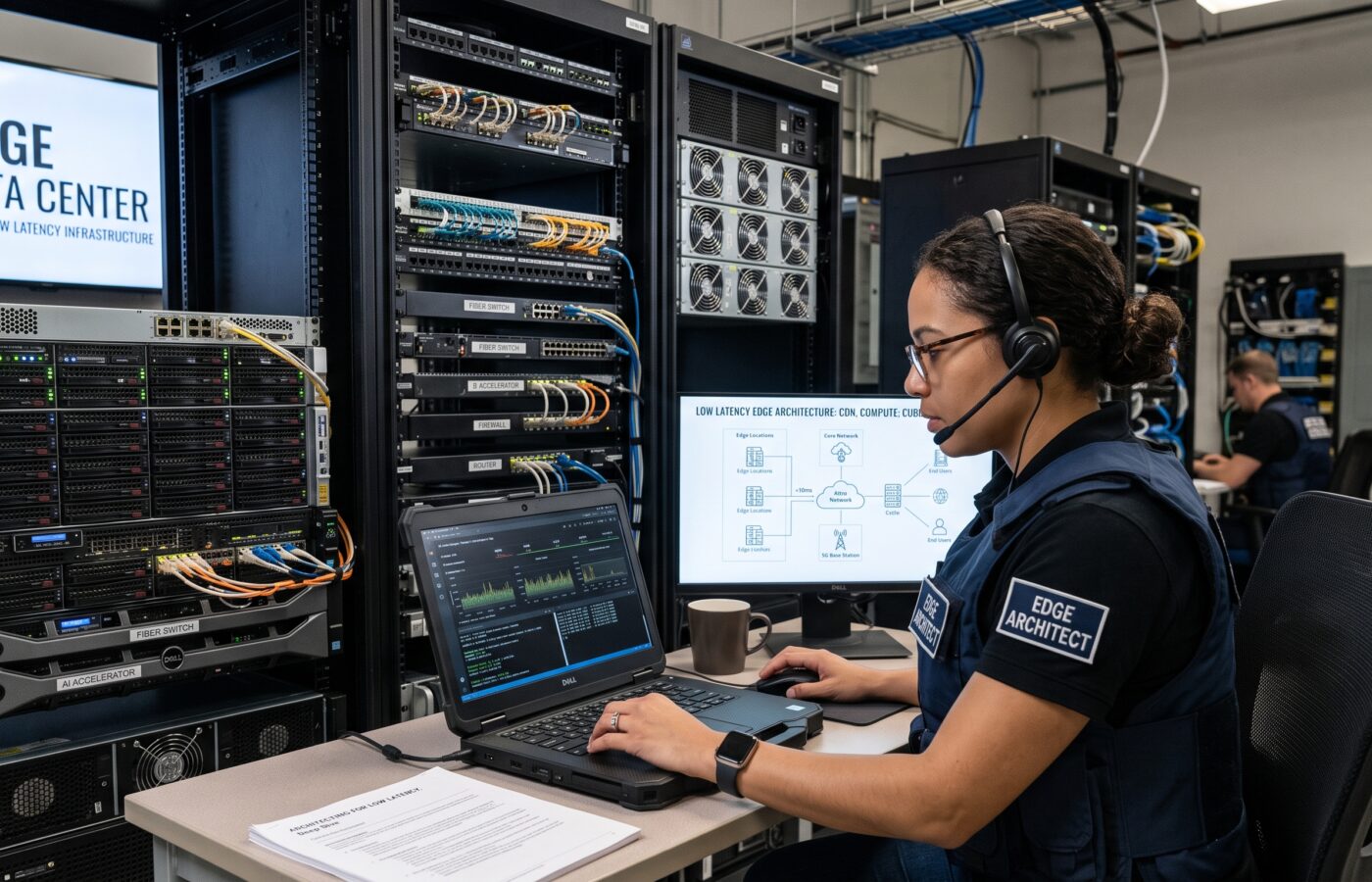
Architecting for Low Latency: A Deep Dive into Edge Infrastructure

I’ve spent the better part of my career staring at rack elevations, power budgets, and fiber maps, and if there’s one lesson that keeps repeating itself, it’s this: latency doesn’t care about your org chart. It doesn’t care that your team ships fast or that your cloud contract has generous burst credits. It cares about physics. That’s the reason edge infrastructure has moved from a niche telco concern to a mainstream architectural requirement, and it’s why I want to walk through how I actually design, deploy, and operate it — not the marketing version, the field version.
Why Edge Infrastructure Stopped Being Optional
For years, “the edge” was something CDN vendors talked about while the rest of us kept shipping everything to three or four regional clouds and calling it a day. That worked when the dominant workload was a web page and a database query. It stopped working once workloads became sensor fusion for autonomous equipment, real-time bidding, AR overlays, industrial control loops, and inference pipelines that need an answer before a human notices a delay.
Here’s the physics problem in concrete terms. Signal in optical fiber travels at roughly two-thirds the speed of light in a vacuum — call it 200 kilometers per millisecond once you account for the refractive index of glass. A facility sitting 1,300 kilometers from your users isn’t a rounding error; it adds about 13 milliseconds of round-trip delay before a single byte of application logic even runs. Stack a few hops of routing, TLS negotiation, and a congested peering point on top of that, and your “fast” cloud region quietly becomes a 60-80ms tax on every interaction. Edge infrastructure exists to collapse that distance, and by extension, that tax.
What makes this a fundamentals topic rather than a niche one is that edge infrastructure isn’t a separate discipline from data center design — it’s the same discipline under harsher constraints. Less space, less power, less staff, more sites. If you understand power distribution, thermal management, and network resiliency at scale, you already have most of what you need. What’s missing is the operating model, and that’s where most teams stumble.
What “Edge Infrastructure” Actually Means
I want to be precise here because the term gets stretched to cover almost anything. In practice, edge infrastructure refers to compute, storage, and networking capacity placed physically close to where data is generated or consumed — a retail backroom, a factory floor, a cell tower site, a regional colocation suite, or a purpose-built micro-data center bolted to the side of a building. It is not simply a smaller cloud region. A cloud region has redundant everything and a bench of engineers a badge-swipe away. An edge site often has neither.
A micro-data center, the physical unit most of these deployments come down to, typically packages compute, cooling, power distribution, and physical security into a single enclosed footprint — anywhere from a few rack units to a couple of standard 42U racks. The design goal is to deliver data-center-grade reliability without a data-center-sized building, staff, or budget. That constraint shapes every decision downstream.
The Edge Infrastructure Blueprint I Actually Use
When I’m asked to stand up new edge infrastructure, I break the design into four layers, and I insist on reviewing all four before a single site gets approved.
Physical and power layer. This is where most edge failures actually originate — not in software, but in an underpowered UPS or a cooling unit that wasn’t sized for the local climate. I size power with headroom for at least one generation of hardware refresh, because ripping out a distribution board in a live retail store is a special kind of miserable. Cooling gets the same treatment: sealed, filtered enclosures with contained hot-aisle exhaust hold up far better in dusty industrial environments than open rack designs borrowed from a core data center.
Compute and orchestration layer. I standardize on a single hardware SKU per deployment wave wherever possible. Heterogeneous hardware at the edge is how you end up debugging a firmware quirk on one specific node type across dozens of unstaffed locations. On top of that hardware, lightweight Kubernetes distributions or similar orchestrators handle workload placement, with GitOps-style declarative configuration so a site can be rebuilt from a repository rather than a runbook someone half-remembers.
Network layer. Every edge site needs at least two paths home — a primary circuit and a backup that doesn’t share a conduit, a pole, or a carrier’s regional aggregation point with the primary. SD-WAN or similar software-defined overlays handle failover, but I still physically verify path diversity before I trust an SLA on paper. I’ve been burned once by “redundant” circuits that turned out to share the same trench.
Management and observability layer. This is the layer that decides whether your edge infrastructure scales to 13 sites or collapses under its own weight at 13 sites. Centralized DCIM (data center infrastructure management) tooling, remote power cycling, and out-of-band access are not nice-to-haves; they’re what keeps a truck roll from being your only recovery option when a node hangs at 2 a.m.
Edge Infrastructure Deployment Strategy: Sequencing Matters More Than Speed
The temptation with edge infrastructure programs is to move fast and roll out everywhere at once, usually because a business unit has a launch date. I push back on that every time. My deployment sequence looks roughly like this:
First, a pilot cluster of three to five representative sites — not the easiest ones, the ones that best represent your worst-case environment (heat, dust, unreliable local power, whatever your actual constraint is). Second, a validation window where I deliberately inject failure: pull a power feed, saturate the network link, kill a node, and watch what actually happens versus what the design assumed would happen. Third, a phased rollout in waves of roughly ten to twenty sites, with a hard requirement that each wave’s telemetry gets reviewed before the next wave ships. Skipping that review step is how a subtle cooling miscalculation in the pilot becomes a fleet-wide problem by site 40.
One pattern I’ve come to rely on is treating site selection itself as an engineering decision, not a real-estate one. I score candidate locations against factors including power availability and cost, fiber or wireless backhaul options, physical security, local climate extremes, proximity to the workload source, and regulatory constraints on data residency. A site that’s geographically perfect but sits on an unreliable grid will cost you more in generator fuel and battery replacement than a slightly farther site with clean utility power.
Managing Decentralized Workloads on Edge Infrastructure Without Losing Your Mind
Here’s where a lot of otherwise solid architectures fall apart: the software operating model doesn’t match the physical reality of edge infrastructure spread across dozens or hundreds of unstaffed, intermittently-connected sites.
The workloads themselves need to be designed for disconnection, not just distribution. That means local-first data handling — a site should keep functioning and queuing data even when its uplink drops, then reconcile with the core once connectivity returns. I’ve seen teams build beautiful edge hardware and then run a workload that hard-fails the moment it loses its database connection to a region three time zones away. That’s not an edge deployment; that’s a remote branch of a centralized system waiting to break.
State management deserves particular care. Wherever possible, I push toward stateless services at the edge with state synchronized asynchronously to a durable store, rather than treating each site as an authoritative database. When state genuinely has to live at the edge — inventory counts, local session data, control-loop setpoints — I use conflict-resolution strategies decided in advance, not improvised during an incident.
Observability across a decentralized fleet also has to change shape. A single pane of glass matters less than a hierarchy: local health checks that can trigger autonomous remediation without waiting for a round trip to a central system, feeding into aggregated fleet-level dashboards that flag anomalies without drowning operators in per-site noise. I generally set alerting thresholds at the fleet level first and only drill into a specific site once a pattern crosses a meaningful percentage of the fleet — otherwise you’re paging someone every time one node out of hundreds has a bad afternoon.
Security follows a different threat model out here too. A server in a locked, badge-access data center and a server in an unlocked utility closet at a retail location are not defended the same way. I assume physical compromise is possible at any edge site and design around it: encrypted storage at rest, hardware-backed secure boot where the hardware supports it, and network segmentation so a compromised edge node can’t pivot into the core. Zero-trust principles apply more literally here than almost anywhere else in the stack, because you genuinely cannot vouch for the physical perimeter the way you can in a leased data center suite.
Edge Infrastructure Practices That Actually Hold Up in Production
A few edge infrastructure habits have saved me repeatedly, and I’d rather pass them on plainly than dress them up:
Standardize the site design and treat every deviation as a documented exception, not a one-off. The moment engineers start customizing individual sites to solve local problems, your fleet stops being a fleet and starts being a collection of snowflakes that nobody wants to touch.
Automate remote hands procedures as far as you possibly can — remote reboot, remote reimage, remote log pull — because the cost of dispatching a technician to a site scales linearly with your fleet size in a way that erodes any savings the edge model was supposed to deliver.
Budget for the boring stuff: spare parts prepositioned regionally, firmware update cycles planned rather than reactive, and a realistic maintenance window that accounts for the fact that nobody is on-site to swap a failed drive at 3 a.m.
Design for graceful degradation, not just failover. A site that can serve stale cached data during an outage is often more valuable to the business than one that fails cleanly and stops serving anything at all.
And measure the thing you actually care about. Uptime percentages are easy to report and often meaningless; what matters is whether the latency budget you designed for is actually being hit at the 95th and 99th percentile, site by site, not just in aggregate.
Where Edge Infrastructure Teams Get This Wrong
The most common mistake I see is treating edge infrastructure as a smaller version of a cloud deployment rather than a fundamentally different operating environment. The second most common is underinvesting in the management layer because it doesn’t show up on a rack diagram — teams will happily spend on compute and cooling and then treat centralized monitoring and remote access as an afterthought, right up until the first 2 a.m. outage at a site nobody can reach without a four-hour drive.
The third, and maybe the most expensive, is skipping the pilot-and-inject-failure phase because a deadline is looming. Every shortcut taken during validation shows up later, multiplied by however many sites you’ve since deployed.
Closing Thought on Edge Infrastructure
Edge infrastructure isn’t a trend to adopt; it’s a response to a constraint that isn’t going away — the finite speed of light and the growing number of workloads that actually notice the difference. Treat it as core infrastructure discipline applied under tighter physical and operational limits, sequence your rollout deliberately, design your software for disconnection, and build the management layer with the same rigor you’d give the compute layer. Do that, and the architecture holds up far past the pilot.
Frequently Asked Questions About Edge Infrastructure
What’s the practical difference between edge infrastructure and a regular cloud region?
A cloud region is built for scale and redundancy with staff on-site around the clock. An edge site is built for proximity — it trades some of that redundancy and staffing for physical closeness to users or data sources, which means the design has to compensate with automation, remote management, and workloads that tolerate intermittent connectivity.
How much latency reduction can I realistically expect from moving to the edge?
It depends entirely on where your users and current infrastructure sit relative to each other, but cutting round-trip distance from, say, 1,300 kilometers down to under 50 can move you from tens of milliseconds of network delay to single digits. The bigger win is usually consistency — edge deployments reduce the variance caused by congested long-haul routes and peering points, not just the average.
Do I need a full micro-data center, or can I get away with edge servers in existing facilities?
If you already have secure, powered space in a retail location, factory, or regional office, you may only need ruggedized edge infrastructure — proper compute and cooling — rather than a full enclosed micro-data center. The enclosure earns its cost when the physical environment is uncontrolled — dust, temperature swings, or a lack of physical security.
What’s the biggest operational risk in running decentralized workloads on edge infrastructure?
Software that assumes constant connectivity. If a workload can’t queue data locally and reconcile later, a routine fiber cut turns into a data-loss incident instead of a brief degradation.
How do I decide how many edge infrastructure sites I actually need?
Start from your latency budget and your users’ geographic distribution, not from a target site count. Map where the 95th-percentile user sits relative to candidate locations, then work backward to the minimum footprint that meets your budget — over-deploying sites adds operational burden without a proportional latency benefit.
Is edge infrastructure more expensive than centralizing everything in the cloud?
Per-site costs are usually higher relative to the compute delivered, since you lose economies of scale. But when you account for the cost of bandwidth, the business impact of latency-sensitive failures, and data residency requirements, a well-scoped edge footprint frequently comes out ahead for the specific workloads that actually need it — the mistake is applying it to workloads that don’t.
References
- Uptime Institute. “Data Center Tier Certification.” uptimeinstitute.com
- Uptime Institute. “Data at the Edge Report.” uptimeinstitute.com/data-centers-at-the-edge
- Schneider Electric / APC by Schneider Electric. “Practical Guide to Ensuring Availability at Edge Computing Sites.” White Paper, se.com
- Mirantis. “The Complete Guide to Edge Computing Architecture.” mirantis.com/blog
- Redis. “Edge Computing Latency: Causes and How to Reduce It.” redis.io/blog
- STL Partners. “How Does Edge Computing Architecture Impact Latency.” stlpartners.com/articles/edge-computing
- Netrality. “Edge Data Centers: The Complete Guide to Edge Computing Infrastructure.” netrality.com/blog