
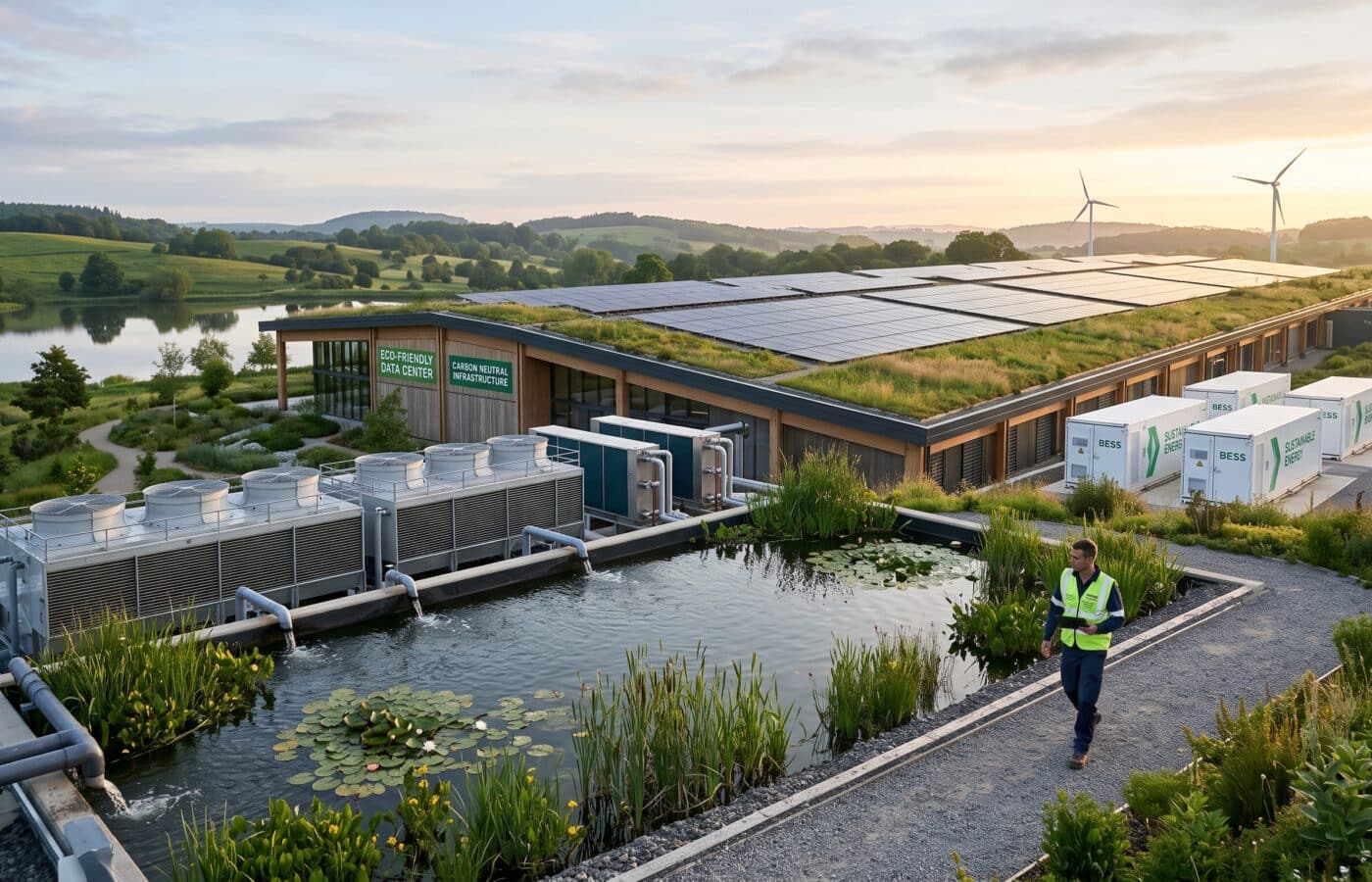
Eco-Friendly Infrastructure: Reducing Carbon Footprints in Data Centers

I have spent the better part of 12 years designing infrastructure for organizations that started out treating power bills as an afterthought and ended up treating them as a design constraint on par with latency and uptime. That shift didn’t happen because sustainability became fashionable. It happened because the math stopped working. A rack that used to draw 6 kilowatts now draws 40 or more once you pack it with GPUs, and every additional kilowatt has to be generated, delivered, and then pulled back out of the room as heat. Green IT and sustainability used to sit in a corporate responsibility slide deck. Today it sits in the capacity planning spreadsheet, right next to power availability and cooling headroom, because it directly determines whether a facility can be built at all.
This piece is written from that vantage point — the architect’s desk, not the marketing brief. I want to walk through what actually reduces carbon in a data center, what tends to be oversold, and where the real leverage points are for a team that has to answer to a CFO as much as to an environmental policy.
Why the Carbon Math Changed
Data centers are estimated to consume around 1.5 percent of global electricity today, and that share is projected to roughly double by 2030 as AI workloads scale. In some markets the concentration is already extreme — data centers account for a fifth of Ireland’s electricity draw and a meaningful slice of demand in Virginia, Singapore, and Frankfurt. When a facility’s power draw starts competing with a region’s grid capacity, utilities and regulators stop treating it as a private business decision. Interconnection queues get longer, environmental disclosure requirements get stricter, and in several jurisdictions new data center permits are now conditioned on renewable sourcing or waste heat reuse commitments.
For an enterprise architect, that means power is no longer just an operating expense line. It is a scarce resource that shapes where you can even site a workload, how fast you can grow, and how much scrutiny your next capital request will receive from a board that reads ESG reports before it reads uptime reports. This is the backdrop against which every green IT and sustainability initiative now gets funded, deferred, or quietly killed.
Energy-Efficient Hardware Is the Foundation, Not the Finish Line
Hardware is usually where a green IT and sustainability conversation starts, and for good reason — it’s the layer with the most direct, measurable impact. A few things I’ve learned matter more than the vendor spec sheet suggests:
Right-sizing beats refreshing. Teams often assume the newest chip generation is automatically greener. Sometimes it is, but the bigger win usually comes from matching compute to actual workload demand rather than provisioning for a peak that happens four days a year. I’ve walked into environments running production databases on servers built for a load three times what they ever see, because nobody revisited the sizing after the initial rollout.
ARM and other efficiency-focused architectures earn their keep on the right workloads. For stateless, horizontally scaled services, the performance-per-watt gains are real and often land in the 20 to 30 percent range compared to equivalent x86 deployments. They are not a universal replacement, though — legacy applications with heavy single-thread dependencies frequently negate the efficiency gain once you account for the re-architecture effort.
Extend hardware life deliberately. The embodied carbon in a server — the emissions from mining raw materials, manufacturing, and shipping — can represent a substantial share of its lifetime footprint before it ever powers on. Stretching a refresh cycle from three years to four or five, where warranty and performance requirements allow, is one of the least glamorous and most effective levers available. It rarely makes it into a sustainability report, but it shows up in the numbers.
Sustainable Cooling and Cloud Computing
Cooling is where infrastructure architects earn their keep, because it is the one area where design decisions compound. The standard efficiency measure here is Power Usage Effectiveness — total facility power divided by IT equipment power. A PUE of 1.0 would mean every watt entering the building goes straight to compute, which is not achievable in practice. Industry-wide, average PUE has been stuck in the 1.5 to 1.6 range for several years now, largely because older facilities and hotter climates offset gains made elsewhere. Newer builds, by contrast, are commonly landing closer to 1.2, and the best hyperscale campuses report figures approaching 1.1.
The design choices that separate a 1.5 facility from a 1.2 facility are not exotic:
Free cooling, using outside air or water-side economizers instead of mechanical chillers whenever ambient conditions allow, can eliminate a large share of cooling-related energy use in temperate climates. It requires site selection discipline — you cannot retrofit geography.
Liquid and immersion cooling are moving from novelty to necessity as rack densities climb with GPU deployments. Direct-to-chip liquid cooling can remove heat far more efficiently than air, and it’s becoming close to mandatory once you’re running dense AI training clusters rather than general-purpose compute.
Hot aisle and cold aisle containment, raised floor pressure management, and airflow modeling remain unglamorous but high-return investments. I’ve seen a poorly sealed containment system alone add several tenths of a point to a facility’s PUE.
On the cloud side, green IT and sustainability thinking means treating region selection as a carbon decision, not just a latency one. Hyperscale providers publish carbon intensity data by region, and workloads that aren’t latency-sensitive can often be shifted to grids with a cleaner energy mix without any application changes. Several providers now offer carbon-aware scheduling that shifts batch and training jobs to windows when the grid is greener, which is a genuinely low-effort, high-impact lever for teams running large periodic workloads.
Renewable Energy Sourcing — and Its Limits
Renewable sourcing is the piece of green IT and sustainability strategy that gets the most airtime, and also the most oversimplification. Most large infrastructure providers now claim renewable energy matching at or near 100 percent on an annual basis, typically through power purchase agreements and renewable energy certificates. That claim is real, but it’s an annual accounting figure, not a real-time one. A facility can be “100 percent renewable matched” on paper while still drawing from a fossil-heavy grid at 9 p.m. on a windless evening, because the renewable generation it paid for happened elsewhere, at a different time.
The industry is moving toward 24/7 carbon-free energy matching, which ties consumption to clean generation on an hourly basis rather than an annual one. It’s a much harder standard to meet and a much more honest one. If you’re evaluating a colocation or cloud provider’s sustainability claims, ask specifically whether their renewable matching is annual or hourly — the answer tells you a lot about how seriously they’re taking the problem versus how well they’re managing the narrative.
For architects designing on-premises or hybrid environments, on-site generation — rooftop solar, in some cases small-scale wind, or waste heat recovery piped into district heating systems — is worth evaluating even when it only offsets a modest fraction of total load. Every kilowatt generated on site is a kilowatt that doesn’t need a PPA, a certificate, or an accounting footnote to justify.
Responsible E-Waste Management
E-waste gets far less attention than energy in most green IT and sustainability conversations, which is a mistake given the scale of the problem. Global e-waste generation reached roughly 62 million tonnes in a recent measured year, and formal collection and recycling rates sit at only around 22 percent worldwide. The gap between what’s generated and what’s properly processed is widening, not closing, and it represents billions of dollars in recoverable materials — copper, gold, rare earth elements — that end up in landfills or informal processing streams instead of back in the supply chain.
For a data center or enterprise IT estate, responsible e-waste management comes down to a few concrete practices:
Certified IT asset disposition (ITAD) partners, ideally R2 or e-Stewards certified, ensure decommissioned hardware is either refurbished for resale, harvested for parts, or recycled through channels that don’t just export the problem to a country with weaker environmental enforcement.
Data destruction and hardware reuse are not in conflict. A drive can be securely wiped or degaussed and still go on to a second life in a less demanding environment, rather than being shredded by default because it’s the path of least liability.
Component-level harvesting — reclaiming RAM, power supplies, and drives from decommissioned servers for use as spares — extends the useful life of a fleet without new procurement, and it’s a practice I’ve reintroduced in more than one environment where it had quietly fallen out of use.
Building a Green IT Roadmap That Survives Contact With a Budget Review
Green IT and sustainability initiatives die in committee when they’re presented as a cost center. The ones that survive are framed as efficiency and risk-reduction programs that happen to also cut emissions. A few principles that have held up across the environments I’ve worked in:
Measure before you commit capital. You cannot manage what you haven’t instrumented. Sub-metering at the rack or row level, not just at the utility feed, is what lets you find the 12 or so highest-impact interventions instead of guessing.
Tie sustainability metrics to existing operational reviews rather than creating a parallel reporting track. If PUE, e-waste diversion rate, and renewable matching percentage show up in the same review where you already discuss uptime and cost, they get sustained attention instead of a once-a-year audit scramble.
Sequence the cheap wins first. Airflow containment, workload consolidation, and extending refresh cycles typically pay back faster than a liquid cooling retrofit or an on-site solar array. Building credibility with early, visible wins makes the case for the bigger capital asks that come later.
Treat vendors as accountable partners, not just suppliers. Hardware manufacturers and cloud providers increasingly compete on efficiency and take-back programs. Building those requirements into procurement criteria, rather than treating them as a nice-to-have, shifts the market over time.
Where This Is Heading
The next few years will make green IT and sustainability harder to treat as optional, not easier. Grid interconnection constraints, tightening disclosure regulations, and the sheer power density of AI infrastructure are converging to make energy and materials efficiency a hard architectural requirement rather than a values statement. The organizations that will be least disrupted by that shift are the ones already measuring, sequencing, and budgeting for it now, rather than the ones waiting for a mandate to force the conversation.
None of this requires abandoning performance or reliability targets. In my experience, the facilities and architectures that are genuinely well-designed for sustainability also tend to be the best-run ones overall — because the discipline of measuring power, heat, and material flow closely is the same discipline that produces a stable, well-understood environment. Carbon reduction, in that sense, isn’t a separate initiative bolted onto infrastructure work. It’s what good infrastructure work looks like when you follow the numbers all the way through.
Frequently Asked Questions
What does “green IT and sustainability” actually mean in a data center context?
It refers to the combined set of practices — energy-efficient hardware, optimized cooling, renewable and carbon-aware power sourcing, and responsible end-of-life handling of equipment — aimed at reducing the environmental footprint of computing infrastructure without sacrificing performance or reliability.
What is a good PUE for a modern data center?
Industry-wide averages have sat between 1.5 and 1.6 for several years, but newer, well-designed facilities commonly achieve 1.2 or lower, and leading hyperscale sites report figures near 1.1. Anything approaching 1.0 is the theoretical ceiling, not a realistic operating target.
Is cloud computing automatically greener than running your own data center?
Not automatically, but often in practice. Hyperscale providers generally operate at lower PUEs and higher renewable matching percentages than a typical enterprise-owned facility, simply due to scale and specialization. The exception is workloads that are chronically over-provisioned in the cloud, which can offset that efficiency advantage.
How big a factor is e-waste compared to energy use?
It’s frequently underweighted. Embodied carbon and material recovery from hardware manufacturing and disposal are a meaningful share of an IT estate’s total footprint, and unlike energy use, e-waste has a global recycling rate stuck near 22 percent, meaning most of it isn’t recovered at all.
What’s the fastest way for an infrastructure team to start reducing its footprint?
Sub-meter what you already have, right-size over-provisioned workloads, and fix airflow containment before considering any major capital project. These steps typically cost little, pay back quickly, and build the operational credibility needed to fund larger initiatives like liquid cooling or on-site renewable generation.
Does 100 percent renewable energy matching mean a facility runs on clean power at all times?
No. Most renewable matching claims are calculated on an annual basis through power purchase agreements or certificates, which doesn’t guarantee clean power at every hour. The emerging, more rigorous standard is 24/7 carbon-free energy matching, tracked hourly against actual consumption.
References
- International Energy Agency data on data center electricity demand, via Our World in Data — How much energy do data centers and artificial intelligence use?
- Uptime Institute Journal — Global PUEs — are they going anywhere?
- United Nations Institute for Training and Research (UNITAR) — Global E-waste Monitor 2024: Electronic Waste Rising Five Times Faster than Documented E-waste Recycling
- Data Center Dynamics — When 100 percent isn’t enough
- McKinsey & Company — How hyperscalers are fueling the race for 24/7 clean power
- TechTarget — How much energy do data centers consume?