
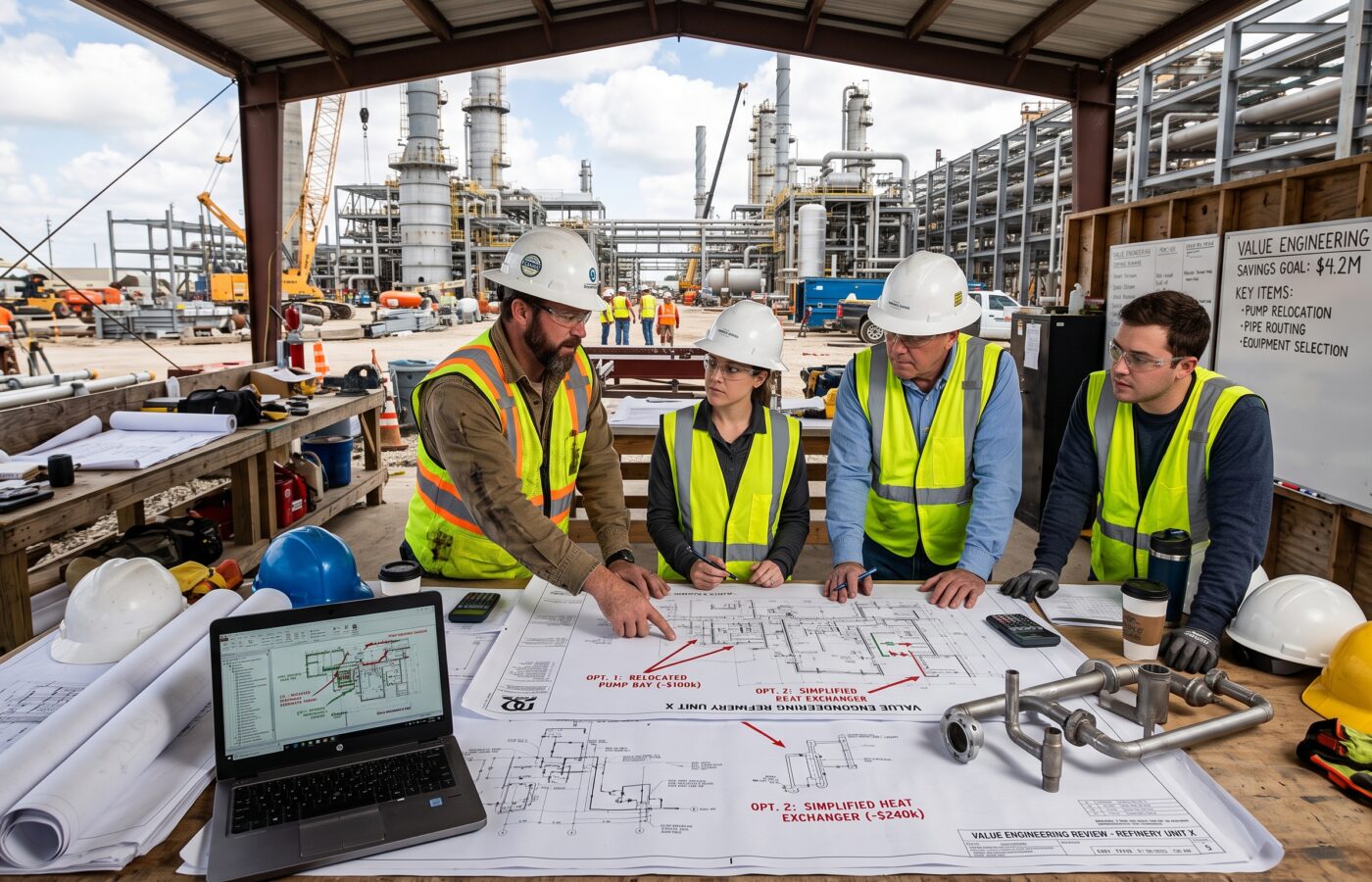
What Value Engineering Actually Looks Like on an Industrial Project

Most people who hear the term “value engineering” assume it’s a polite name for cutting corners. Ask anyone who has actually run a value engineering process on a real industrial job. You’ll get a different answer, usually a slightly annoyed one. I wanted to find out what the work is really like once the meeting room fills up and the drawings come out. So I sat down with Marcus Delgado, a Certified Value Specialist (CVS®) and Value Engineering Facilitator. He has spent close to two decades running workshops on process plants, manufacturing expansions, and heavy industrial builds. What follows is our conversation, lightly trimmed for length.
So let’s start with the basic misunderstanding. What is the value engineering process, really?
Marcus laughed a little at this one. He said it’s the question he answers most at the start of nearly every project kickoff. Usually it comes from someone on the owner’s side who has been burned before. A contractor once promised savings, and those savings turned into problems six months into construction.
“The value engineering process is a structured, function based method. It improves the relationship between cost and performance on a project,” he said. “That’s the textbook definition, and honestly it’s a good one. But people miss the word function. We’re not sitting around asking how do we spend less money. We’re asking what does this system actually need to do. Then we find the smartest way to make it do that. Sometimes the smartest way costs less. Other times it costs more up front and saves money over the life of the plant. Cost doesn’t always move much, but reliability or maintainability often improves a lot. A client sometimes walks into a workshop only wanting a lower number on page one. I tell them upfront that’s not what this is.”
He pointed to the formalized version of this process that comes from SAVE International. That’s the professional society that also runs the CVS certification program he holds. Their job plan has been the backbone of the value engineering process in industrial and construction settings for decades, he said. Most experienced practitioners still structure their workshops around its phases, even when they never mention the acronym to the client.
Walk me through what actually happens during a value engineering process workshop.
“There are six phases, and I’ve never seen a good facilitator skip one,” Marcus said, counting them off on his fingers.
Phase one: information
“Before anyone brainstorms anything, you have to understand the project cold. You need drawings, specs, the design basis, cost estimates, and schedule. You also need the client’s actual priorities, as opposed to what’s written in the proposal. On an industrial job this usually means pulling in process flow diagrams, piping and instrumentation diagrams, and equipment lists. It also means talking to the design engineers directly instead of just reading their deliverables. I’ve walked into workshops where the printed cost estimate didn’t match what the estimator actually believed. You only find that out by asking.”
Phase two: function analysis
“This phase separates value engineering from a general cost review. We break the project down into its functions, each one expressed as a verb and a noun. Not convey material, but move material. Not house equipment, but protect equipment. It sounds almost too simple. But forcing a room full of engineers to describe a system by what it does, rather than what it is, changes the conversation completely. We usually build this out as a FAST diagram, a function analysis system technique diagram. It lays out the functions in a logical how and why order. It looks like a flowchart, and it takes patience to build correctly. Once it’s on the wall, people start seeing redundant functions and overdesigned components. Nobody notices those while staring at a P&ID.”
Phase three: creative
“This phase is brainstorming, but disciplined brainstorming. Nobody judges ideas as they come out, and no engineer defends their original design yet. I’ve had workshops generate over a hundred ideas in an afternoon for a single function. Most of them turn out bad, and a handful turn out genuinely useful. The volume matters because a good idea that nobody suggests never gets evaluated.”
Phase four: evaluation
“Now the team gets critical. We rank ideas against criteria the client actually cares about: cost, schedule impact, reliability, safety, constructability, and operability. I usually push for a weighted matrix here rather than a gut feeling vote. A weighted matrix forces people to be explicit about tradeoffs. Otherwise people just pick whatever idea the loudest person in the room liked.”
Phase five: development
“The surviving ideas turn into real proposals, backed by enough engineering that a decision maker can actually approve or reject them. A lot of amateur value engineering falls apart right here. An idea that sounded great in the brainstorm sometimes needs a redesign of three adjacent systems. Skip that homework and you hand the client a false promise.”
Phase six: presentation and follow up
“You present the recommendations, and the client’s team decides what gets accepted. Someone then has to track whether the accepted changes actually make it into the final design. Great recommendations get lost between the workshop and the issued for construction drawings more often than people realize. Nobody assigns anyone to chase them down.”
That’s a lot of structure for something people assume is just a budget haircut.
Cutting cost versus adding value
“That’s exactly the misconception I spend half my career correcting,” Marcus said. “Cost cutting is subtractive. You take the number, find things to remove, and hope nothing important was hiding underneath what you cut. The value engineering process is additive, in the sense that it tries to add value. Value itself is a ratio of function to cost. Lowering cost while holding function steady increases value, sure. But holding cost steady while improving function does the same thing. Spending more can even increase value, if the function improvement justifies it.”
Why this matters on connected industrial systems
“On an industrial project this distinction matters because the systems connect in ways that aren’t always obvious on a drawing. A few years back I worked a value engineering study on a materials handling upgrade at a mid sized manufacturing plant. Someone on the client side wanted to downsize the conveyor motors to save on the equipment line item. That’s a straightforward cost cutting move on paper. But function analysis showed the real function wasn’t move product. It was move product reliably at peak production rate without unplanned downtime. Downsizing the motors would have technically worked most days. Then it would have failed during exactly the high demand periods when failure costs the most. That kind of decision looks smart in a spreadsheet and terrible on the plant floor.”
Can you give me a fuller example of a workshop that changed a project?
He thought about this for a moment before landing on one.
The reactor train example
“There was a chemical processing expansion, a new reactor train being added to an existing facility. The original design routed a new set of process piping around an existing structure. That’s just how the site had always been laid out. That routing required an extra pipe rack section and additional structural steel. It also required a longer run of specialty alloy piping, which is not cheap material. During function analysis, one of the client’s own process engineers asked a simple question. Why did the routing have to go around the structure at all, rather than through a section mostly used for storage? That single question led to a redesign of the pipe rack support structure. It shortened the run by about forty percent.”
What the savings actually cost
“Here’s the part people leave out of value engineering success stories. That change wasn’t free. It required additional structural analysis on the existing building. It also required coordination with the client’s operations team, because the storage area needed reorganizing during construction. The schedule for that portion of the work needed revising too. We didn’t just hand over an idea and walk away. The development phase took almost three weeks of engineering time. That time proved the idea was sound and quantified the real net savings after accounting for those additional costs. In the end, the client saved a meaningful amount on materials and schedule. More importantly, the shorter piping run meant fewer welds and fewer potential leak points. Long term maintenance exposure dropped too. That’s a value improvement on multiple fronts, not just a smaller invoice.”
What mistakes do you see most often, either from clients or from less experienced facilitators?
Running it too late
“The biggest one is treating the value engineering process as an event instead of a phase of the project,” Marcus said. “Sometimes I get called in after the design is ninety percent complete. The client wants a one day workshop to find savings before bidding goes out. You can still find useful things at that stage, but your options stay limited because so much has already been locked in. Run it earlier, ideally during conceptual or early detailed design. The team then keeps the freedom to change function based decisions rather than just swap materials.”
Skipping function analysis
“This one drives me a little crazy. People want to jump straight to solutions because it feels productive. Skip function analysis, though, and you end up brainstorming variations on the existing design. You never genuinely reconsider what the system needs to accomplish. I’ve sat in on workshops run by people without formal training. They essentially delivered a glorified cost review dressed up as value engineering, and it shows in the output. Shallow analysis produces shallow ideas.”
Leaving decision makers out of the room
“Sometimes the person who can actually approve a design change isn’t present. Or they aren’t represented by someone with real authority. Either way, the workshop produces a list of great recommendations that sit in limbo for months. By the time approval works its way up the chain, the project has often moved on. Implementing those ideas then costs more than it would have.”
Forgetting follow through
“A value engineering study that produces a great report nobody implements has produced nothing. I always push for a designated owner on the client side. Their job includes tracking every accepted recommendation until it shows up in the final design package.”
Who needs to be in the room for this to work on an industrial project?
“You want a cross section, not just engineers,” Marcus said. “Design engineers matter, obviously, from whichever disciplines apply. That could mean process, mechanical, structural, or electrical, depending on the project. You also want someone from operations or maintenance who will actually run the finished facility. They catch functional issues that a design engineer focused on meeting spec might miss entirely. A procurement or cost estimating person keeps the numbers honest in real time instead of leaving everyone to guess. And ideally you want someone from construction or a contractor’s team in the room. Constructability concerns kill a lot of theoretically great ideas. Better to find that out during the workshop than after a change order shows up.”
“Part of the facilitator’s job is running the process itself. The other part is making sure quieter voices in that room get heard. Some of the best ideas I’ve seen in workshops came from a maintenance technician. That technician almost didn’t speak up because six more senior engineers sat at the same table.”
Is there a point where the value engineering process isn’t worth doing?
“Sure. A project can be small enough that running a formal workshop costs more than any realistic savings justify. Even then, some lighter version of function thinking is almost always worth five minutes of a design review. A project can also sit so far into construction that changes would cause more disruption than they’re worth. Sometimes the honest answer for a client is that we’re past the point where this makes sense for this phase. Let’s capture the ideas for the next project instead.”
“The process also gets misapplied when a team uses it purely defensively. Sometimes people run a workshop just to say they did one, without any real intention of implementing changes. That happens more than people admit, usually because a contract mandates a value engineering study. Nobody upstream actually values the outcome in those cases. Those workshops tend to produce weak results, because everyone in the room can tell it’s theater.”
Last question. What should someone expect at their first value engineering process workshop on an industrial project?
“Expect it to feel slower than you want at first, especially during the information and function analysis phases. People get impatient because it doesn’t look like problem solving yet. Trust that structure anyway. Expect some ideas from the creative phase to land badly, which is normal and even healthy. Expect the real value to show up months later, not in the workshop room. It shows up when the plant runs the way it’s supposed to. And nobody remembers there was ever a cheaper, worse version of the design that almost got built instead.”
Frequently Asked Questions
What is the difference between value engineering and cost cutting?
Cost cutting removes features or downgrades materials to lower a number, often without analyzing whether the removed item was actually necessary. The value engineering process evaluates a system by its required function first, then looks for the best way to deliver that function, which can lower cost, raise it, or leave it unchanged while improving performance. A detailed comparison of the two approaches is available from Metal Architecture and from Cooperative LA.
What are the main phases of a value engineering job plan?
Most practitioners follow a six phase value engineering process: information, function analysis, creative, evaluation, development, and presentation with implementation follow up. Gordian and Procore both break down these phases in the context of construction and industrial projects.
What is a FAST diagram used for in value engineering?
A Function Analysis System Technique diagram maps a project’s functions in a logical how and why sequence, helping teams identify redundant or overdesigned elements before brainstorming solutions. SixSigma.us has a practical walkthrough of building one.
Who certifies value engineering professionals?
SAVE International administers the Certified Value Specialist (CVS) credential along with associate level certifications. It also maintains the standardized methodology and job plan most facilitators use worldwide. Details on the certification path are available directly from SAVE International.
When in a project timeline should a value engineering study happen?
The value engineering process delivers the most benefit during conceptual or early detailed design, while major decisions about system function and configuration are still flexible. Running it later, closer to bid or construction, still finds some savings, but with far fewer available options. Autodesk and ProjectManager both discuss this timing question.
Does value engineering ever increase project cost?
Yes. The goal is improving the ratio of function to cost, not simply lowering the budget. A recommendation can call for spending more upfront if it meaningfully improves reliability, safety, maintainability, or long term operating cost. BigRentz covers this alongside more typical cost reduction outcomes.
References
SAVE International. CVS Certification Program. Available at https://www.value-eng.org/page/CVS
Gordian. Value Engineering in Construction: A 6 Step Methodology. Available at https://www.gordian.com/resources/value-engineering-for-construction/
Procore. Value Engineering in Construction: 6 Steps to Increase Project Value. Available at https://www.procore.com/library/value-engineering
Autodesk. Value Engineering: A Complete Guide. Available at https://www.autodesk.com/blogs/construction/value-engineering/
BigRentz. What is Value Engineering in Construction. Available at https://www.bigrentz.com/blog/value-engineering-construction
ProjectManager. Value Engineering in Construction: Phases and Techniques. Available at https://www.projectmanager.com/blog/value-engineering-in-construction
SixSigma.us. Function Analysis System Technique (FAST) Diagram. Available at https://www.6sigma.us/six-sigma-in-focus/function-analysis-system-technique-fast-diagram/
Metal Architecture. Value Engineering versus Cost Cutting. Available at https://www.metalarchitecture.com/articles/value-engineering-versus-cost-cutting/
Cooperative LA. What Is Value Engineering in Construction? And Why It Is Not Cost Cutting. Available at https://cooperative.la/perspectives/what-is-value-engineering-in-construction-and-why-it-is-not-cost-cutting/Worked