





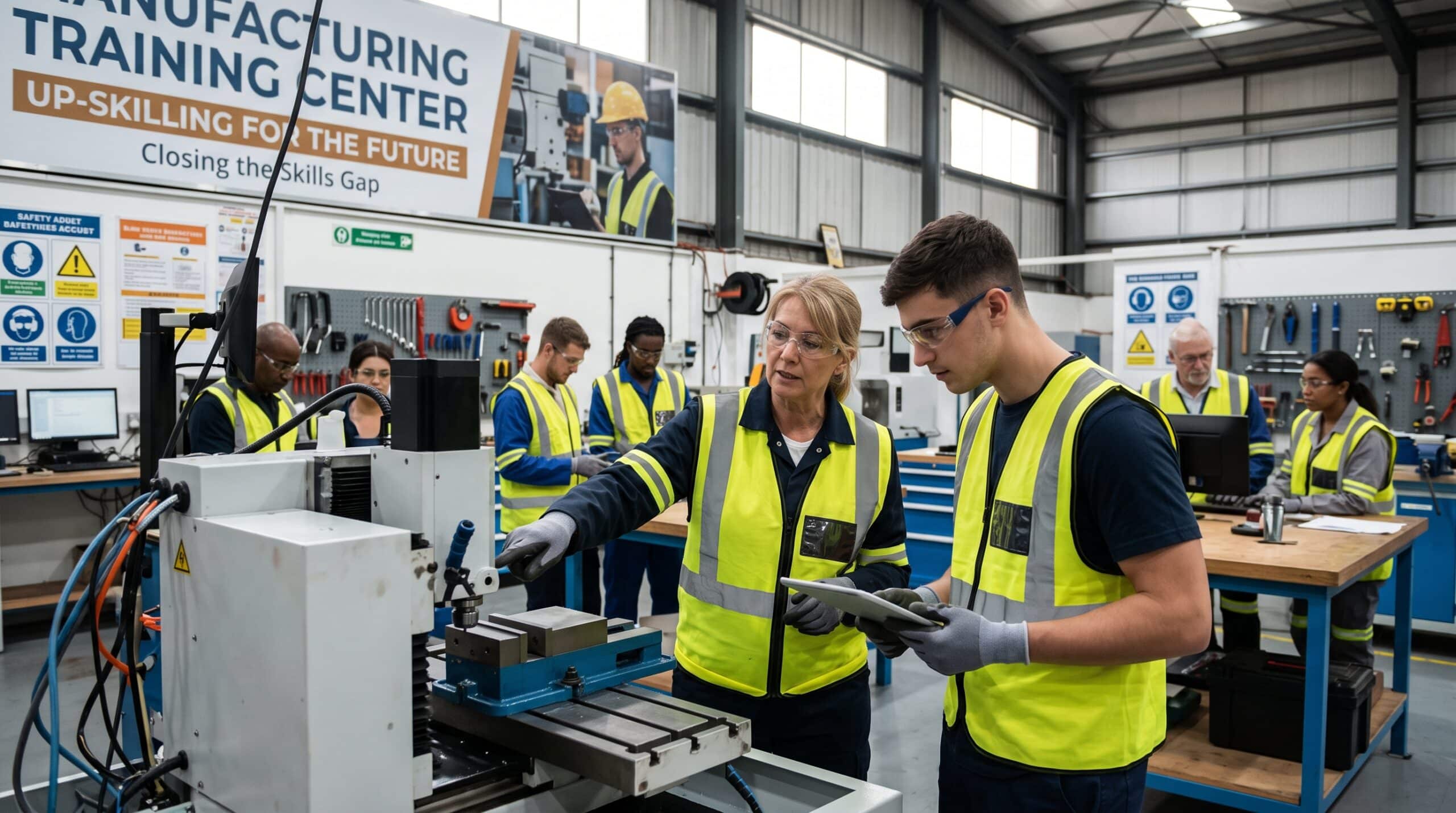
A few years ago, while reviewing manufacturing workforce training at a metal stamping plant, I stood on the floor watching a new press operator try to set up a progressive die. He had been on the job for eleven days. Meanwhile, his trainer, a 31 year veteran who could do the setup half asleep, had shown him the process exactly twice. Each time, the veteran worked fast, talked over the noise of the line, and skipped the small details that had become second nature to him. As a result, the new hire nodded along, said he understood, and then froze when it was his turn alone.
That moment stuck with me because it explains the skills gap better than any chart I have ever seen. The plant did not lack talent. Instead, it lacked a way to move talent from one head to another. In other words, the knowledge was there, sitting in the veteran’s hands, but it was not getting passed on.
For most of my career, I have built and fixed manufacturing workforce training programs in plants of every size, from 40 person job shops to multi site operations running three shifts. What follows, therefore, is not theory. Rather, it is what I have seen work, what I have seen fail, and why the difference usually comes down to a handful of decisions that leadership makes long before anyone walks into a classroom.
The Gap Is Real, But It Is Not What Most People Think
Why Manufacturing Workforce Training Matters Now
First, let me get the numbers out of the way, because they matter. The Manufacturing Institute and Deloitte project that manufacturing could need as many as 3.8 million additional employees between 2024 and 2033. They also estimate that as many as 5 in 10 of the skilled open positions, or 1.9 million jobs, could remain unfilled if manufacturers cannot address the skills and applicant gaps.
Of course, that is not a new story. Back in 2018, the same research partners found that negative perception of the industry topped the list of reasons positions went unfilled, cited by 45% of participants. That was followed by the shift in desired skill sets driven by advanced technologies and the retirement of baby boomers, both at 36%.
Likewise, manufacturers keep saying the same thing quarter after quarter. In the National Association of Manufacturers outlook survey, more than 67% of manufacturers cited the inability to attract and retain employees as their top primary challenge in the second quarter of 2024.
The Gap Inside Your Own Walls
Here is what I want you to notice, though. When people hear “skills gap,” they usually picture a shortage of bodies. Some of it is exactly that. However, a large share of the problem lives inside the walls of plants that already employ people.
For example, there is the gap between the operator who has been hired and the operator who can actually run the cell without supervision. Similarly, a gap exists between the maintenance tech who can swap a part and the one who can diagnose why it failed. Above all, there is the gap between what your best people know and what your newest people have been taught.
You cannot always control the labor market. You can, however, absolutely control how fast you turn a new hire into a capable, confident worker. That is precisely where manufacturing workforce training earns its money.
Why Most Manufacturing Workforce Training Fails
Before talking about what works, it is worth being honest about why so much training does not.
Shadowing Is Not a Training Method
It relies on shadowing and hope. An IndustryWeek survey, cited by the Association for Talent Development, found that 72 percent of manufacturing companies still rely on shadowing as their primary method of training. In my experience, that number has not moved as much as people would like to believe. After all, shadowing is not a method. It is simply a placement. Putting a new hire next to an experienced worker and calling it training assumes the experienced worker knows how to teach. Unfortunately, most were never shown how.
It is treated as an HR event instead of an operations system. I have walked into plants where training lived entirely in a binder in the front office. Every sheet was signed, dated, and filed, yet nobody on the floor ever looked at them. So if training does not show up in production meetings, shift handoffs, and the daily schedule, it does not really exist.
Content Is Not Capability
It teaches content instead of capability. A forklift video and a quiz will check a compliance box. Still, they will not tell you whether that person can safely load a trailer at 5:40 in the morning when the dock is crowded and the shift is behind. Ultimately, capability is proven at the machine, not on a screen.
It disappears the moment production gets busy. This is the big one. Every plant manager I have ever worked with supports training in principle. Then a rush order comes in, and suddenly the first thing cut from the schedule is the training hour. When that becomes a pattern, workers learn very quickly what the company really values.
It ignores the trainer. We spend money on courses, platforms, and certifications for the learner, but almost nothing on the person doing the teaching. Yet the trainer is the single biggest variable in whether knowledge transfers or evaporates.
What Manufacturing Workforce Training That Works Actually Looks Like
None of the following ideas are flashy. In fact, they are not supposed to be. Good training in a plant should feel like good maintenance: planned, routine, and boring in the best possible way.
Start Manufacturing Workforce Training With a Skills Matrix
Every program I build begins with a skills matrix, not a course catalog. Essentially, it is a simple grid. Down one side, you list every person in a department. Across the top, you list every task or skill that department needs to run. Then, in each cell, you add a rating for where that person stands, usually on a four level scale: not trained, in training, can perform with support, and can perform alone and teach others.
This one document changes the conversation. Suddenly a supervisor can see that only one person on second shift can run the CNC changeover, and that person is planning to retire next spring. They can also see which skills have no backup at all, as well as who is ready to move up.
In short, a course catalog tells you what training is available, while a skills matrix tells you what training is needed. So always start with need.
Teach the Trainers
If I could only make one change in a plant, this would be it. Take your best operators, the ones who will be doing most of the teaching, and train them how to teach.
The method I come back to again and again is actually older than most of the equipment on any plant floor. Training Within Industry, or TWI, is an on the job training method developed in the United States in 1940 to train unskilled workers on a massive scale during the Second World War. Its best known module, Job Instruction, works in four stages: prepare the learner, present the operation, try out performance, and follow up.
Why TWI Still Works Today
What makes Job Instruction so effective is one simple idea at its core: if the learner hasn’t learned, it’s the trainer who hasn’t taught. Consequently, that flips the usual blame. Instead of “the new guy just doesn’t get it,” the question becomes “what did I leave out?”
Not surprisingly, TWI keeps coming back. IndustryWeek has written about its resurgence, noting that the program was once widely deployed in the U.S. and is said to have influenced the development of the Toyota Production System. When a method has survived eight decades of management fads, it is usually because it works.
Whenever I run a Job Instruction session with veteran operators, there is almost always a moment where someone says, “I never realized how much I do without thinking about it.” That is exactly the moment the knowledge becomes teachable.
Write Job Breakdowns for Critical Tasks
A job breakdown is a short, one page document that captures a task in three layers: the important steps (what you do), the key points (how you do it right, safely, and with quality), and the reasons behind each key point (why it matters).
Think back to my press operator. The veteran knew to check the die alignment pins by feel before clamping, because a misaligned pin had once cost the plant a $30,000 die. Yet that detail was not written anywhere. Instead, it was a key point with a very expensive reason behind it, and it lived only in one person’s memory.
Writing job breakdowns for your highest risk and highest value tasks does two things. First, it standardizes how the work is taught, so every trainer passes on the same method. Second, it protects you when experienced people leave. For that reason, I usually tell clients to start small: pick the ten tasks that would hurt most if done wrong, and break those down first. When a process changes, update the breakdown through the same engineering change management process you use for drawings and specs, so training never drifts from how the work is actually done.
Build Apprenticeships Into Manufacturing Workforce Training
For the roles that take years to master, such as maintenance technicians, tool and die makers, and machinists, short training bursts are not enough. These roles need a structured path that combines paid work with related instruction over time.
Moreover, this matters more than ever, because demand in these roles is climbing. Reporting on the Deloitte and Manufacturing Institute research noted that industrial machinery maintenance technicians, who made up 270,000 manufacturing workers in 2022, are slated to grow by 16% by 2032.
Why Registered Apprenticeship Works
Registered Apprenticeship is the most proven framework I know for this. The Department of Labor describes it as a proven solution for employers to recruit, train, and retain world class manufacturing talent, and its latest fact sheet reports 97,500 registered apprentices served in the advanced manufacturing sector.
In addition, there is real money on the table. The Department of Labor’s American Manufacturing Apprenticeship Incentive Fund is a $35.8 million initiative to expand registered apprenticeships in advanced manufacturing. Under it, eligible registered apprenticeship sponsors may receive $3,500 for each new apprentice enrolled in a qualifying program. The department has also said the effort is aimed at helping small and midsized firms launch or scale Registered Apprenticeships that meet real time industry needs for skilled labor.
Apprenticeships for Smaller Shops
Small shops often tell me apprenticeship programs are only for big companies. That is no longer true. Today, industry intermediaries, community colleges, and trade associations will do much of the paperwork for you. Meanwhile, the heavy lifting you need to do is internal: assign a mentor, protect their time, and build a clear progression of skills.
Apprenticeships also help with the perception problem. Notably, the 2024 research found that nearly half (47%) of those surveyed said apprenticeships, work studies, or internships at manufacturing companies would be the most effective way to increase interest in manufacturing as a career choice. After all, young people respond to a visible path. “Start here, earn this, move there” is far more attractive than “we’re hiring, apply within.”
Where Digital Tools Fit in Manufacturing Workforce Training
To be clear, I am not against technology in training. I am, however, against technology replacing the human part of training.
Digital tools are excellent for a few specific jobs. For instance, short videos showing a correct setup, viewable on a tablet at the machine, work beautifully as a refresher. Likewise, digital work instructions with photos cut down on errors for tasks that are done infrequently. Learning management systems also make tracking certifications and refresher dates far easier than paper ever did. Simulation, in particular, is becoming genuinely important. Deloitte and the Manufacturing Institute found that demand for simulation and simulation software skills has risen 75% in the last five years, mostly for technology enabled production or testing roles.
On the other hand, digital tools fall short when they try to replace the moment when an experienced person watches a learner do the task and corrects them in real time. So use technology to support the trainer, not to replace them. A good rule of thumb I share with clients: if the task involves judgment, feel, or safety risk, a human must sign off on competency at the machine. The same thinking applies when you weigh new equipment; a sound manufacturing automation ROI calculation should include the training needed to run it well.
Protect Manufacturing Workforce Training Time on the Schedule
As I mentioned earlier, training is the first thing cut when production gets tight. The fix, however, is not a motivational speech. Rather, training belongs on the schedule like any other production activity, with planned capacity set aside for it.
One plant I worked with, for example, started treating training hours the same way they treated preventive maintenance. Each was scheduled and tracked, and skipping either one required a supervisor to explain why in the morning production meeting. Within six months, their training completion rate went from roughly 40% to over 90%. On top of that, first pass yield on the lines with the newest operators improved noticeably.
Simply put, what gets measured in the daily meeting gets done, whereas what lives only in an HR report gets forgotten.
Capture Knowledge Before It Walks Out the Door
Retirement is one of the quietest threats to any plant. Indeed, the 2018 study estimated that more than 2.6 million baby boomers were expected to retire from manufacturing jobs over the following decade. Every one of those people takes knowledge with them that may never have been written down.
My approach is simple. About two years before a key person’s expected retirement, pair them with a successor. Next, use the job breakdown method to capture their critical tasks. Then record short videos of them explaining their troubleshooting process. Most importantly, give them the status of a teacher. Many senior workers are proud of what they know and are happy to share it, as long as they feel respected rather than replaced.
Measuring Whether Your Manufacturing Workforce Training Works
A lot of training programs report activity, such as hours delivered, courses completed, and sign off sheets collected. Although those numbers are easy to track, they are almost useless on their own.
Metrics That Matter
Instead, the measures I care about connect training to the things plant leaders already watch:
- Time to competency. How many days or weeks does it take a new hire to reach “can perform alone” on their core tasks? If your training is working, this number should drop.
- Quality on new operator lines. Compare scrap, rework, and first pass yield for operators in their first 90 days against experienced operators. Over time, the gap should narrow. Your manufacturing quality control process already collects most of this data.
- Safety incidents by tenure. If most of your recordables come from people in their first year, then your onboarding has a hole in it.
- Skills matrix coverage. What percentage of critical tasks have at least two fully qualified people on every shift? Ideally, I push clients to aim for three.
- Early turnover. How many new hires leave in the first 90 days? Because people who feel lost or unsupported leave fast, this is often a training failure dressed up as a hiring failure.
Making the Case to Leadership
When you present these numbers to leadership, training stops looking like a cost center. Instead, it starts looking like what it truly is: a lever on productivity, quality, and retention. It belongs on the same list as your other manufacturing cost reduction strategies.
A Practical 90 Day Manufacturing Workforce Training Plan
If you are reading this and thinking, “This all sounds good, but where do I start?” then here is the sequence I use with most clients at midsize plants.
Days 1 to 30: Diagnose
To begin, build a skills matrix for one department, ideally the one with the most turnover or the most quality problems. After that, identify the ten highest risk tasks and the people who know them best. Finally, pull your current data on time to competency, early turnover, and quality by tenure so you have a baseline.
Days 31 to 60: Build
During this stage, train three to five of your best operators in the Job Instruction method. Next, have them write job breakdowns for the ten priority tasks. Then put a fixed block of training time on the weekly schedule for that department, and make the supervisor accountable for it in daily meetings.
Days 61 to 90: Run and Measure
Now train the next group of new hires using the new breakdowns and certified trainers. Meanwhile, update the skills matrix weekly. At day 90, compare your results with the baseline and decide where to expand next. If the numbers support it, start the conversation with a local college or intermediary about a registered apprenticeship for your hardest to fill role.
Keep in mind that this is not a giant transformation program. Rather, it is a pilot you can run with your own people and your own data, using the same discipline found in solid engineering project management best practices. Once it works in one department, the rest of the plant usually asks for it.
Retention Is Part of Manufacturing Workforce Training
Before wrapping up, I want to stress one thing: training and retention are not two separate problems. In reality, they are the same problem viewed from different angles.
Deloitte’s research found that employees are 2.7 times less likely to leave their organization in the next 12 months if they feel they can acquire the skills that matter for the future. That aligns perfectly with what I see on the floor. People stay where they can grow, and they leave when they feel stuck, ignored, or set up to fail.
Similarly, Deloitte’s 2025 outlook pointed out that while wages are likely to keep rising, manufacturers still have a cost lever they can pull: reducing turnover. Every operator you keep is one you do not have to recruit, onboard, and train from scratch. Therefore, good training is how you keep them.
When a new hire can see a clear path from operator to lead to technician, and can also see the company actually investing in getting them there, they stop looking at the job across the street that pays fifty cents more an hour.
Final Thoughts on Manufacturing Workforce Training
I still think back to that young press operator often. Eventually, the plant rebuilt its approach. Leadership trained the veterans to teach, wrote breakdowns for every die setup, and scheduled training like production. Within a year, as a result, their new operators were running setups on their own in weeks instead of months. And that young man? Last I heard, he was training new hires himself.
In the end, the skills gap is not going to close because of a single government program, a new software platform, or a better job posting. Instead, it will close one plant at a time, when leaders decide that manufacturing workforce training is part of how the work gets done, not something extra on top of it.
So start with what your people need. Next, train your trainers. Write down what matters, protect the time, and measure what counts. None of it is complicated, although all of it takes commitment. In my experience, though, it is the most reliable return any plant can get on its investment.
Frequently Asked Questions
What is manufacturing workforce training?
Manufacturing workforce training is the structured process of building the technical, safety, and problem solving skills workers need to perform production, maintenance, and quality tasks. Effective programs combine classroom learning, digital resources, and supervised practice at the machine. The Manufacturing Institute offers research and resources on workforce development across the industry.
How big is the manufacturing skills gap?
According to research by Deloitte and The Manufacturing Institute, the industry could need as many as 3.8 million additional workers between 2024 and 2033, with roughly 1.9 million of those jobs at risk of going unfilled.
What is Training Within Industry (TWI)?
TWI is a structured on the job training method developed in 1940 that includes Job Instruction, Job Methods, and Job Relations. It remains one of the most effective ways to teach standardized work. IndustryWeek covers its history and modern use.
Are registered apprenticeships worth it for small manufacturers?
Yes, especially for roles that take years to master. Industry intermediaries can help with setup, and federal incentives are available. Visit the Apprenticeship.gov manufacturing fact sheet to learn more about the model.
Is there funding available for manufacturing apprenticeships?
The U.S. Department of Labor’s American Manufacturing Apprenticeship Incentive Fund provides $3,500 for each new apprentice enrolled in qualifying advanced manufacturing programs.
How do I measure the ROI of manufacturing workforce training?
Track time to competency, quality and safety results by tenure, skills matrix coverage, and early turnover. Tooling U-SME’s resource library includes guidance on connecting training to productivity and retention results.
Why is retention connected to training?
Workers who feel they are gaining valuable skills are far more likely to stay. Deloitte’s research, summarized by Food Manufacturing, found employees are 2.7 times less likely to leave within a year when they feel they can build future ready skills.
References
- The Manufacturing Institute. Manufacturers Need as Many as 3.8 Million New Employees by 2033.
- Deloitte Insights. 2018 Deloitte and The Manufacturing Institute Skills Gap and Future of Work Study.
- Staffing Industry Analysts. Manufacturing Industry Faces Unprecedented Worker Shortage, 2.4 Million Jobs to Go Unfilled.
- National Association of Manufacturers. Manufacturers’ Outlook Survey, Second Quarter 2024.
- Association for Talent Development. Driving Productivity on the Factory Floor With Continuous Learning.
- Mercateam. Training Within Industry: A Complete Guide to the Field Training Method.
- IndustryWeek. Training Within Industry: Everything Old Is New Again.
- Manufacturing Dive. Manufacturing Labor Shortage Through 2033: Deloitte and MI Report.
- U.S. Department of Labor, Apprenticeship.gov. Registered Apprenticeship in Manufacturing Fact Sheet.
- U.S. Department of Labor. American Manufacturing Apprenticeship Fund News Release.
- MSCI. U.S. Department of Labor Launches Advanced Manufacturing Apprenticeship Program.
- NJBIA. Report: US Manufacturing Could Need 3.8M New Employees by 2033.
- Fabricating and Metalworking. U.S. Manufacturing Could Need as Many as 3.8 Million New Employees by 2033.
- Food Manufacturing. Study: US Manufacturing Could Need 3.8 Million New Employees by 2033.
- Deloitte Insights. 2025 Manufacturing Industry Outlook.
- Tooling U-SME. Workforce Training and Development Resource Library.