




The most expensive sentence I hear from owners who want to skip an engineering feasibility study is “We already know it will work.” I have heard it from plant managers expanding a production line. I have heard it from developers buying land for a warehouse. Once, I heard it from an owner who had signed an equipment purchase order before anyone checked whether the building could carry the load. Sometimes they were right. More often, the project worked eventually, but only after a redesign, a change order, or an awkward meeting with the finance team.
An engineering feasibility study exists to move those surprises to the front of the project, where they are cheap to fix. It happens before steel arrives and before crews pour concrete. The study answers a question that sounds simple but rarely is: can this project be built here, on this budget and schedule, and still meet the owner’s needs?
I have spent much of my career preparing these studies. Just as often, I review projects that skipped them. This article shares what I have learned about why the study matters, what a good one contains, and the mistakes it catches early.
What an Engineering Feasibility Study Actually Is
An engineering feasibility study is a structured technical and economic assessment of a proposed project. It comes before the owner commits serious capital. The study tests the idea against reality: site conditions, utilities, codes, technology options, cost, schedule, and operational needs.
It is not a sales document, and it is not a rubber stamp for a decision someone already made. A good study can say no. It can also say “yes, but not like this.” That is the answer I give more often than any other.
How It Differs From a Generic Feasibility Study
Generic definitions usually split feasibility into technical, economic, legal, operational, and schedule dimensions, often shortened to TELOS. In construction terms, Billd’s glossary describes a feasibility study as an evaluation of budget, schedule, and requirements that typically involves site review, cost estimating, and a check of utility infrastructure. What separates an engineering study is depth on the technical side. We are not just asking whether the market wants the product.
Instead, we ask practical questions. Will the soil hold the foundation? Can the local grid supply another few megawatts? Does the fire code allow that storage arrangement? Can the maintenance team actually reach the equipment once it is in place?
Large industrial firms describe the same progression. Técnicas Reunidas, for example, frames its engineering studies as a path from conceptual analysis to full feasibility. Along the way, it produces design bases, process models, and economic estimates that investors can rely on. That is the right mindset. Feasibility is not one document. It is a sequence of increasing certainty.
Why Early Decisions Carry So Much Weight
Here is the part many owners underestimate. The cheapest time to change a project is before it exists on paper in detail. After that point, decisions harden, drawings multiply, and people sign contracts. A change that costs an afternoon during a study can cost months during construction. That is also why a disciplined engineering change management process matters so much once a project moves past feasibility.
What the Rework Research Shows
The research backs this up. The Construction Industry Institute studied nine industrial construction projects. Rework, repair, and replacement averaged 12.4 percent of total installed project cost. Design changes, errors, and omissions made up roughly 79 percent of those deviation costs. Read that twice. Most rework money traced back to design decisions, not to crews in the field.
Other studies point the same way. Love and Sohal examined two Australian construction projects and put rework at 3.15 percent and 2.4 percent of contract value. Client changes and errors in contract documents were the leading causes. Autodesk, citing work with FMI, reports that miscommunication and poor project data cause nearly half of all rework on US jobsites.
Overruns on Large and Small Projects Alike
At the large end of the scale, the numbers become uncomfortable. McKinsey estimates that 98 percent of megaprojects run more than 30 percent over budget. It also found that 77 percent finish at least 40 percent late. Mining offers a similar warning. A McKinsey study presented at PDAC found that about one in five mining megaprojects completed between 2008 and 2018 suffered significant cost and schedule overruns. Among projects whose feasibility studies put capital costs above $2 billion, 61 percent went over budget.
You do not need a billion dollar project for this to apply. The same pattern shows up on a $3 million packaging line or a $12 million cold storage expansion. The proportions hold. Poor definition at the start becomes expensive change later.
The Mistakes an Engineering Feasibility Study Catches Most Often
Over the years I have kept a rough mental list of problems that come up again and again. None of them are exotic. That is exactly why they keep happening. Each one is the kind of issue a disciplined engineering feasibility study is designed to flag.
1. Building on a Site Nobody Really Investigated
A client once bought a parcel for a new fabrication shop because the price was attractive. The location was also close to their customers. The geotechnical investigation came after the purchase. It found soft, compressible soils across half the footprint.
The building could still go there, but it needed deep foundations. That added a figure close to the original contingency before a single wall went up.
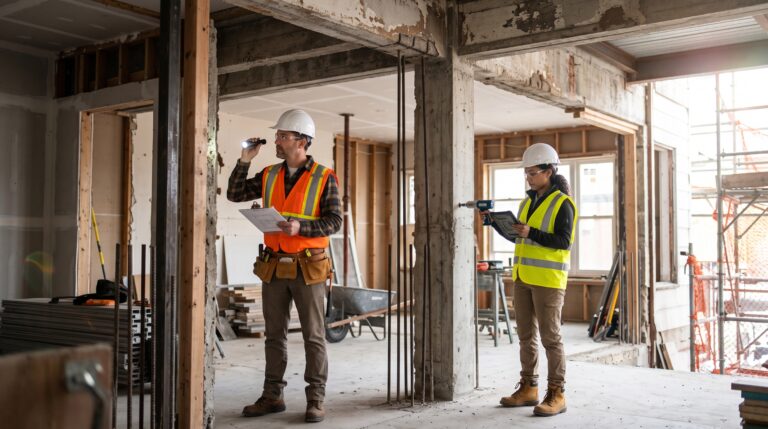
A feasibility study puts site investigation where it belongs, before the land commitment or at least before design. That means boreholes or test pits, flood maps, drainage review, and a check for buried utilities. It also means a look at access for heavy deliveries. If the project reuses an existing building, it means a proper structural engineering inspection before anyone assumes the floor or roof can take new loads. If the site has a problem, you want to know while you can still negotiate or walk away.
2. Assuming the Utilities Will Be There
Power is the one that catches people most. Owners assume that existing electrical service means a new line only needs some extra cable. Then the utility comes back with a twelve month lead time on a transformer upgrade. Or the incoming service turns out to be at capacity already.
Water, wastewater, compressed air, natural gas, and fire water supply deserve the same scrutiny. During a study, I contact utility providers directly. I request available capacity in writing where possible and compare it against the projected load. It is not glamorous work. Still, it has saved more projects than any clever design idea I have ever had.
3. Treating an Early Estimate as a Promise
This mistake damages trust between owners and engineers more than any other. Someone produces a number early in the project. That number goes into a board presentation. From that moment, it becomes “the budget,” even though nobody meant it to carry that weight.
Cost engineers have a standard for this. AACE International classifies estimates by how much of the project the team has defined. The accuracy range narrows as definition matures. A Class 5 estimate can land roughly 50 percent below to 100 percent above the final cost. A Class 4 estimate, the typical feasibility level, narrows to about 30 percent below and 50 percent above. Vista Projects has a clear explanation of these construction cost estimate classes if you want the full ladder.
A proper engineering feasibility study states which class its estimate belongs to. It also explains what the estimate includes and excludes. When I present a feasibility estimate, I always show the range, not just the midpoint. Owners sometimes find that frustrating at first. They appreciate it far more when the final number lands inside the range.
4. Choosing the Technology Before Defining the Problem
I have walked into projects where the owner had already chosen a specific machine or supplier. They wanted the study to confirm it. Sometimes the choice is sound. Other times, a slick trade show presentation drove the decision.
A good study starts with the performance requirement. What throughput do you need? Which product mix will run on the line? How tight is the quality tolerance? What uptime must it hit? Only then does it compare options.
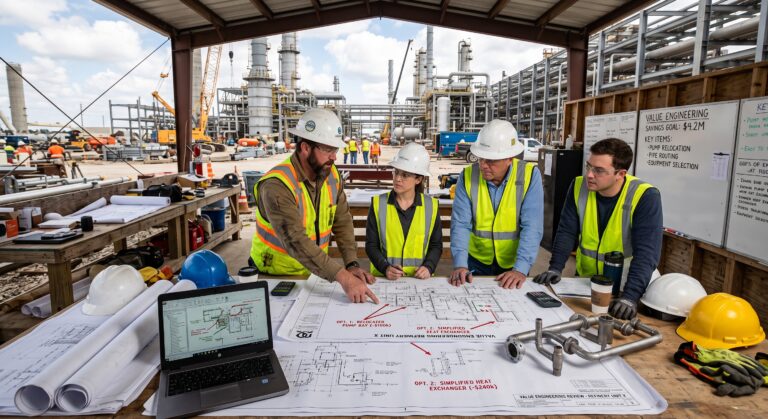
I usually evaluate two or three alternatives, even when the owner has a favorite. The comparison itself exposes hidden costs. The cheaper machine might need a larger footprint or more operators. It might also need a utility upgrade that wipes out its price advantage. A structured value engineering process and a realistic manufacturing automation ROI calculation both sharpen this comparison.
5. Treating Permits as Paperwork for Later
Permits and codes can each add months to a schedule. That includes environmental permits, emissions limits, stormwater rules, fire codes, occupancy classifications, and zoning. Some can kill a project outright. Yet I still see teams that plan to “handle permits” once design is finished.
In a feasibility study, we identify every permit the project is likely to need. We estimate the approval timeline for each and flag possible deal breakers. Suppose a new process pushes the facility into a stricter emissions category. That changes everything about cost and schedule. Finding it after design means redesign. Finding it during feasibility means a decision.
6. Forgetting the People Who Will Run It
Engineers love elegant layouts. Operators and technicians love reaching a valve without a ladder. They also like replacing a motor without removing three other machines first. Those goals do not always align.
When I prepare an engineering feasibility study, I interview the people who will live with the facility. Operations, maintenance, quality, and safety staff will tell you things no specification mentions. One maintenance supervisor told me the proposed mezzanine would block the only crane path to a critical gearbox. He mentioned it over coffee, and that one comment turned a future two day repair back into a four hour job. Good manufacturing plant layout design always starts with conversations like that one.
7. Being Too Optimistic About the Schedule
Teams usually build early schedules backward from a date someone wants. They rarely build them forward from the actual work. Long lead equipment, permit reviews, utility upgrades, and contractor availability do not care about the target date.
A feasibility study builds the schedule from realistic durations. It identifies the critical path and highlights long lead items early. Sometimes the honest answer is that the target date is not possible. Other times it is possible, but only if the owner releases purchases before design is complete. Either way, the owner makes that call with eyes open. Our guide to engineering project management best practices covers how to carry that schedule discipline into execution.
What a Solid Engineering Feasibility Study Includes
Scope varies with the size and type of project. Even so, the studies I trust tend to contain the same core elements:
- Clear objectives, constraints, and success criteria agreed with the owner.
- Site assessment covering soils, topography, drainage, access, and existing structures or utilities.
- Utility capacity review with input from providers.
- Evaluation of technical alternatives, with a recommended option and the reasoning behind it.
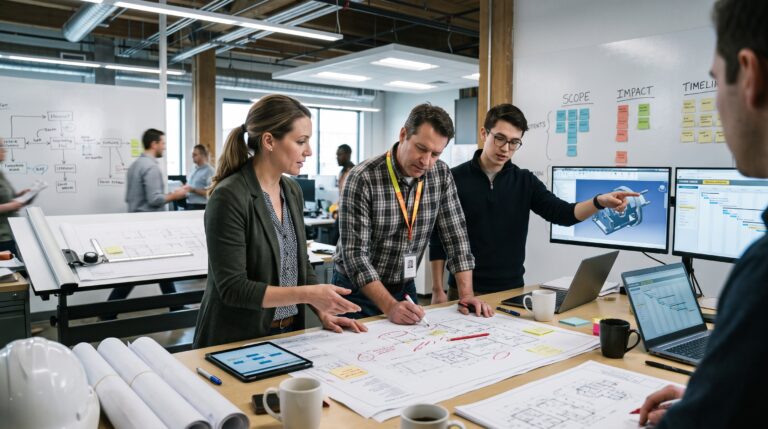
- Conceptual design deliverables, such as block diagrams, general arrangements, and preliminary equipment lists.
- Regulatory and permitting review with expected timelines.
- Cost estimate with a stated accuracy class, assumptions, exclusions, and contingency.
- Schedule showing the critical path and long lead items.
- Risk register listing major risks, with suggested mitigation.
- Final recommendation to proceed, proceed with changes, or stop.
Public infrastructure work often spells this out in detail. For instance, Hong Kong’s Drainage Services Department scoped its feasibility study for relocating the Sham Tseng Sewage Treatment Works to include technical and impact assessments, ground investigation, outline design, implementation strategies, and public engagement. Industrial projects benefit from the same discipline, even when no agency requires it.
How to Tell a Good Study From a Box Ticking Exercise
Not every document labeled “feasibility study” deserves the name. These are the signs I look for when reviewing someone else’s work. I hold my own studies to the same standard.
First, look at how the report handles uncertainty. It should tell you what is known, what is assumed, and what still needs investigation. If the report presents every number with equal confidence, be suspicious.
Next, check whether the author considered alternatives honestly. Sometimes only one option appears. Sometimes the author dismisses competing options in a single sentence. In either case, the author probably wrote the study to justify a decision rather than inform one.
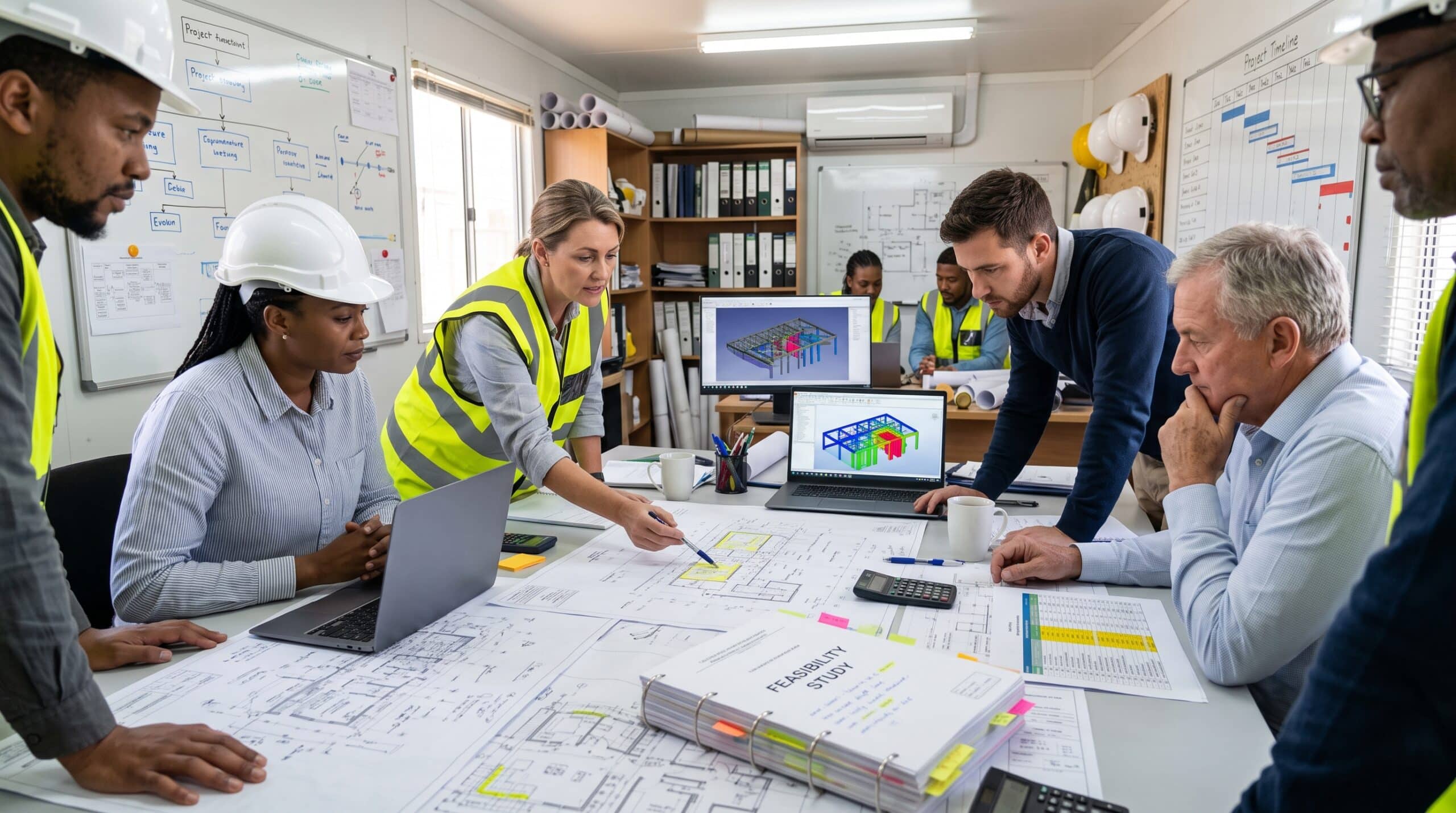
Then ask who took part. Operations, maintenance, safety, finance, and the relevant engineering disciplines should all have had input. One person working alone behind a desk will miss things.
The report should also end with a clear recommendation. Owners commission these studies to make decisions. Laying out information without a conclusion leaves the job unfinished.
Finally, the people paying for it should be able to read it. Technical appendices can go as deep as needed. The executive summary, however, should explain the answer, cost range, key risks, and next step in a few minutes.
What an Engineering Feasibility Study Costs Compared to What It Saves
The objection I hear most often is cost. A thorough engineering feasibility study is not free. On a tight budget, it can feel like money spent before the “real” project starts.
I understand the instinct, but the evidence is lopsided. The Construction Industry Institute has studied front end planning across more than 1,000 projects worth about $96.5 billion. Projects with effective planning showed cost differences of 6 to 25 percent. Schedule differences ranged from 6 to 39 percent. Burns & McDonnell, citing CII research, notes that front end planning can cut schedules by about 7 percent and costs by about 10 percent.
Put those percentages against your own project. On a $10 million expansion, a 10 percent improvement is a million dollars. A study for a project that size usually costs a small fraction of that. Preventing even one significant redesign typically covers the fee.
There is also value that does not show up neatly on a spreadsheet. Sometimes a study recommends stopping a project altogether. That saves the entire budget that would have gone into something that should never have existed. Owners rarely talk about those studies publicly. Yet they are some of the most valuable work I have done.
When a Full Study Might Not Be Necessary
I would be doing you a disservice if I claimed every project needs a large, formal study. Some do not.
Replacing a machine with an identical unit in the same location is a good example. If utilities and capacity stay the same, a short engineering review may be enough. Repeating a facility design you have built several times on similar sites is another. You have effectively done much of the feasibility work already.
The right question is not “do we need a study?” Instead, ask how much uncertainty you are carrying and what happens if you are wrong. Small, familiar, reversible projects can move with lighter checks. Large, new, or irreversible ones should not. Coursera’s overview of the benefits of a feasibility study makes a similar point about matching study depth to the size of the decision.
A useful middle ground is a staged approach. Start with a short prefeasibility study to rule out obvious problems and narrow the options. Then commission a full engineering feasibility study only for the option that survives. This keeps early spending modest while protecting the larger investment.
A Few Words Before You Commission One
If you are planning a project and considering a study, here is the practical advice I give every client.
Bring the study in early. Its value drops sharply once you buy land, order equipment, or start design.
Be honest about what you want. If you have a preferred outcome, say so. Then give the consultant permission to challenge it. A study that only confirms your beliefs has limited value.
Share everything you have. Old drawings, previous studies, utility bills, maintenance records, and incident reports all help. Consultants who must rediscover information will charge for the time and may still miss something.
Read the risks section carefully. The executive summary tells you the answer. The risk register tells you what could change it.
Treat the study as a living reference. My best clients keep it on the table throughout design and construction. When something changes, they know exactly which assumption moved and what it affects.
Projects rarely fail because of one big mistake. They fail because of small, unchecked assumptions that each add a little cost and delay. An engineering feasibility study is how you check those assumptions while being wrong is still cheap.
Frequently Asked Questions
What is the main purpose of an engineering feasibility study?
It confirms whether a project is technically possible, economically sensible, and compliant before major money goes in. It ends with a recommendation to proceed, modify, or stop. The Construction Industry Institute research on front end planning shows why this early work shapes final cost and schedule.
How long does an engineering feasibility study take?
A team can often study a small industrial project in four to eight weeks. Larger projects may take several months, especially when they need site investigation or environmental review. Timing depends heavily on how quickly data and stakeholder input arrive.
How accurate is the cost estimate in a feasibility study?
Feasibility estimates usually fall into AACE Class 4 or Class 5. Cost engineers commonly expect a Class 4 estimate to land within about 30 percent below to 50 percent above actual cost. Vista Projects explains each estimate class in plain terms.
What is the difference between a prefeasibility study and a feasibility study?
A prefeasibility study is a lighter screening exercise. It compares broad options and rules out obvious problems. A feasibility study goes deeper on the preferred option, with a tighter estimate, realistic schedule, and full risk review.
Can a feasibility study really reduce rework during construction?
Yes. Design changes, errors, and omissions drive a large share of rework costs. The CII study on costs of quality deviations found design issues caused most deviation costs on the projects it examined. Defining scope early reduces those late changes.
Who should be involved in an engineering feasibility study?
At minimum, include the owner’s decision makers, relevant engineering disciplines, and operations and maintenance staff. Someone responsible for safety and compliance should take part as well. Finance should review the cost basis, and the team should consult utility providers and permitting agencies where needed.
References
- Construction Industry Institute. Costs of Quality Deviations in Design and Construction (SD-29).
- Construction Industry Institute. Assessment of Effective Front End Planning Processes.
- McKinsey & Company. (2015). The Construction Productivity Imperative.
- International Mining. McKinsey Presents Mega Project Blowouts and How to Avoid Them at PDAC.
- Vista Projects. Construction Cost Estimate Classes Explained.
- Burns & McDonnell. Save Time and Money With Front End Project Development.
- Love, P. E. D. and Sohal, A. S. (2003). Capturing Rework Costs in Projects. Managerial Auditing Journal, 18(4), 329–339.
- Autodesk Construction Blog. 8 Ways to Reduce Construction Rework.
- Coursera. Exploring the Benefits of a Feasibility Study.
- Billd. Feasibility Study (Construction Glossary).
- Drainage Services Department, Hong Kong. Relocation of Sham Tseng Sewage Treatment Works to Caverns – Feasibility Study.
- Técnicas Reunidas. Engineering Studies.