




Years ago, long before I had built a dual sourcing strategy for anyone, I sat in a conference room while a plant manager explained to our CFO why a $14 casting had shut down a $40 million production line for eleven days. The casting came from one foundry. The foundry had a furnace failure. We had no second source, no safety stock to speak of, and no qualified alternative that engineering would sign off on in under eight weeks. The CFO asked one question I’ve never forgotten: “How much would it have cost us to not be here?”
That question is the heart of every dual sourcing strategy decision. It isn’t “is a backup supplier a good idea?” Almost everyone agrees it is, in theory. The real question is whether the protection is worth what you pay for it, year after year, on parts that may never actually fail you.
I’ve built dual sourcing programs that saved quarters, and I’ve also unwound ones that were quietly draining margin for no real gain in resilience. This article is my attempt to lay out how I think about the tradeoff now, after a lot of expensive lessons.
What a Dual Sourcing Strategy Actually Means (and What It Doesn’t)
At its simplest, dual sourcing means buying the same part, material, or service from two qualified suppliers instead of one. As TechTarget notes, the term is often used loosely to mean multi sourcing, which can involve more than two suppliers. It also stands apart from sole sourcing, where only one source is available at all.
That distinction matters more than people think. Single sourcing is a choice: you have alternatives but you consolidate volume with one vendor for price, quality consistency, or simplicity. Sole sourcing isn’t a choice: the supplier holds a patent, owns the tooling, or is literally the only one who makes the thing. A lot of failed dual sourcing efforts start with someone treating a sole source part like a single source part and assuming a second supplier is just a few RFQs away.
What a dual sourcing strategy is not: two suppliers on paper with one doing all the work. I’ve audited approved vendor lists where the “backup” hadn’t shipped a single piece in three years. Their tooling was out of date, their contact had left the company, and their quote was stale. That’s not a second source. That’s a line in a spreadsheet that makes people feel better.
The Real Cost of a Dual Sourcing Strategy
Before anyone gets excited about resilience, be honest about what a second supplier really costs. In my experience the costs fall into four buckets, and finance usually only sees the first one.
The Unit Price Premium
When you split volume, you give up some of your leverage. The supplier who used to get 100% of your business now gets 70% or 50%, and their pricing reflects that. The second supplier, starting with a smaller allocation, almost always quotes higher. Researchers studying this have pointed out that dual sourcing gives up the full potential of economies of scale, along with the long term learning curve savings you’d get from deepening one relationship. If you’re already chasing manufacturing cost reduction strategies, this premium needs to be part of that conversation.
Qualification and Onboarding
For industrial components, qualifying a new supplier isn’t a purchase order. It’s first article inspection, PPAP or its equivalent, process audits, sometimes customer approval, and occasionally new tooling. On a machined or cast part, I’ve seen a full supplier qualification process run anywhere from a few thousand dollars to well into six figures once you count engineering hours and test runs.
Ongoing Management Overhead
Two suppliers means two sets of scorecards, two quality relationships, two sets of quarterly reviews, two logistics lanes, and more complexity in your ERP. That complexity can strain manufacturing resource planning systems and other software. Inconsistent quality between sources is a real risk too, which is why a tight manufacturing quality control process matters even more with two vendors. Every engineering change now has to be implemented twice and verified twice.
Lost Leverage and Relationship Depth
This one doesn’t show up on any invoice. When you’re a supplier’s biggest customer, you get priority during shortages, early warning on problems, and a seat at the table for cost reduction ideas. Split your volume and you may drop down their priority list right when you need them most.
Add those up honestly and the cost of a dual sourcing strategy on a critical part can easily land between 3% and 10% of category spend in the first year, then settle lower once things are running. On a low value, high volume commodity, it can be close to zero. On an engineered part with heavy tooling, it can be significant.
Why the Math Behind a Dual Sourcing Strategy Has Changed
For a long stretch of my career, the default answer from leadership was “consolidate.” Fewer suppliers, deeper discounts, leaner inventory. And for a while, that worked, because disruption was treated like a rare storm.
Disruption Is No Longer Rare
It isn’t rare anymore. The McKinsey Global Institute’s analysis of global value chains found that supply chain disruptions lasting a month or longer now happen every 3.7 years on average. It also found that companies can expect losses equal to almost 45% of one year’s profits over the course of a decade. When I first read that number, I ran it against our own history. It wasn’t far off.
The trend hasn’t eased. Resilinc’s monitoring data showed a 38% increase in global supply chain disruptions in 2024 compared to the previous year. Factory fires held the top spot as the number one disruption for the sixth consecutive year. Factory fires. Not exotic geopolitical events. The kind of thing that takes a single source supplier offline overnight.
Procurement Leaders Are Rethinking Their Dual Sourcing Strategy
Procurement leaders feel it too. In a Gartner survey released in October 2024, forty two percent of procurement leaders cited supply disruptions as the top risk to procurement’s future success.
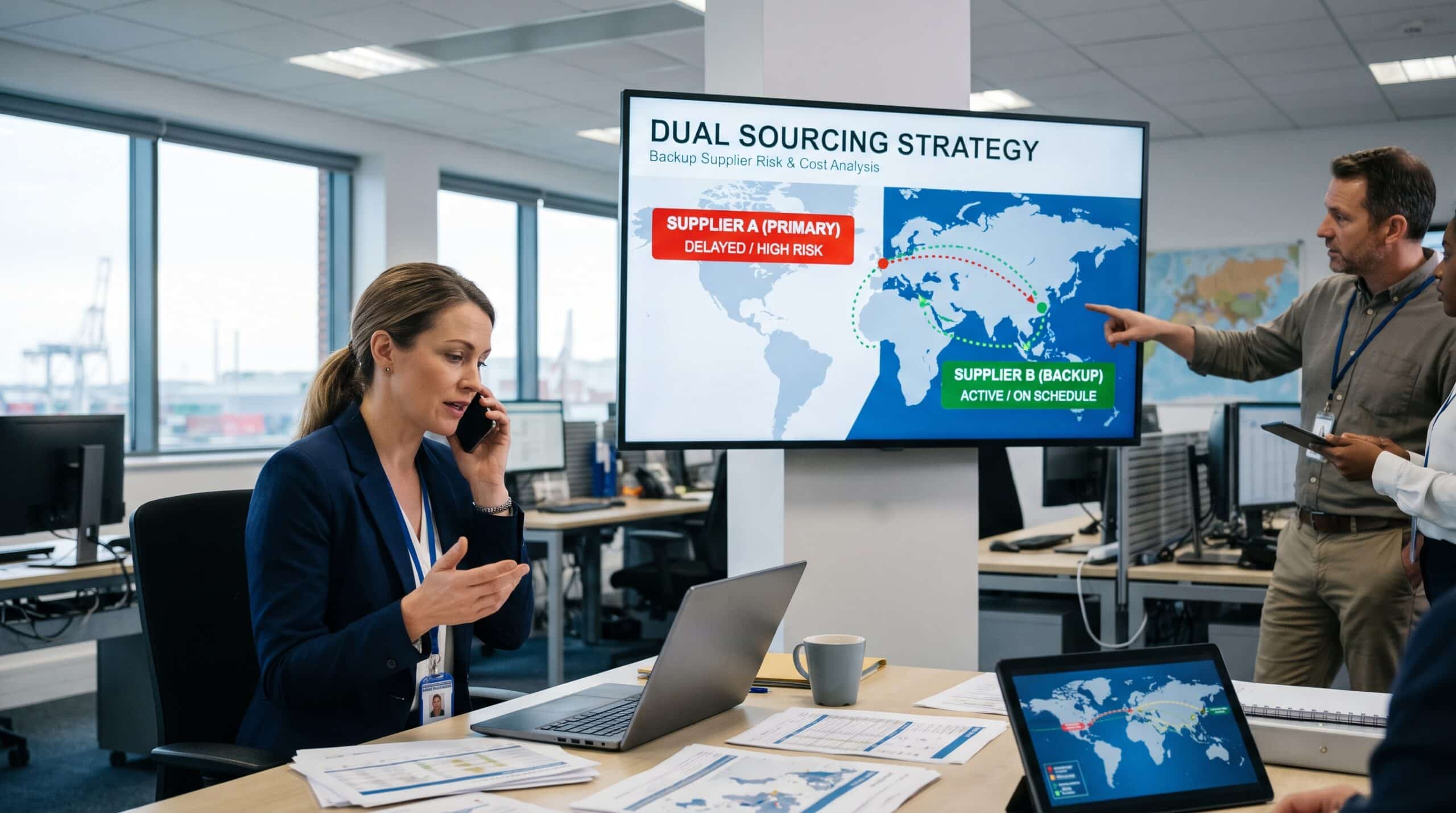
And companies acted on it. McKinsey’s 2022 supply chain survey found that 81 percent of respondents had implemented dual sourcing strategies during the past year, up from 55 percent in 2020. That’s a massive shift in a short period, and frankly, some of it was panic buying of resilience. Which brings me to the point of this article: not every part deserves a dual sourcing strategy.
Five Conditions Where a Dual Sourcing Strategy Pays for Itself
After a lot of trial and error, I look for these five conditions. If a part hits three or more of them, it almost always justifies a second source. If it hits one or none, I usually look at other tools first.
1. The Cost of a Stoppage Dwarfs the Cost of the Part
This is the casting story. When a cheap component can idle an expensive line, the economics flip hard in favor of redundancy. I calculate a simple “line down cost per day” for critical assemblies and compare it against the annual premium of dual sourcing. If one week of downtime would cover five or more years of the premium, the conversation is usually over.
2. Supplier Reliability Is Uncertain or Uneven
Academic work on this is surprisingly practical. A study published in Manufacturing and Service Operations Management found that dual sourcing is favored over supplier improvement efforts when supplier reliability differs a lot between options. Improving your existing supplier makes more sense as the cost gap between suppliers widens. In plain terms: if your main supplier is shaky and you can’t fix them fast, buy insurance. If they’re solid but expensive alternatives exist, invest in the relationship instead.
3. Lead Times to Qualify a Replacement Are Long
If you could qualify a new supplier in two weeks during a crisis, you don’t need one on standby. If it takes four months because of customer approvals, certifications, or tooling, you need that work done before the crisis, not during it.
4. Demand Is Growing or Volatile
A second source isn’t only about failure. Having more than one supplier can also help a company keep up with increasing customer demand. I’ve used a dual sourcing strategy as a capacity valve more often than as a disaster plan.
5. Geographic or Regulatory Concentration Is High
If your only supplier sits in one region exposed to one port, one tariff regime, and one power grid, you’re carrying concentrated risk whether you’ve noticed it or not. Tariff volatility in particular has pushed a lot of my peers toward a “country plus one” structure, and some toward reshoring manufacturing altogether. As C.H. Robinson describes it, companies keep their incumbent base while adding backup capacity for critical components in a second country.
When a Dual Sourcing Strategy Is the Wrong Call
This part doesn’t get written about enough. I’ve seen companies dual source parts that should never have been split, and they paid for it in quality escapes, price creep, and supplier fatigue.
Commodity Parts With Abundant Spot Supply
If you can buy the item from a distributor tomorrow at a modest premium, a formally qualified second source adds overhead without adding much protection. Interestingly, highly competitive commodity categories are also where dual sourcing can be cheapest.
Art of Procurement notes that the main exception to warnings about automatic dual sourcing is commoditized products with multiple suppliers, low switching costs, and similar quality. So the rule isn’t “never.” It’s “don’t build heavy infrastructure for something the market already backs up for you.”
Suppliers That Share the Same Hidden Risk
This is the trap I see most often. You qualify two suppliers in different cities, feel great about it, and then discover they both buy resin from the same compounder or bar stock from the same mill. Suppliers scattered across the globe may all be buying materials from the same raw material sources, which means you didn’t diversify anything. You just added a second invoice.
Before signing off on any dual sourcing strategy, I ask both suppliers to name their critical subtier sources. It’s an uncomfortable conversation for some vendors. Have it anyway.
Proprietary or Tightly Specified Parts
Some products simply can’t be dual sourced because you are buying a unique spec, or the supplier has an advantage or patent. For those, the answer is usually strategic inventory, contractual protections, or a long term redesign to open the spec. Applying design for manufacturability principles early can keep you out of this corner on future parts.
Low Volume Parts Where Splitting Kills the Economics
If your annual volume barely justifies one supplier’s setup costs, splitting it in two can make both relationships unprofitable for the vendors. They’ll deprioritize you, and you’ll end up with two weak sources instead of one strong one.
Choosing the Right Dual Sourcing Strategy Model
A dual sourcing strategy isn’t one thing. How you structure it matters as much as whether you do it. I use three models depending on the part.
The Active Split
Both suppliers ship production volume continuously. This is the most resilient setup and the most expensive. Both suppliers stay current on revisions, both keep their tooling warm, and both have real skin in the game.
The common instinct is to split 50:50 for “fairness.” Don’t. Research on optimal allocation found that an even split isn’t optimal, even when suppliers are similar, and that a simple 75:25 allocation rule is a very robust policy.
That matches what I’ve seen on the floor. A 70:30 or 75:25 split keeps your primary supplier motivated and gives them enough volume for good pricing, while the secondary ships enough to stay sharp. Anything under about 15% to the secondary and I start worrying they’re drifting out of practice.
The Standby Source
The second supplier is fully qualified but receives little or no ongoing volume. You activate them when the primary fails. This is cheaper, but it carries real risk of decay. Tooling gets lost, process knowledge fades, and when you finally call, they may not be able to ramp fast. If you go this route, I strongly recommend paying for a small periodic production run, even a few hundred pieces a year, just to prove the process still works.
Shadow Qualification
This is my favorite option for parts that sit in the middle. You do the hard work up front: drawings reviewed, samples approved, process audited, pricing agreed in principle. But you don’t place production orders. You’ve shortened the qualification timeline from months to weeks without carrying the ongoing cost. It’s not as fast as a true active source, but it’s dramatically better than starting from zero during a crisis.
How to Run the Numbers on a Dual Sourcing Strategy
I don’t let my team propose a dual sourcing strategy without a one page business case. It doesn’t need to be fancy. It needs to be honest. Here’s the framework I use.
Step 1: Estimate the Annual Cost of Dual Sourcing
Add the unit price premium times annual volume, the one time qualification cost spread over three years, and the extra management time. Be generous with this number. Underestimating it is how programs lose credibility with finance.
Step 2: Estimate the Cost of a Disruption
Calculate the daily cost of a stoppage, including lost margin, expediting, overtime to catch up, penalty clauses, and customer goodwill. Then estimate a realistic duration if the primary supplier failed with no backup. Use your qualification lead time as a guide, since that’s roughly how long you’d be down.
Step 3: Assign a Probability
This is where people freeze up, because no one knows the exact odds. You don’t need precision. A basic supply chain risk assessment covering the supplier’s history, financial health, geographic exposure, and the industry baseline will get you close. If month long disruptions hit roughly every few years across industries, a 10% to 25% annual probability for a meaningful disruption on a critical source is a reasonable starting assumption for many industrial categories.
Step 4: Compare Expected Loss to Annual Cost
Multiply disruption cost by probability. If expected annual loss is higher than the annual cost of the backup, the dual sourcing strategy pays for itself on paper. If it’s close, look at the softer factors like customer commitments, growth plans, and your own appetite for risk.
Two Examples From the Same Year
Here’s a simplified example from a hydraulic fitting category I managed. Dual sourcing cost about $85,000 a year once we added up the premium, overhead, and amortized qualification. A disruption without backup would have run about six weeks at roughly $60,000 a day in lost contribution and expediting, so somewhere north of $2 million. Even at a modest 10% annual probability, expected loss was over $200,000. The decision took about ten minutes.
Contrast that with a fastener family we evaluated the same year. Dual sourcing would have cost about $40,000 annually, but distributors could cover us within days, and expected loss from a disruption came to under $15,000. We stayed single sourced and put a small buffer stock agreement in place instead, which fit neatly into our broader approach to inventory management for manufacturers.
One more nuance worth knowing: the research suggests that the advantage of dual sourcing decreases when there’s more uncertainty about supplier reliability. In practice, that means it pays to get good data on your suppliers before modeling. Garbage inputs make the business case look stronger or weaker than it really is.
Making Your Dual Sourcing Strategy Real, Not Decorative
Qualifying a backup is the easy part. Keeping it alive is where most programs fail. These are the habits that separate a working dual sourcing strategy from a paper one.
Write Switching Rules Down in Advance
Effective dual sourcing relies on clear supplier data, transparent performance metrics, and well defined switching rules. Decide now what triggers a volume shift. A missed delivery threshold? A quality escape? A force majeure notice? If you wait until the crisis to decide, you’ll lose days arguing.
Manage Engineering Changes in Parallel
Every drawing revision goes to both suppliers at the same time, with the same effective date. The fastest way to break a dual source is to let one supplier fall a revision behind. A disciplined engineering change management process keeps both sources in lockstep.
Score Both Suppliers on the Same Card
Same metrics, same review cadence. If the secondary only hears from you when something goes wrong, the relationship will feel transactional, and they’ll treat you that way.
Check for Hidden Overlap Every Year
Ask about subtier sources, shared logistics providers, and shared ports. Using two suppliers located in the same region, exposed to the same logistics routes or regulatory environment, limits the protective effect of dual sourcing. Reviewing your logistics network optimization plan alongside your supplier map helps expose those shared lanes.
Talk to Your Incumbent First
Before launching a dual sourcing strategy, have a candid conversation with your primary supplier. Sometimes they can solve your concern themselves by adding a second plant, holding consigned inventory, or qualifying their own backup material. Ask what they can do to help reduce your concentration risk. Otherwise you risk trading single source risk for a different kind of concentration. I’ve had suppliers volunteer solutions I would never have thought to ask for.
Invest in Visibility
McKinsey’s survey found that companies with digital dashboards for end to end supply chain visibility were twice as likely as others to avoid supply chain problems during the disruptions of early 2022. A backup supplier only helps if you see trouble coming early enough to shift volume.
The Bottom Line on Dual Sourcing Strategy
A dual sourcing strategy is insurance, and like any insurance, it’s possible to be overinsured and underinsured at the same time. Most companies I’ve worked with are overinsured on parts that the market already protects and underinsured on the quiet, critical, hard to qualify components that actually stop lines.
The fix isn’t a blanket policy. It’s discipline: segment your parts by criticality, be honest about the full cost of a second source, model the expected loss, and then pick the model (active split, standby, or shadow qualification) that fits. Then do the unglamorous work of keeping that second supplier genuinely ready.
Go back to the CFO’s question: how much would it have cost us to not be here? If you can answer that for each critical part in your portfolio, you’ll know exactly where a backup supplier is worth the cost and where it’s just comfort.
Frequently Asked Questions About Dual Sourcing Strategy
What is a dual sourcing strategy in simple terms?
It’s buying the same item from two qualified suppliers so a failure at one doesn’t stop your operation. TechTarget offers a clear definition of dual sourcing and how it differs from sole sourcing.
How much more does a dual sourcing strategy typically cost?
It depends heavily on the category. Commodity parts may cost almost nothing extra, while engineered parts with tooling and qualification can add several percent to category spend. Art of Procurement explains why dual sourcing is generally more expensive than sole sourcing and when it isn’t.
Should volume be split evenly between two suppliers?
Usually not. Research in the European Journal of Operational Research found that a 75:25 allocation is a very robust policy compared with an even split.
Is it better to dual source or improve my current supplier?
It depends on how reliable your options are relative to their cost. This INFORMS study on dual sourcing versus supplier process improvement breaks down when each approach wins.
How common is dual sourcing among manufacturers today?
Very common. McKinsey reported that 81 percent of supply chain leaders had implemented dual sourcing by 2022, up sharply from 2020.
Can a dual sourcing strategy help with tariff risk?
Yes, especially when the second supplier sits in a different country. C.H. Robinson outlines how shippers use dual sourcing across countries to manage tariff and trade volatility.
References
- McKinsey & Company. Taking the Pulse of Shifting Supply Chains. August 2022.
- McKinsey Global Institute. Risk, Resilience, and Rebalancing in Global Value Chains. August 2020.
- Gartner. Gartner Survey Shows Supply Disruption Is Top Risk to Procurement’s Future Success. October 2024.
- Resilinc. Resilinc Reveals the Top 5 Supply Chain Disruptions of 2024. January 2025.
- Silbermayr, L. and Minner, S. Dual Sourcing Under Disruption Risk and Cost Improvement Through Learning. European Journal of Operational Research, 2016.
- Wang, Y., Gilland, W., and Tomlin, B. Mitigating Supply Risk: Dual Sourcing or Process Improvement? Manufacturing and Service Operations Management, 2010.
- Art of Procurement. Why Dual Sourcing as a Risk Mitigation Strategy May Not Be the Answer.
- C.H. Robinson. Dual Sourcing: The Rapid Supply Chain Resilience Strategy Every Shipper Should Consider.
- TechTarget. What Is Dual Sourcing?
- AGR Inventory. Dual Sourcing to Increase Supply Chain Resilience.