


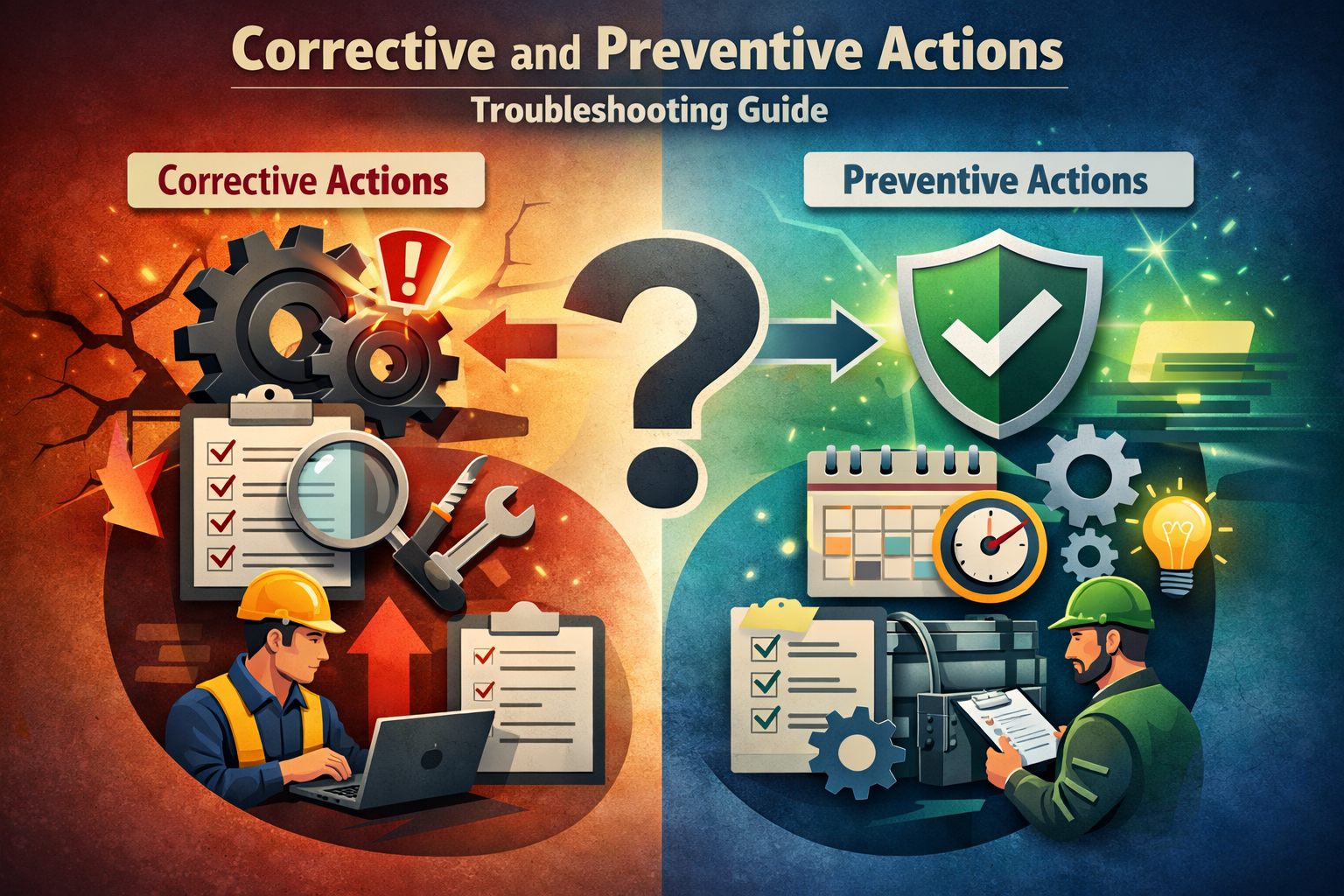
Corrective and preventive actions are fundamental components of effective troubleshooting and problem solving in modern organizations. Whether addressing system failures, operational inefficiencies, quality defects, or compliance issues, organizations must not only fix problems when they occur but also prevent them from happening again. This dual approach forms the foundation of continuous improvement and long-term operational resilience.
This article explores the principles, processes, and best practices behind corrective and preventive actions, providing a structured framework for professionals responsible for maintaining system reliability, quality, and performance.
Understanding Corrective and Preventive Actions
Corrective and preventive actions, often referred to as CAPA, are systematic methods used to identify, analyze, and resolve problems while eliminating their root causes.
For a more detailed explanation of the CAPA process and how it prevents recurring issues, see this CAPA process and best practices guide.
Corrective Actions
Corrective actions are steps taken to fix an existing problem and restore normal operations. They address the immediate issue and ensure that the problem does not recur.
Preventive Actions
Preventive actions focus on eliminating potential causes of problems before they occur. They are proactive measures designed to reduce risk and improve system stability.
Together, corrective and preventive actions form a closed-loop improvement cycle.
Why Corrective and Preventive Actions Matter?
Organizations that rely solely on reactive fixes often experience repeated failures. Corrective and preventive actions provide several strategic benefits:
- Reduced downtime
- Lower operational costs
- Improved quality and consistency
- Enhanced compliance
- Stronger risk management
- Increased customer satisfaction
CAPA frameworks are widely used in industries such as IT, manufacturing, healthcare, finance, and quality management.
Common Triggers for Corrective and Preventive Actions
Corrective and preventive actions are typically initiated by:
- System incidents and outages
- Customer complaints
- Audit findings
- Performance deviations
- Non-conformance reports
- Security incidents
Each trigger provides valuable insight into weaknesses within systems or processes.
The Corrective Action Process
Corrective action follows a structured problem-solving workflow.
Step 1: Problem Identification
Define the issue clearly, including its scope, impact, and symptoms.
Step 2: Root Cause Analysis
Identify the underlying cause using techniques such as:
- 5 Whys
- Fishbone (Ishikawa) diagrams
- Fault tree analysis
Step 3: Action Planning
Design targeted actions to eliminate the root cause.
Step 4: Implementation
Deploy corrective measures in a controlled environment.
Step 5: Verification
Confirm that the corrective action resolved the issue.
Step 6: Documentation
Record actions, results, and lessons learned.
Corrective actions focus on permanent solutions rather than temporary workarounds.
The Preventive Action Process
Preventive actions emphasize anticipation and risk reduction.
Step 1: Risk Identification
Detect potential failures through audits, monitoring, and trend analysis.
Step 2: Risk Assessment
Evaluate the likelihood and impact of each risk.
Step 3: Preventive Planning
Design controls and safeguards.
Step 4: Implementation
Apply preventive measures proactively.
Step 5: Monitoring
Continuously track performance indicators.
Preventive actions transform organizations from reactive to proactive.
Root Cause Analysis in CAPA
Root cause analysis is the backbone of both corrective and preventive actions.
Common Techniques:
- 5 Whys
- Pareto analysis
- Process mapping
- Failure mode and effects analysis (FMEA)
Without proper root cause analysis, corrective actions become superficial and ineffective.
Corrective and Preventive Actions in IT Environments
In IT systems, CAPA plays a critical role in reliability and security.
Examples of Corrective Actions:
- Fixing software bugs
- Restoring corrupted data
- Replacing faulty hardware
- Resolving configuration errors
Examples of Preventive Actions:
- Implementing automated monitoring
- Applying security patches
- Performing regular backups
- Introducing redundancy
IT environments benefit significantly from structured CAPA frameworks.
CAPA in Quality Management Systems
Corrective and preventive actions are core requirements in standards such as:
- ISO 9001
- ISO 27001
- ITIL
- Six Sigma
These frameworks emphasize documentation, traceability, and continuous improvement.
Challenges in Implementing CAPA
Despite their importance, organizations often struggle with CAPA execution.
Common Challenges:
- Poor problem definition
- Incomplete root cause analysis
- Lack of accountability
- Insufficient documentation
- Resistance to change
These obstacles reduce the effectiveness of corrective and preventive actions.
Best Practices for Effective Corrective and Preventive Actions
To maximize CAPA effectiveness, organizations should adopt the following practices:
Establish Clear Ownership
Assign responsibility for each action.
Standardize Processes
Use consistent CAPA templates and workflows.
Leverage Data and Metrics
Track KPIs such as incident recurrence and resolution time.
Integrate with Change Management
Ensure corrective actions are aligned with system updates.
Encourage a Learning Culture
Treat failures as opportunities for improvement.
Measuring the Success of CAPA
Success is measured by:
- Reduction in incident recurrence
- Improved system stability
- Increased process efficiency
- Enhanced customer satisfaction
- Stronger compliance results
CAPA effectiveness should be reviewed regularly.
Preventing CAPA from Becoming Bureaucratic
CAPA systems should support problem solving, not hinder it.
To avoid bureaucracy:
- Keep documentation simple
- Focus on high-impact issues
- Automate tracking where possible
- Encourage collaboration
Effective CAPA is practical, not administrative.
Integrating CAPA into Organizational Culture
Corrective and preventive actions work best when embedded into daily operations.
Organizations should:
- Train staff on CAPA principles
- Encourage reporting of issues
- Reward proactive problem solving
- Share lessons learned across teams
A strong CAPA culture fosters resilience and innovation.
Conclusion
Corrective and preventive actions are essential pillars of professional troubleshooting and problem solving. While corrective actions restore normal operations, preventive actions protect organizations from future failures. Together, they create a continuous improvement cycle that strengthens systems, processes, and people.
By applying structured CAPA frameworks, organizations can move beyond reactive firefighting toward sustainable operational excellence. In high-performing organizations, corrective and preventive actions are not isolated activities—they are integral components of strategic success.