


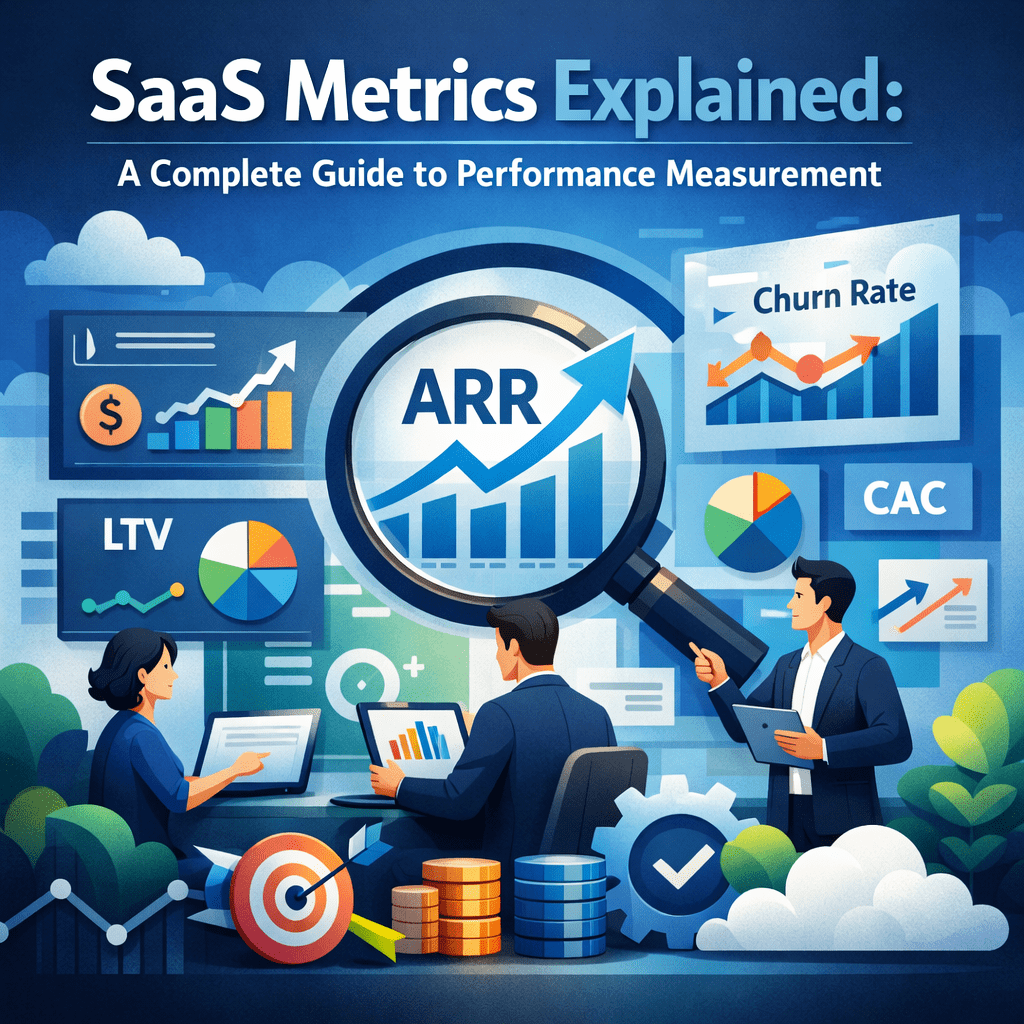
SaaS metrics explained is essential knowledge in today’s competitive digital economy. Whether you are a startup founder, product manager, or investor, performance measurement through the right metrics determines how well a SaaS business can scale, retain customers, and achieve long-term profitability.
What Are SaaS Metrics?
SaaS metrics are key performance indicators (KPIs) used to measure the health, efficiency, and scalability of a Software-as-a-Service business. Unlike traditional businesses, SaaS companies rely on recurring revenue models, which means performance measurement focuses heavily on customer behavior, retention, and lifetime value.
In other words, SaaS metrics translate operational data into actionable insights. They help leaders answer critical questions such as:
- Are we growing sustainably?
- Are customers staying long enough?
- Are we spending too much to acquire users?
- Is our pricing model profitable?
Without accurate SaaS metrics, decision-making becomes guesswork.
Why SaaS Metrics Matter?
Performance measurement in SaaS is complex because revenue is spread over time rather than earned upfront. As a result, traditional financial metrics like profit or sales volume are not enough.
SaaS metrics matter because they:
- Reveal hidden inefficiencies
- Predict future revenue
- Improve investor confidence
- Guide pricing strategies
- Support data-driven scaling
More importantly, they allow SaaS companies to optimize unit economics, ensuring that each customer generates more value than they cost.
Core SaaS Metrics Explained
1. Monthly Recurring Revenue (MRR)
MRR is the most fundamental SaaS metric. It represents predictable monthly income from subscriptions.
Formula:
MRR = Number of customers × Average revenue per customer
MRR is essential because it smooths revenue forecasting and helps track growth trends. Most SaaS dashboards are built around this metric.
2. Annual Recurring Revenue (ARR)
ARR is simply MRR multiplied by 12. It is primarily used for long-term planning and investor reporting.
ARR provides a high-level snapshot of business scale and is often used in company valuations.
3. Customer Acquisition Cost (CAC)
CAC measures how much it costs to acquire one customer.
Formula:
CAC = Total sales and marketing spend ÷ New customers acquired
A rising CAC is a warning sign. Ideally, CAC should decrease as marketing systems become more efficient.
4. Customer Lifetime Value (LTV)
LTV estimates how much revenue a customer generates during their entire relationship with your business.
Formula:
LTV = Average revenue per user × Customer lifespan
The LTV-to-CAC ratio is one of the most important SaaS performance indicators. A healthy ratio is typically 3:1 or higher.
5. Churn Rate
Churn measures how many customers leave during a given period.
Formula:
Churn Rate = Lost customers ÷ Total customers
High churn means your product is leaking value. Even strong acquisition cannot compensate for poor retention.
6. Net Revenue Retention (NRR)
NRR measures how much revenue remains after accounting for churn, upgrades, and downgrades.
Formula:
NRR = (Starting revenue – churn + expansions) ÷ Starting revenue
Top-performing SaaS companies often maintain NRR above 110%, meaning existing customers grow revenue over time.
7. Average Revenue Per User (ARPU)
ARPU shows how much revenue each customer generates on average.
ARPU helps optimize pricing tiers and identify upsell opportunities.
8. Gross Margin
Gross margin measures profitability after service delivery costs.
Formula:
Gross Margin = (Revenue – Cost of Service) ÷ Revenue
Most healthy SaaS businesses maintain 70–85% gross margins, reflecting strong scalability.
9. Burn Rate
Burn rate tracks how fast a company spends cash.
This metric is crucial for startups because it determines runway, or how long the company can operate before needing additional funding.
10. Activation Rate
Activation rate measures how many users reach the “aha moment” after signup.
A strong activation rate indicates product-market fit and predicts long-term retention.
How to Use SaaS Metrics Strategically?
SaaS metrics should not exist in isolation. Instead, they must work together to form a performance measurement system.
For example:
- High MRR with high churn is unstable
- Low CAC with low LTV is unsustainable
- High growth with negative margins is risky
Therefore, companies should monitor leading indicators (activation, engagement) alongside financial indicators (MRR, LTV, CAC).
SaaS Metrics for Different Business Stages
Early-Stage SaaS
Focus on:
- Activation rate
- Churn
- Product usage
- Customer feedback
Goal: Validate product-market fit.
Growth-Stage SaaS
Focus on:
- MRR growth
- CAC efficiency
- NRR
- ARPU
Goal: Scale profitably.
Mature SaaS
Focus on:
- Gross margin
- Net revenue retention
- Expansion revenue
- Operating efficiency
Goal: Maximize lifetime value.
Common Mistakes in SaaS Performance Measurement
Many SaaS companies fail not because of poor products, but because they measure the wrong things.
Common mistakes include:
- Tracking vanity metrics (downloads, page views)
- Ignoring churn until it becomes critical
- Focusing only on revenue, not retention
- Comparing metrics without industry context
- Using inconsistent calculation methods
Metrics should drive decisions, not just reports.
Tools for Tracking SaaS Metrics
Modern SaaS businesses rely on analytics platforms such as:
- Stripe
- Baremetrics
- ChartMogul
- Mixpanel
- Google Analytics
However, tools are only as good as the strategy behind them. Metrics must align with business objectives, not overwhelm teams with unnecessary data.
SaaS Metrics and Investor Expectations
Investors evaluate SaaS companies primarily through performance metrics, not narratives.
They typically look for:
- LTV > 3× CAC
- Churn < 5% monthly
- Gross margin > 70%
- NRR > 100%
- Predictable MRR growth
Strong SaaS metrics reduce perceived risk and increase valuation multiples.
Conclusion
Understanding SaaS metrics explained is fundamental to mastering performance measurement in subscription-based businesses. These metrics provide visibility into customer behavior, financial sustainability, and operational efficiency.
More importantly, SaaS metrics transform raw data into strategic intelligence. They allow founders to scale responsibly, investors to assess risk accurately, and teams to focus on what truly drives growth.
In a market where competition is relentless and customer loyalty is fragile, the companies that succeed are not those with the best features—but those with the best metrics discipline.
Performance is not guessed. It is measured.