


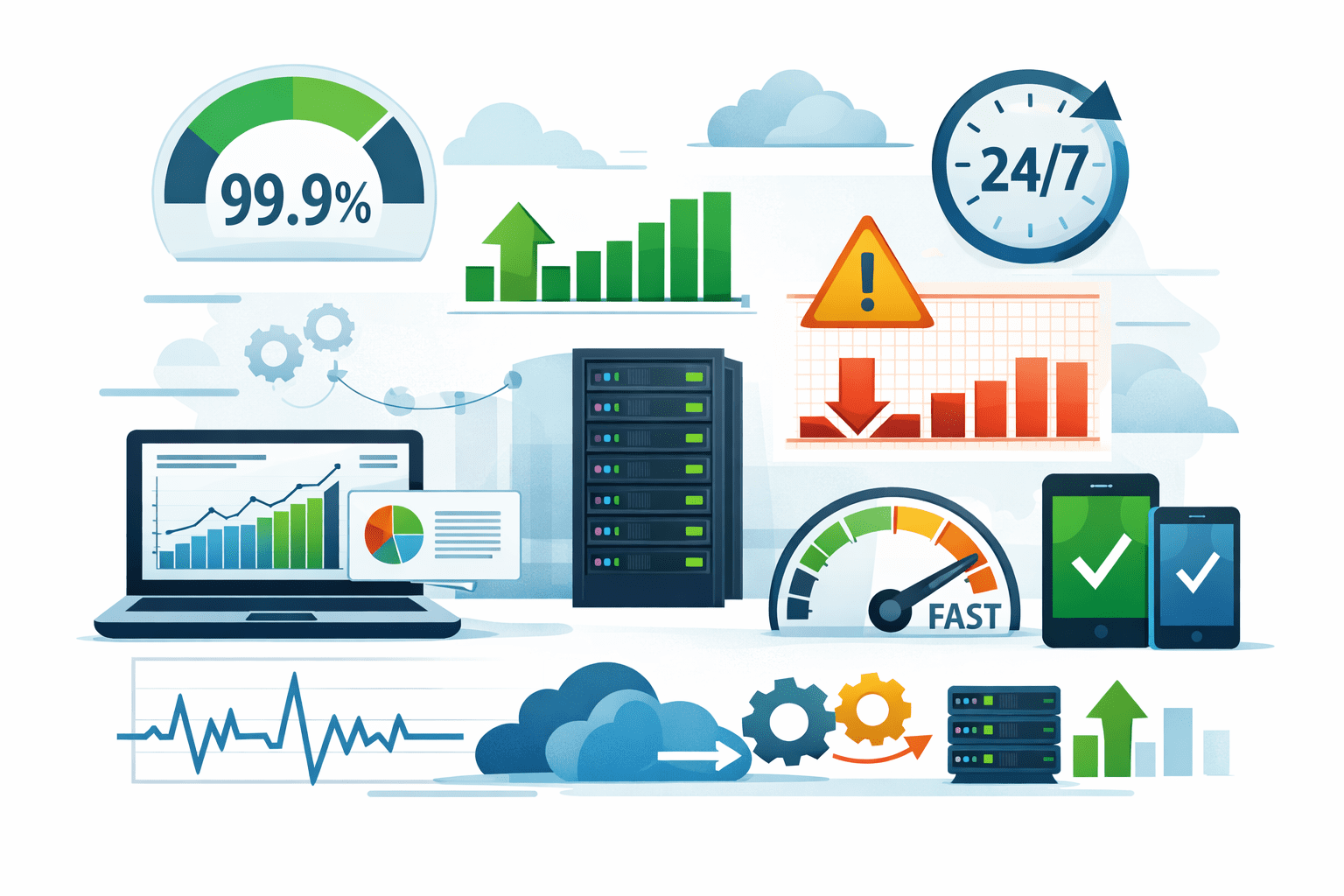
In modern digital environments, uptime and availability metrics are essential components of effective performance measurement. Organizations increasingly depend on technology systems to deliver services, process transactions, and support critical operations. As a result, even small periods of downtime can lead to financial losses, reputational damage, and reduced customer trust. This article explains what uptime and availability metrics are, why they matter, and how to use them strategically to improve system reliability and business performance.
What Are Uptime and Availability Metrics?
Uptime and availability metrics are performance indicators that measure how often a system is operational and accessible to users. They are widely used in IT, cloud services, telecommunications, manufacturing systems, and digital platforms.
Uptime refers to the total time a system is functioning correctly, while availability represents the percentage of time a system is accessible when required.
Although often used interchangeably, there is a subtle difference:
- Uptime measures operational status.
- Availability measures user access.
Together, they provide a clear picture of system reliability.
Why Uptime and Availability Metrics Matter?
Performance measurement is not meaningful without understanding system reliability. Uptime and availability metrics matter because they directly influence:
- Customer experience
- Revenue continuity
- Operational efficiency
- Compliance with service agreements
- Brand reputation
In digital businesses, downtime often results in lost sales, abandoned users, and contractual penalties. For internal systems, downtime disrupts workflows and reduces productivity.
High uptime and availability ensure business continuity and support long-term organizational stability.
Key Uptime and Availability Metrics
Several core metrics are used to measure uptime and availability.
Uptime Percentage
Uptime percentage measures how long a system remains operational during a specific period.
Formula:
Uptime = (Total time – Downtime) ÷ Total time × 100
Common benchmarks include:
- 99% uptime = 3.65 days of downtime per year
- 99.9% uptime = 8.76 hours of downtime per year
- 99.99% uptime = 52.6 minutes of downtime per year
Higher percentages indicate stronger system reliability.
Availability Percentage
Availability measures whether users can access the system when needed.
Availability accounts for both planned and unplanned downtime, including maintenance windows.
High availability does not simply mean fewer failures; it means faster recovery and better system design.
Mean Time Between Failures (MTBF)
MTBF measures how long a system operates before experiencing a failure.
A higher MTBF indicates more reliable system components.
Mean Time to Recovery (MTTR)
MTTR measures how quickly a system recovers after failure.
Lower MTTR means better incident response and stronger operational processes.
Service Level Agreement (SLA) Compliance
SLA metrics measure whether a system meets contractual uptime commitments.
SLA compliance is critical in outsourced services, cloud platforms, and enterprise IT environments.
How Uptime and Availability Metrics Support Business Strategy?
Uptime and availability metrics are not purely technical indicators. They directly support strategic goals.
For example:
- E-commerce platforms rely on near-perfect uptime to prevent revenue loss.
- Financial institutions require high availability to maintain transaction integrity.
- Healthcare systems depend on continuous access for patient safety.
- Manufacturing systems require uptime to avoid production delays.
In each case, uptime metrics align system performance with business priorities.
Uptime and Availability in Performance Measurement Frameworks
Effective performance measurement integrates uptime metrics into broader operational frameworks.
These metrics typically align with:
- Risk management
- Service management
- Business continuity planning
- IT governance
- Customer experience programs
Without uptime indicators, performance frameworks lack a foundation for reliability assessment.
Leading and Lagging Uptime Metrics
Uptime measurement benefits from both leading and lagging indicators.
Leading Indicators
Leading indicators predict future downtime risks.
Examples include:
- System load trends
- Resource utilization
- Aging infrastructure components
- Security vulnerability scans
These indicators enable preventive maintenance.
Lagging Indicators
Lagging indicators measure past reliability.
Examples include:
- Historical outages
- Downtime reports
- SLA violations
- Incident logs
Lagging metrics support accountability and improvement analysis.
Common Causes of Poor Uptime
Understanding uptime failures helps improve performance.
Common causes include:
- Hardware failure
- Software bugs
- Network disruptions
- Human error
- Cybersecurity incidents
- Poor capacity planning
Most downtime is preventable through proactive monitoring and governance.
Tools for Monitoring Uptime and Availability
Organizations use monitoring platforms to track uptime metrics in real time.
Popular tools include:
- UptimeRobot
- Pingdom
- Datadog
- New Relic
- Zabbix
- SolarWinds
These tools provide dashboards, alerts, historical reports, and automated incident tracking.
However, tools alone do not guarantee reliability. Processes and accountability are equally important.
Best Practices for Improving Uptime and Availability
High-performing organizations follow best practices for uptime management.
Key practices include:
- Redundant system architecture
- Automated failover mechanisms
- Regular maintenance schedules
- Disaster recovery planning
- Real-time monitoring
- Incident response procedures
Together, these practices create resilient systems capable of handling unexpected disruptions.
Uptime and Availability in Cloud Environments
Cloud platforms have transformed uptime measurement.
Cloud environments emphasize:
- Distributed infrastructure
- Load balancing
- Geographic redundancy
- Elastic scaling
Major cloud providers publish SLA guarantees, often above 99.9% availability.
However, cloud uptime still depends on system design, configuration, and operational discipline.
Uptime Metrics and Risk Management
Downtime represents operational risk.
Uptime metrics reduce risk by:
- Identifying weak system components
- Supporting contingency planning
- Enabling faster recovery
- Improving regulatory compliance
Organizations with strong uptime measurement experience fewer critical failures and faster business recovery.
Financial Impact of Downtime
Downtime has measurable financial consequences.
Common costs include:
- Lost revenue
- Employee productivity loss
- Customer churn
- Legal penalties
- Brand damage
In large enterprises, downtime can cost thousands or millions of dollars per hour.
Uptime metrics help justify investment in infrastructure and resilience.
Uptime Metrics and Continuous Improvement
Uptime measurement supports continuous improvement.
The improvement cycle includes:
- Measure uptime and availability
- Identify downtime causes
- Implement corrective actions
- Re-measure performance
This cycle builds stronger systems over time.
Industry Applications of Uptime Metrics
Different industries emphasize uptime differently.
IT and Software
Focus on:
- Server uptime
- Application availability
- Network latency
Manufacturing
Focus on:
- Equipment uptime
- Machine utilization
- Production continuity
Healthcare
Focus on:
- System accessibility
- Data availability
- Emergency system uptime
Finance
Focus on:
- Transaction uptime
- Security availability
- Regulatory compliance
Although contexts differ, uptime remains a universal performance indicator.
Future Trends in Uptime and Availability Measurement
Performance measurement is evolving.
Key trends include:
- AI-based outage prediction
- Automated root-cause analysis
- Predictive maintenance
- Self-healing systems
- Real-time observability platforms
Future systems will detect failures before users experience them.
Conclusion
Uptime and availability metrics are fundamental to effective performance measurement in modern organizations. They provide objective insight into system reliability, operational risk, and service quality.
More importantly, uptime metrics transform technical performance into strategic intelligence. They enable better decisions, stronger resilience, improved customer trust, and long-term sustainability.
In a digital economy where systems drive business value, uptime is no longer optional. It is measurable, manageable, and essential for success.