


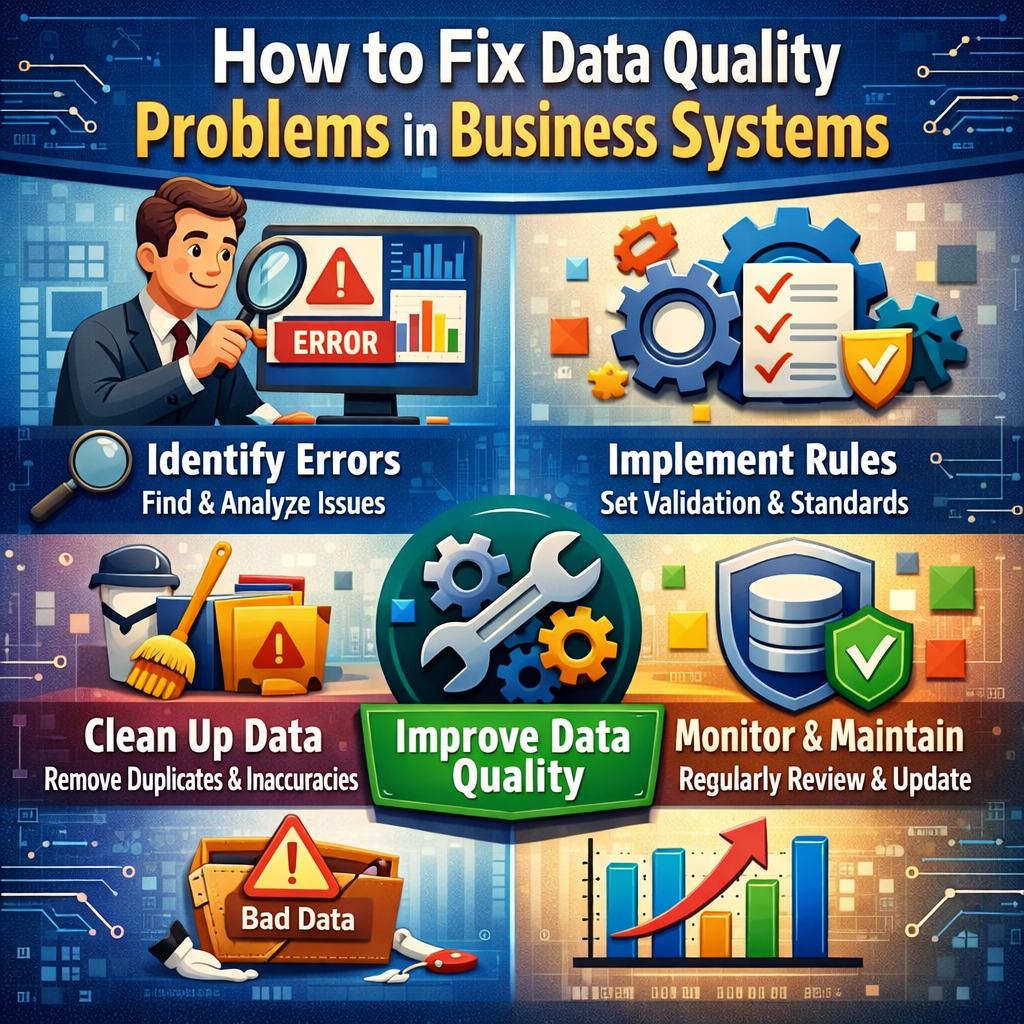
Data quality problems are one of the most critical yet underestimated challenges in modern organizations. As businesses increasingly rely on data for decision-making, automation, analytics, and customer engagement, the accuracy, completeness, and reliability of that data directly determine operational success. Poor data quality leads to flawed insights, system failures, regulatory risks, and lost business opportunities.
This guide explores the most common data quality problems and provides structured, professional approaches to troubleshooting and problem solving across enterprise systems.
Understanding Data Quality in Business Systems
Data quality refers to the degree to which data is fit for its intended purpose. High-quality data is accurate, consistent, complete, timely, valid, and relevant. When any of these dimensions are compromised, systems begin to produce unreliable outputs.
Data quality problems often emerge due to:
- Manual data entry errors
- System integration failures
- Poor data governance
- Inconsistent data standards
- Rapid system changes
Because data flows across multiple platforms, a single weak point can contaminate entire datasets.
Common Types of Data Quality Problems
Data quality problems typically fall into several well-defined categories.
For real-world examples of common data quality problems and solutions, see this guide to common data quality problems and fixes.
1. Inaccurate Data
Data that does not reflect real-world values, such as incorrect addresses, wrong prices, or invalid measurements.
2. Incomplete Data
Missing fields, null values, or partial records that prevent full analysis or processing.
3. Inconsistent Data
Conflicting information across systems, such as different customer names or product codes.
4. Duplicate Data
Multiple records representing the same entity, leading to redundancy and confusion.
5. Outdated Data
Information that is no longer current, such as expired contracts or inactive users.
6. Invalid Data
Data that violates predefined rules or formats, such as invalid email addresses or negative quantities.
Each of these issues introduces risk and reduces system reliability.
Root Causes of Data Quality Problems
Understanding root causes is essential for effective troubleshooting.
Human Errors
Manual data entry remains one of the largest contributors to poor data quality. Typos, omissions, and inconsistent interpretations of rules lead to widespread inaccuracies.
System Integration Failures
When data moves between systems, mismatched formats, mapping errors, and synchronization failures often corrupt records.
Lack of Data Governance
Without clear ownership, standards, and accountability, data becomes fragmented and unmanaged.
Poor Process Design
Inefficient workflows and unclear validation rules allow errors to propagate.
Technology Limitations
Legacy systems and poorly designed applications may lack proper validation, auditing, and cleansing capabilities.
Business Impact of Data Quality Problems
The consequences of data quality problems extend beyond technical inconvenience.
Operational Impact
- Incorrect reporting
- Failed transactions
- System downtime
- Inefficient workflows
Financial Impact
- Revenue loss
- Increased operational costs
- Poor investment decisions
Compliance and Risk
- Regulatory violations
- Audit failures
- Legal exposure
Strategic Impact
- Loss of customer trust
- Poor strategic planning
- Competitive disadvantage
In data-driven organizations, data quality directly influences business performance.
Detecting Data Quality Problems
Effective troubleshooting begins with early detection.
Data Profiling
Analyze datasets to identify patterns, anomalies, and statistical outliers.
Validation Rules
Implement checks for acceptable ranges, formats, and relationships.
Reconciliation
Compare data across systems to detect inconsistencies.
Monitoring and Alerts
Use automated tools to detect deviations in real time.
Early detection significantly reduces remediation costs.
Troubleshooting Data Quality Problems
A structured troubleshooting approach ensures consistent resolution.
Step 1: Define the Problem
Identify which datasets are affected and how the issue manifests.
Step 2: Trace the Data Flow
Map how data is created, transformed, and consumed.
Step 3: Identify the Root Cause
Determine whether the issue originates from human input, system logic, or integration processes.
Step 4: Apply Targeted Fixes
Correct existing data and prevent recurrence.
Step 5: Validate Results
Confirm that fixes improve accuracy without side effects.
Step 6: Document and Improve
Update procedures and controls to strengthen future data quality.
This methodology aligns with professional data management frameworks such as DAMA and ITIL.
Data Cleansing and Correction Techniques
Data cleansing is a core component of problem solving.
Standardization
Convert data into consistent formats (dates, units, codes).
Deduplication
Identify and merge duplicate records.
Enrichment
Fill missing fields using trusted reference sources.
Validation
Apply business rules to reject invalid entries.
Auditing
Track changes to ensure accountability.
Automated data quality tools significantly improve efficiency and consistency.
Preventing Future Data Quality Problems
Prevention is more cost-effective than remediation.
Establish Data Governance
Define ownership, standards, and responsibilities.
Implement Validation at Entry
Prevent bad data from entering systems.
Automate Data Monitoring
Detect anomalies before they escalate.
Train Users
Educate staff on data standards and importance.
Regular Audits
Conduct periodic data quality assessments.
Strong governance frameworks transform data quality from a technical issue into an organizational capability.
Role of Technology in Data Quality Management
Modern technologies play a critical role in addressing data quality problems.
Data Quality Platforms
Tools such as data profiling, cleansing, and validation systems.
Master Data Management (MDM)
Centralizes key entities like customers and products.
Metadata Management
Provides visibility into data definitions and lineage.
AI and Machine Learning
Detect anomalies and predict potential quality issues.
Technology alone is not sufficient, but it enables scalable and sustainable solutions.
Organizational Challenges in Data Quality
Many data quality problems persist due to organizational factors.
Lack of Ownership
No single team is accountable for data quality.
Siloed Systems
Disconnected departments maintain conflicting datasets.
Competing Priorities
Data quality is often deprioritized in favor of speed.
Cultural Resistance
Staff may view data governance as bureaucratic.
Successful organizations treat data as a strategic asset, not a technical byproduct.
Best Practices for Sustainable Data Quality
Professional organizations adopt the following best practices:
- Define enterprise-wide data standards
- Assign data stewards and owners
- Automate validation and monitoring
- Integrate quality checks into workflows
- Measure data quality KPIs
- Continuously improve processes
These practices embed quality into daily operations rather than treating it as a one-time project.
Conclusion
Data quality problems are not merely technical defects—they are organizational risks that affect decision-making, customer trust, compliance, and competitiveness. Most data quality issues arise from predictable causes such as human error, poor integration, lack of governance, and inadequate validation.
By applying structured troubleshooting frameworks, investing in preventive controls, and fostering a culture of data accountability, organizations can transform data quality from a persistent problem into a strategic advantage. In a digital economy, high-quality data is not optional—it is a foundation for sustainable success.