


Understanding technology stack fundamentals is one of the most important steps for anyone entering the world of software development, startups, or digital product management. Whether you are a founder, developer, investor, or business decision-maker, knowing how a technology stack works will help you make smarter, more strategic choices.
This beginner-friendly yet expert-level guide explains what a technology stack is, why it matters, and how to choose the right stack for your project.
What Is a Technology Stack?
A technology stack (often called a tech stack) is the combination of programming languages, frameworks, libraries, tools, and infrastructure used to build and run a software application.
A technology stack is the combination of programming languages, frameworks, libraries, tools, and infrastructure used to build and run a software application. If you want a deeper technical breakdown of what is a technology stack, MongoDB provides a helpful industry overview that explains how stack layers work together.
In simple terms:
A technology stack is the complete set of technologies that power a website, app, or software platform.
Think of it like building a house. You need:
- A foundation
- A structure
- Electrical systems
- Plumbing
- Finishing materials
Similarly, a software application needs:
- A user interface
- Business logic
- Data storage
- Servers
- Security systems
All of these layers together form the technology stack.
The Core Layers of a Technology Stack
To understand technology stack fundamentals, you must first understand its main layers.
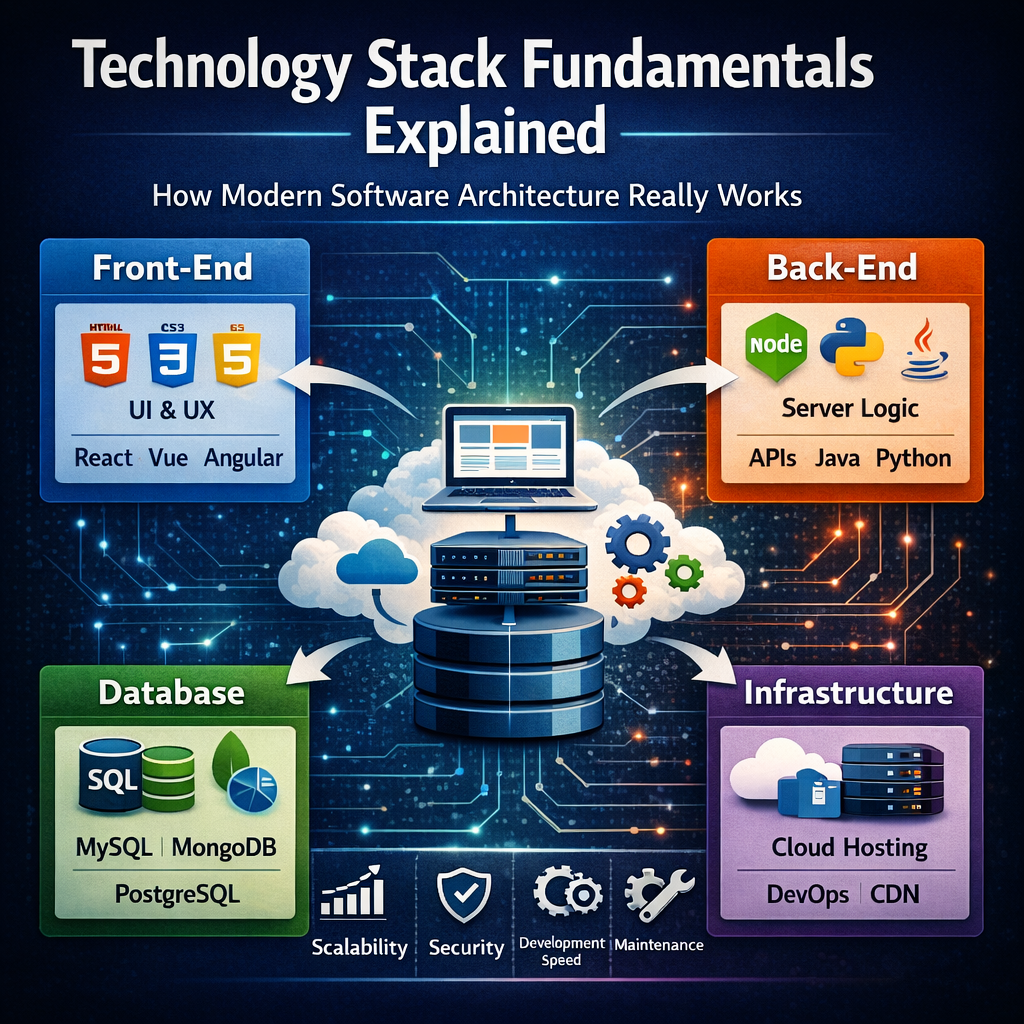
1. Front-End (Client-Side)
The front-end is what users see and interact with.
Common front-end technologies include:
- HTML (structure)
- CSS (design and layout)
- JavaScript (interactivity)
Popular front-end frameworks:
- React
- Vue
- Angular
The front-end runs in the user’s browser or mobile device.
2. Back-End (Server-Side)
The back-end handles business logic, authentication, data processing, and communication with databases.
Common back-end languages:
- JavaScript (Node.js)
- Python
- Java
- PHP
- Ruby
- C#
The back-end runs on servers and is invisible to users.
3. Database Layer
The database stores application data.
Two major types:
Relational Databases
- MySQL
- PostgreSQL
- SQL Server
NoSQL Databases
- MongoDB
- Cassandra
- Firebase
Choosing the right database is a critical part of technology stack fundamentals because it directly impacts performance and scalability.
4. Infrastructure and Hosting
Infrastructure includes:
- Cloud providers (AWS, Azure, Google Cloud)
- Servers
- Content Delivery Networks (CDNs)
- Containerization (Docker)
- Orchestration (Kubernetes)
Modern applications typically run in the cloud rather than on physical in-house servers.
What Is a Full-Stack Technology Stack?
A full-stack refers to both front-end and back-end combined.
Examples of popular stacks:
- LAMP Stack: Linux, Apache, MySQL, PHP
- MERN Stack: MongoDB, Express, React, Node.js
- MEAN Stack: MongoDB, Express, Angular, Node.js
Each stack is optimized for different use cases, developer skills, and scalability needs.
Understanding these common stacks is central to mastering technology stack fundamentals.
Why Technology Stack Fundamentals Matter?
Choosing the right technology stack affects:
1. Performance
Some technologies handle high traffic better than others.
2. Scalability
Can the system handle growth from 100 users to 1 million?
3. Development Speed
Certain stacks allow faster prototyping and deployment.
4. Security
Some ecosystems provide stronger built-in security tools.
5. Hiring and Talent Availability
It’s easier to hire developers for widely adopted technologies.
6. Long-Term Maintenance
Outdated or niche stacks can increase maintenance costs.
A poor stack decision can slow down growth, increase technical debt, and limit innovation.
Key Principles of Technology Stack Fundamentals
To think like an expert, keep these foundational principles in mind.
1. Simplicity First
Avoid overengineering.
Beginners often believe that more technologies equal better performance. In reality:
The best technology stack is the simplest one that solves your problem efficiently.
2. Match the Stack to the Product Type
Different products require different architectures.
For example:
- A blog site → Simple CMS stack
- A SaaS platform → Scalable cloud-based stack
- A real-time chat app → WebSockets and event-driven architecture
- A fintech app → High-security, compliance-ready infrastructure
There is no universal “best” stack.
3. Scalability Planning
When studying technology stack fundamentals, you must understand scaling models:
- Vertical scaling (bigger server)
- Horizontal scaling (more servers)
- Microservices architecture
- Serverless architecture
Planning for scalability early prevents expensive rewrites later.
4. Ecosystem Strength
A strong ecosystem includes:
- Active developer community
- Frequent updates
- Rich documentation
- Third-party libraries
- Security patches
Popular ecosystems reduce risk.
5. Security as a Core Layer
Security must be integrated into the stack from the beginning.
This includes:
- Secure authentication
- Data encryption
- Role-based access control
- Monitoring and logging
- Regular updates
Security is not an afterthought in modern technology stack fundamentals.
Monolithic vs Microservices Architecture
Understanding architecture types is essential.
Monolithic Architecture
All components are combined into a single application.
Advantages:
- Easier to build initially
- Simple deployment
- Lower early-stage cost
Disadvantages:
- Harder to scale
- Difficult to update individual features
- Can become complex over time
Microservices Architecture
The system is divided into independent services.
Advantages:
- Easier to scale
- Better fault isolation
- Faster team development
Disadvantages:
- Higher complexity
- More infrastructure overhead
Beginners should usually start monolithic and transition later as complexity grows.
Front-End vs Back-End vs DevOps
Modern stacks now include DevOps tools.
DevOps layer includes:
- CI/CD pipelines
- Automated testing
- Deployment automation
- Monitoring tools
- Infrastructure as Code
Technology stack fundamentals now extend beyond just coding — they include automation and operational reliability.
Common Mistakes When Choosing a Technology Stack
1. Following Trends Blindly
Just because a technology is popular does not mean it fits your project.
2. Ignoring Developer Expertise
Choose a stack your team understands well.
3. Overbuilding Early
Do not design for 10 million users if you have 100.
4. Underestimating Maintenance Costs
Some technologies require more DevOps management than others.
5. Not Planning for Integration
Ensure your stack supports APIs and integrations with other tools.
How to Choose the Right Technology Stack?
Here is a practical framework:
Step 1: Define Product Requirements
- Web or mobile?
- Real-time features?
- AI integration?
- High-security needs?
Step 2: Define Scale Expectations
- MVP stage?
- Growth stage?
- Enterprise scale?
Step 3: Evaluate Team Skillset
- Existing expertise?
- Hiring pipeline?
- Budget constraints?
Step 4: Consider Long-Term Vision
- Will you expand features?
- Will you serve global users?
- Will you integrate third-party services?
Making a stack decision is a strategic business choice, not just a technical one.
Modern Trends in Technology Stack Fundamentals
The software ecosystem continues evolving.
Key trends include:
- Serverless computing
- AI-powered development tools
- Low-code and no-code platforms
- API-first design
- Headless architecture
- Cloud-native development
Staying informed about these trends ensures your stack remains future-ready.
Technology Stack Fundamentals for Non-Developers
If you are a founder or investor, focus on these questions:
- Is the stack scalable?
- Is it widely supported?
- Does it align with business goals?
- Can we hire developers easily?
- Is security integrated properly?
You do not need to code to understand technology stack fundamentals. You only need to understand structure, trade-offs, and risk.
Final Thoughts on Technology Stack Fundamentals
Technology stack fundamentals form the backbone of modern digital systems. Every website, SaaS product, mobile app, and enterprise platform relies on a carefully selected combination of technologies working together.
To summarize:
- A technology stack includes front-end, back-end, database, and infrastructure.
- The right stack depends on product goals, team skillset, and scalability needs.
- Simplicity and maintainability are more important than trends.
- Security and DevOps are now essential layers.
- Strategic stack decisions impact long-term growth.
If you master technology stack fundamentals, you gain the ability to evaluate software systems critically, communicate effectively with engineers, and build resilient digital products.
In today’s technology-driven world, understanding the foundations of a technology stack is no longer optional — it is essential.