





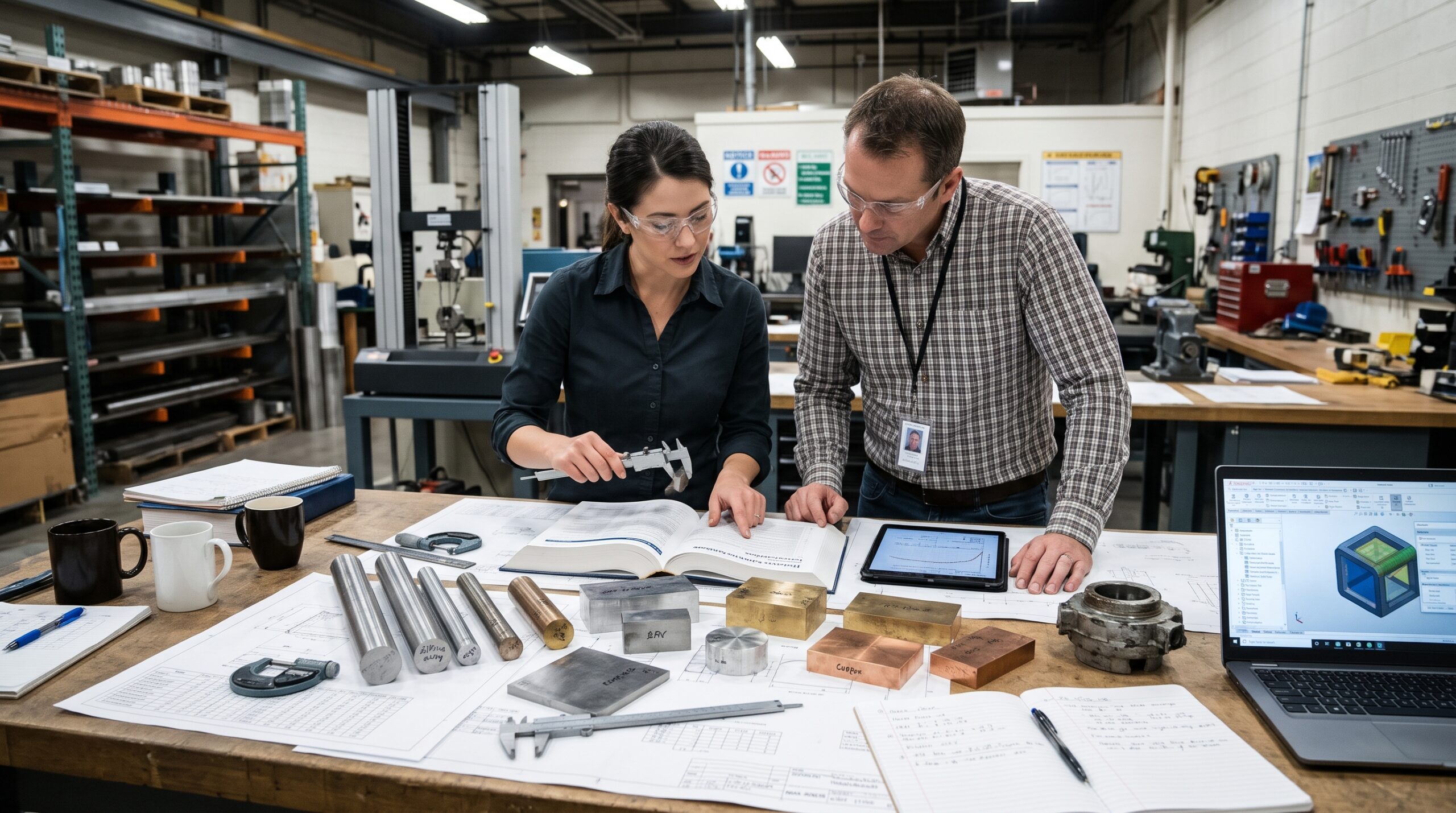
Every few months a broken part lands on my bench with a sticky note that says some version of “Why did this fail?” Sometimes it is a cracked shaft, sometimes a bracket that rusted through in a year, sometimes a bolt that snapped clean in two with almost no warning. I cut the part, polish it, etch it, and look at it under the microscope. And more often than you would expect, the answer is not a manufacturing defect or an abusive operator. The answer is a mistake in engineering material selection: somebody picked the wrong metal.
That is not a criticism of the designers. Engineering material selection is hard, and most mechanical engineers get one or two semesters of materials science before they head out into a world with thousands of alloys, dozens of heat treatments, and suppliers who will happily sell you whatever is in stock. What I want to do here is walk through how I actually think about choosing a metal for a job, the way I would explain it to a young engineer sitting across the table from me in the lab. No magic charts that solve everything, just the questions that keep parts in service and keep people safe.
Engineering Material Selection Starts With the Job, Not the Alloy
The most common mistake I see is starting with a material name. “Let’s make it out of 4140.” “Use 316 stainless, it doesn’t rust.” “Aluminum, because it’s light.” Each of those might be the right answer, but nobody should arrive at it first.
Before you open a single datasheet, write down what the part has to do. I mean literally write it down, with the same discipline you would bring to an engineering feasibility study. I ask four things:
- What is the function? Does it carry load, seal a fluid, conduct heat, carry current, resist wear, or some combination?
- What are the hard constraints? Maximum weight, minimum stiffness, operating temperature range, fixed dimensions, a regulatory code it must meet.
- What is the objective? Are you trying to minimize cost, minimize mass, maximize service life, or minimize downtime?
- What is the environment? Indoors in a dry warehouse is a completely different world from a splash zone on a coastal pier or a chemical plant handling hot brine.
This is not something I invented. It is the backbone of engineering material selection as Michael Ashby formalized it at Cambridge. NASA describes essentially the same sequence in its work on materials selection for aerospace systems: establish the design requirements, screen out materials that cannot meet them, rank what is left, research the specific candidates, and then apply the result. Screening and ranking are two different steps, and mixing them up is where a lot of bad specifications come from.
Step One of Engineering Material Selection: Screening
Think of this step as a pass or fail test. If the part sees 600 °C continuously, most aluminum alloys are out, full stop. Seawater service rules out plain carbon steel without protection. And if the part must be nonmagnetic for an MRI suite, ferritic and martensitic steels are out.
I like screening because it is fast and honest. You do not need a perfect answer here. You just need to stop wasting time on candidates that were never going to survive.
The trap at this stage of engineering material selection is being too generous. People keep a material in the running because “we could coat it” or “we could keep it dry.” Maybe you can. But every one of those “could” statements is a maintenance promise someone has to keep for the life of the equipment, and in my experience people start breaking those promises around year three.
Ranking Candidates in Engineering Material Selection
Once you have a short list, you need a fair way to compare it. This is where the performance index comes in, and it is the single most useful idea in engineering material selection that I wish more people used.
A performance index is a combination of material properties that captures how well a material does a particular job. It is not a single property. For a light, strong tie rod in tension, what matters is strength divided by density. A light, stiff beam in bending has an index equal to the square root of stiffness (Young’s modulus) divided by density. With a light, stiff flat panel, it becomes the cube root of modulus over density, because plate bending stiffness scales with thickness cubed. The Wikipedia overview of material selection has a clean worked example showing how to derive those indices for tension and bending, and it is worth working through once with a pencil.
Why the Index Changes the Answer
Why does this matter on the shop floor? Because it changes the answer. Compare steel and aluminum on raw strength and steel wins easily. Compare them on stiffness per unit weight for a beam in bending, and aluminum starts to look very good, because you can make it thicker for the same mass and that extra depth pays off heavily in bending. I have seen teams reject aluminum for a structural frame because “steel is stronger,” then wonder why their steel frame is twice as heavy as a competitor’s product that performs the same.
Ashby’s material property charts plot one property against another on logarithmic scales, and on those charts a performance index shows up as a straight line. Slide the line toward the better corner and the materials it crosses are your winners. You do not need commercial software to use the idea. Even a rough sketch on graph paper will keep you from comparing apples to oranges.
The Properties That Decide Engineering Material Selection
Datasheets list dozens of numbers. In my day to day failure work, a handful of them decide almost everything.
Yield Strength, Not Just Tensile Strength
Ultimate tensile strength looks impressive on a datasheet, but we design parts so they never reach it. Yield strength is where permanent deformation starts, and for most machine parts, permanent deformation is already a failure. A shaft that bends a fraction of a millimeter can wreck a bearing or a seal. Always check which number the design calculation is really using.
Toughness and the Temperature Nobody Planned For
Toughness is the ability to absorb energy and resist a crack once it starts. Strength and toughness often pull in opposite directions. Harden a steel and it gets stronger, but usually less forgiving.
The classic lesson here is the Liberty ships of the Second World War. Of the roughly 2,700 Liberty ships that American shipyards built, a large number suffered serious brittle fractures, and some broke completely in two. As Maine Maritime Academy’s “Broken Ships” materials course presentation explains, early ships cracked badly in cold North Atlantic waters, and later research tied the fractures to the grade of steel and its loss of toughness in the cold.
Welded construction, sharp hatch corners acting as stress raisers, and weld defects finished the job. A historical review published in MDPI’s Challenges journal notes that about half of the serious fractures started at the corners of the cargo hatches.
Here is the metallurgy behind it. Body centered cubic metals like ordinary carbon steel lose toughness sharply below a certain temperature, while face centered cubic metals like austenitic stainless steel, copper, and aluminum generally do not show that transition. The DoITPoMS teaching library from the University of Cambridge has a good explanation, including the classic demonstration of mild steel snapping like glass after a dip in liquid nitrogen.
This is not just history. I still see designers specify carbon steel flanges, brackets, and pressure parts for outdoor equipment in cold climates without anyone asking for impact testing. The fix is cheap: specify a grade with Charpy V notch impact testing at your minimum design metal temperature. The Texas Flange team’s article on brittle fracture in cold service flanges traces the line from those ships to modern piping specifications very nicely.
Fatigue
Most mechanical failures I examine are fatigue failures. The part did not see one big overload. It saw millions of small ones. On a fracture surface you can often read the history in the beach marks, curved bands that show the crack front advancing a little at a time until the remaining section could not hold the load.
For fatigue, the material matters, but surface condition and geometry matter just as much. A sharp fillet, a rough machined surface, a stamped part number in the wrong place, or a weld toe can cut fatigue life dramatically. When I select a metal for cyclic loading, I also ask about surface finish, shot peening, and whether the design has generous radii. A great alloy with a terrible notch will lose to an ordinary alloy with a good design.
Hardness and Wear
Hardness is the easiest property to measure and the easiest to misuse. It is a fine proxy for wear resistance and a rough proxy for strength in steels. But chasing hardness without thinking about toughness is how people end up with gears that chip and pins that shatter. Case hardening, where the surface is hard and the core stays tough, exists precisely because most wear parts need both.
Corrosion: Where Engineering Material Selection Quietly Fails
If I had to name the property that ruins the most engineering material selection decisions, it would not be strength. It would be corrosion resistance, because it is the one designers most often treat as a yes or no box on a form.
“Stainless” Is Not a Single Material
Stainless steel resists corrosion because chromium forms a thin passive oxide film on the surface. That film is excellent in many environments and surprisingly vulnerable in others, especially where chlorides are present. Salt air, seawater, deicing salt, many process chemicals, and even some cleaning solutions are full of chlorides.
The usual comparison is Type 304 versus Type 316. The key difference is molybdenum. Type 316 contains roughly 2 to 3 percent molybdenum, which substantially improves resistance to pitting and crevice corrosion in chloride environments.
Engineers compare grades with the Pitting Resistance Equivalent Number, calculated as percent chromium plus 3.3 times percent molybdenum plus 16 times percent nitrogen. According to Rapid Protos’ PREN reference values, Type 304 comes in around 18 to 20 and Type 316 around 24 to 26. In my experience, 304 becomes vulnerable to pitting and crevice attack in warmer chloride service.
That sounds like a clear rule: use 316 near salt. But 316 is not invincible either. In hot, concentrated chlorides it can still pit, and austenitic grades can suffer chloride stress corrosion cracking under tensile stress. When conditions get serious, I start looking at duplex stainless steels, super austenitics, or nickel alloys, and I want real exposure data, not a brochure.
One more practical note: welding matters. Standard grades can lose corrosion resistance next to a weld if chromium carbides form at the grain boundaries. That is why low carbon “L” grades like 304L and 316L are so common in welded fabrications.
Galvanic Corrosion: The Marriage Problem
Galvanic corrosion happens when two dissimilar metals share an electrical connection in the presence of an electrolyte. The more active metal becomes the anode and corrodes faster, while the more noble one stays protected. According to the Engineers Edge galvanic compatibility guide, three conditions all have to be present: two electrochemically dissimilar metals, an electrically conductive path between them, and an electrolyte connecting them.
The classic field example is stainless fasteners in an aluminum structure, or titanium touching aluminum. As MW Components explains in its material compatibility data, when titanium and aluminum are in contact, the aluminum acts as the anode and corrodes.
Area ratio matters too. A small anode connected to a large cathode is the worst case, because the attack concentrates on a small area. That is why a small stainless screw in a big aluminum panel is usually tolerable, while a big stainless panel held with small aluminum rivets is asking for trouble.
The practical fixes are well established. Choose metals close together in the galvanic series, isolate them with nonconductive washers, sleeves, or gaskets, and keep the joint dry with coatings or sealants. Corrosionpedia’s guide to the galvanic series is a handy reference when you need to check a pairing quickly, and Inspenet’s article on preventing galvanic corrosion covers the design side, such as detailing joints so water does not sit in them.
Strength Has a Ceiling: Hydrogen Embrittlement
Here is a failure mode that catches even experienced engineers. When you push steel to very high strength, it becomes more sensitive to hydrogen. Atomic hydrogen can enter the steel during pickling, acid cleaning, electroplating, or even from corrosion in service, then migrate to areas of high stress and cause cracking well below the expected load. The fracture often shows up hours, days, or even years after installation.
The Simpson Strong Tie structural engineering blog on hydrogen embrittlement gives a useful rule of thumb from the fastener world. Good quality fasteners with an actual hardness below about 38 on the Rockwell C scale, roughly 170,000 psi tensile strength, are not ordinarily susceptible. Above that, you need to think carefully, especially in corrosive service where galvanic action can generate hydrogen at the steel surface.
From an engineering material selection standpoint, the lesson is simple. Stronger is not always better. If a design calls for an ultra high strength bolt in a wet, corrosive location, I would rather see a larger bolt at a moderate strength level, or a different coating and baking process, than a smaller bolt that is one plating line mistake away from breaking.
Manufacturability: Can You Actually Make It?
A metal that looks perfect on paper can be a nightmare in the shop. I always ask the production people a few questions before I sign off on any engineering material selection, and I treat them as part of design for manufacturability, not an afterthought.
Can it be welded with the procedures we already have? High carbon and many alloy steels need preheat and postweld heat treatment to avoid cracking. Some aluminum alloys, such as the high strength 7xxx series, generally make poor candidates for fusion welding in structural work. If your fabricator has never welded the alloy, budget time for procedure qualification under your metal fabrication quality standards.
Can it be machined economically? Free machining grades exist because tool life and cycle time are real costs. Austenitic stainless steels work harden and can be slow and expensive to machine. Titanium is wonderful until you see the machining quote.
What heat treatment does it need, and who will do it? A quenched and tempered alloy steel is only as good as the furnace and the quench. Distortion, decarburization, and quench cracking are all real risks. Specify the heat treatment condition and the hardness range on the drawing, and require certification.
Is it available in the form and size you need? Some alloys come easily in bar but not in plate, or in thin sheet but not heavy sections. Long lead times on a specialty alloy can quietly kill a project schedule, which is why material availability belongs in your engineering project management best practices from the start.
Cost: Think in Life Cycle, Not Price Per Kilogram
Purchasing departments see price per kilogram. Plant managers see downtime. A metallurgist has to speak both languages.
A cheaper alloy that needs replacing every eighteen months can easily cost more than a premium alloy that lasts ten years, once you add labor, lost production, scaffolding, permits, and the risk of an unplanned outage. That is the kind of trade that real manufacturing cost reduction strategies should capture.
On the other hand, I have seen engineers specify superalloys for jobs where a painted carbon steel part would have lasted decades. Over specifying is a failure too. It just fails on the balance sheet instead of in the field, and a disciplined value engineering process is one of the best ways to catch it.
When I run a cost comparison as part of engineering material selection, I include the raw material, fabrication, protective coatings, inspection, expected maintenance, expected life, and the cost of failure. That last item is the one people leave out, and it is often the largest.
Standards, Certificates, and Verification
Engineering material selection is not finished when you write “316L” on a drawing. You have to make sure that is what arrives. Any later substitution should also go through formal engineering change management rather than a phone call to purchasing.
Reference a recognized specification, such as an ASTM, ASME, EN, or ISO standard, rather than a generic name. Require mill test reports that show chemistry and mechanical properties, and build that requirement into your supplier qualification process. For critical parts, consider positive material identification with a handheld XRF analyzer at receiving. I have personally caught bar stock that carried the label of one stainless grade but was clearly another, and it is far cheaper to catch that at the dock than after the part fails in service.
For anything safety related, also think about inspection after fabrication, starting with a proper first article inspection. Hardness checks on heat treated parts, dye penetrant or magnetic particle testing on welds, and impact testing where toughness matters all belong in your manufacturing quality control process, because a material is only as good as the condition it ends up in.
An Engineering Material Selection Example From the Field
Let me tie this together with a simple example of the kind I see often. Say you need a bracket that holds a sensor on outdoor equipment near the coast. It carries modest vibration loads, sees temperatures from well below freezing in winter to hot summer sun, and bolts to a painted carbon steel frame.
Function: support a small load under vibration. Constraints: survive salt air, survive cold temperatures without brittle fracture, fit an existing bolt pattern. Objective: lowest life cycle cost with minimal maintenance.
Screening removes bare carbon steel (corrosion), and makes me cautious about any material with a ductile to brittle transition in the winter range. Candidates left: hot dip galvanized steel, 316 stainless, and a marine grade aluminum alloy.
Now ranking. Loads are modest, so strength is not the deciding factor. Fatigue from vibration matters, so I want good radii and no sharp notches whatever the alloy. Corrosion and the galvanic couple with the painted steel frame decide the rest.
An aluminum bracket on a steel frame near salt water needs good isolation. A stainless bracket on carbon steel puts the frame at risk wherever the paint chips. Galvanized steel is close to the frame metal galvanically, tough enough in the cold when you choose an appropriate structural grade, and cheap.
In many cases like this, galvanized steel with isolated, well chosen fasteners is the sensible answer, not the exotic one. If the bracket sits in a splash zone or is impossible to reach for maintenance, the balance may tip toward 316 with careful isolation. Either way, the decision came from the job, not from a favorite alloy.
Habits That Make Engineering Material Selection Work
After years of looking at failed parts, the patterns are clear. The best material selections share a few habits.
Write the requirements before naming a metal. Screen ruthlessly, then rank fairly with a performance index. Respect temperature, because toughness can disappear when it gets cold. Treat corrosion as a design property, not an afterthought, and look at every joint where two metals meet. Remember that very high strength brings its own risks. Talk to the people who will weld, machine, and heat treat the part. Compare on life cycle cost. Then verify that the material you specified is the material you received.
None of this requires genius. It requires discipline and a willingness to ask “what could kill this part?” before anyone builds the part instead of after it lands on my bench.
Engineering Material Selection FAQ
What is engineering material selection?
Engineering material selection is the process of choosing the material that best meets a component’s functional requirements, constraints, environment, and cost targets. It usually follows a sequence of defining requirements, screening out unsuitable materials, ranking the remaining candidates, and verifying the final choice, the same sequence described in NASA’s materials selection approach for aerospace systems.
What is a performance index in material selection?
A performance index is a combination of material properties, such as strength divided by density, that measures how well a material performs a specific function. It lets you compare very different materials fairly. The Wikipedia article on material selection shows how to derive indices for parts in tension and bending.
Why did the Liberty ships crack?
Their steel lost toughness in cold North Atlantic waters. Combined with welded construction, stress concentrations at hatch corners, and weld defects, this led to brittle fractures. The MDPI Challenges review of the Liberty ship failures summarizes the causes well.
Should I use 304 or 316 stainless steel?
For dry indoor service, 304 is usually fine. For chloride exposure such as coastal air, seawater, or deicing salts, 316 is generally the better choice because its molybdenum content raises pitting resistance. See Rapid Protos’ PREN reference for typical PREN values by grade.
How do I prevent galvanic corrosion between two metals?
Pick metals close together in the galvanic series, electrically isolate them with nonconductive washers or sleeves, avoid a small anode connected to a large cathode, and keep joints dry with coatings or sealants. The Engineers Edge galvanic compatibility guide is a good starting reference.
Is a stronger steel always the better choice?
No. Very high strength steels can be more sensitive to hydrogen embrittlement and usually have lower toughness. The Simpson Strong Tie blog on hydrogen embrittlement notes that fasteners above roughly 38 HRC need careful consideration, especially in corrosive service.
What is the ductile to brittle transition temperature?
It is the temperature range below which certain metals, mainly body centered cubic steels, lose toughness and fracture in a brittle way with little warning. Engineers measure it with Charpy impact tests across a range of temperatures, as DoITPoMS at the University of Cambridge explains.
References
- NASA Technical Reports Server. Materials Selection for Aerospace Systems
- Wikipedia. Material Selection
- Maine Maritime Academy. Broken Ships: A New Design for Materials Lab Courses
- MDPI Challenges. Technical Problem Identification for the Failures of the Liberty Ships
- DoITPoMS, University of Cambridge. Ductile Brittle Transition Temperature
- Texas Flange. From Liberty Ships to the Pipe Rack: Brittle Fracture in Cold Service Flanges
- Rapid Protos. PREN Calculator and Typical Stainless Steel Values
- Engineers Edge. Galvanic Compatibility Corrosion Guide
- MW Components. Material Compatibility and Selection Data
- Corrosionpedia. Galvanic Series
- Inspenet. Understanding and Preventing Galvanic Corrosion
- Simpson Strong Tie Structural Engineering Blog. Hydrogen Embrittlement in High Strength Steels