


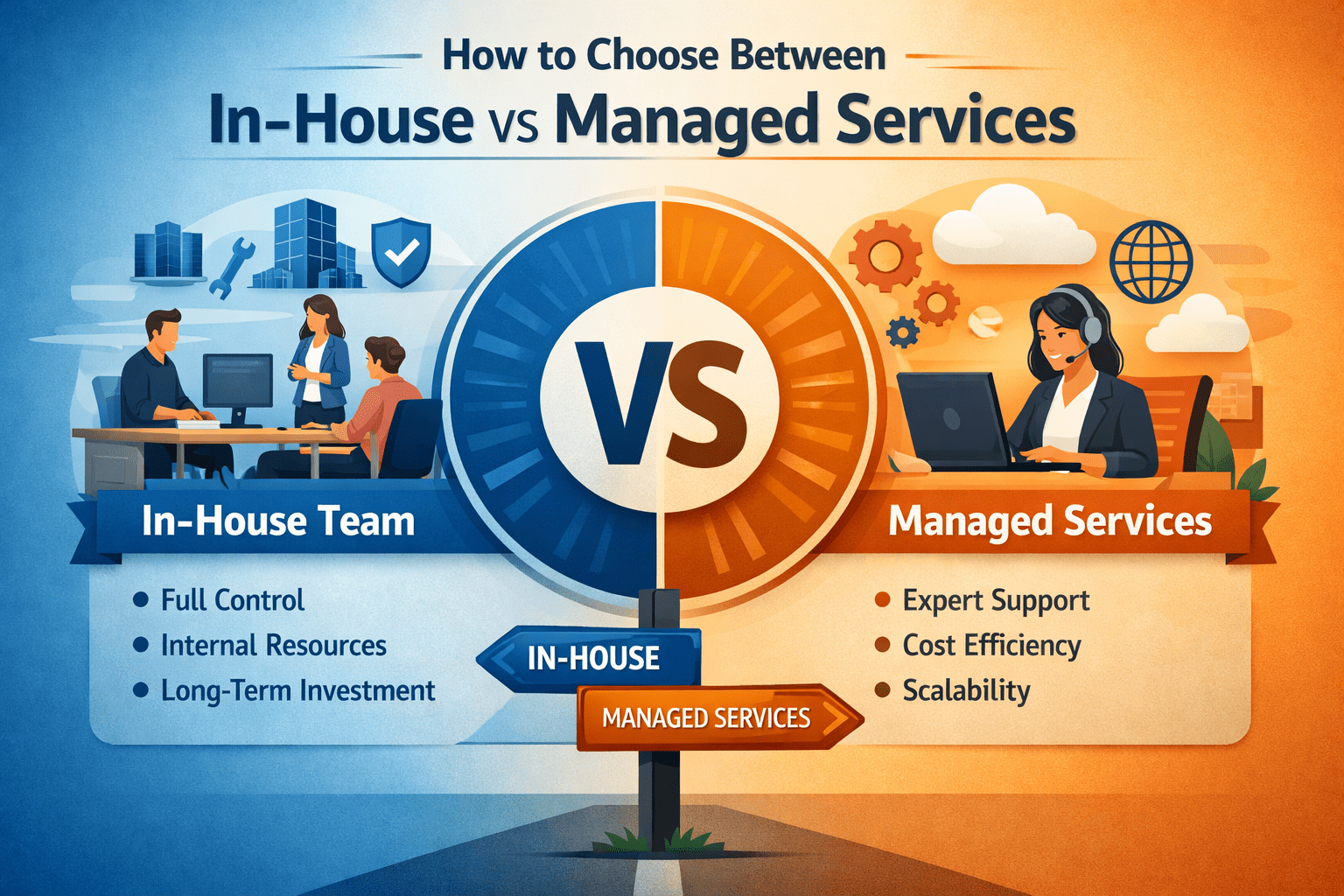
The choice between in-house vs managed services is one of the most consequential decisions organizations make when defining their IT and operational strategy. This decision influences cost control, service quality, scalability, security posture, and the ability to respond to changing business demands. Without a clear decision framework, organizations risk inefficiencies, hidden costs, and misaligned capabilities that limit long-term growth.
This article provides a professional, expert-level decision framework for evaluating in-house vs managed services, while delivering practical guidance for executives, IT leaders, and operations managers.
Understanding In-House vs Managed Services
Before applying a decision framework, it is essential to define both models clearly.
- In-house services rely on internal employees to manage IT systems, infrastructure, applications, and support functions.
- Managed services involve outsourcing specific functions or entire operational domains to a third-party provider under a defined service-level agreement (SLA).
Neither approach is inherently better. The optimal choice depends on business strategy, internal capabilities, risk tolerance, and long-term objectives.
Why Decision Frameworks Are Critical?
Organizations often default to in-house or managed services based on tradition, perceived cost, or past experience. A structured decision framework ensures decisions are:
- Aligned with business goals and growth plans
- Based on measurable criteria rather than assumptions
- Defensible to leadership and stakeholders
- Flexible enough to adapt as the organization evolves
Decision frameworks replace subjective debates with consistent, repeatable evaluation.
Key Factors in In-House vs Managed Services Decisions
1. Strategic Importance of the Function
The first and most important question is whether the function is core to competitive advantage.
- In-house services are often preferred for systems that directly support proprietary processes, intellectual property, or customer differentiation.
- Managed services are well suited for standardized, non-differentiating functions such as help desks, infrastructure monitoring, or routine maintenance.
If the function defines how the organization competes, retaining internal control may be strategically justified.
2. Total Cost of Ownership (TCO)
Cost comparisons must extend beyond salaries or monthly service fees.
In-house costs include:
- Salaries, benefits, and payroll taxes
- Recruitment and onboarding
- Training and certifications
- Turnover and knowledge loss
Managed services costs include:
- Contract and subscription fees
- Scope changes and overage charges
- Vendor management and governance
A proper decision framework evaluates total cost of ownership over multiple years, not just short-term savings.
3. Access to Skills and Expertise
Technology environments evolve rapidly, and skills gaps can become operational risks.
- In-house teams offer institutional knowledge and cultural alignment but may lack specialized or emerging expertise.
- Managed services provide access to diverse skill sets, certifications, and round-the-clock coverage.
Organizations struggling to recruit or retain specialized talent often benefit from managed services.
4. Scalability and Flexibility
Business growth and market changes demand adaptable operations.
- In-house services scale through hiring, which can be slow and costly.
- Managed services scale more easily, allowing organizations to increase or reduce capacity based on demand.
For organizations with fluctuating workloads or aggressive growth plans, scalability is a decisive factor.
5. Speed of Implementation and Responsiveness
Time to value matters in competitive environments.
- Managed services can often be deployed faster using established processes and tools.
- In-house teams may require time to build capabilities, document processes, and implement systems.
Decision frameworks should assess how quickly each model can deliver measurable outcomes.
6. Control and Customization
Control over systems and processes varies significantly between models.
- In-house services offer full control over priorities, workflows, and customization.
- Managed services operate within defined contracts and SLAs, which may limit flexibility.
Organizations with highly customized environments or rapidly changing requirements may prefer in-house control.
7. Security, Compliance, and Risk Management
Security and compliance considerations are central to the in-house vs managed services decision.
- In-house teams provide direct oversight but require continuous investment in training and tooling.
- Managed services often bring mature security frameworks, monitoring tools, and compliance certifications.
Highly regulated industries must carefully evaluate how each model supports legal and compliance obligations.
8. Reliability and Service Continuity
Downtime and service interruptions can have significant business impact.
- In-house services depend on internal staffing levels and redundancy planning.
- Managed services typically offer guaranteed uptime and defined response times through SLAs.
A decision framework should assess tolerance for downtime and the cost of service disruptions.
Applying a Practical Decision Framework
A structured approach improves clarity and accountability:
- Identify evaluation criteria such as cost, control, scalability, and risk.
- Assign weights based on organizational priorities.
- Score in-house and managed service options objectively.
- Review findings with business, technical, and financial stakeholders.
This method transforms complex trade-offs into transparent, data-driven decisions.
Common Mistakes to Avoid
- Choosing managed services solely to reduce headcount
- Assuming in-house teams are always more secure
- Underestimating vendor management effort
- Ignoring long-term scalability needs
- Failing to define clear service expectations
Avoiding these mistakes significantly improves decision outcomes.
When a Hybrid Model Is the Best Option?
In many cases, the optimal solution is a hybrid approach.
Examples include:
- Retaining in-house teams for strategic systems
- Using managed services for infrastructure or support
- Outsourcing specialized or after-hours functions
Hybrid models balance control, cost, and expertise when guided by a clear framework.
Governance and Performance Management
Regardless of the chosen model, strong governance is essential.
Best practices include:
- Clearly defined ownership and accountability
- Documented roles and responsibilities
- Performance metrics and regular reviews
- Exit and transition planning
Governance ensures continuity and protects long-term value.
Conclusion: Making Confident In-House vs Managed Services Decisions
The in-house vs managed services decision is not simply about outsourcing—it is a strategic choice that shapes how organizations operate, scale, and compete. By applying a structured decision framework, leaders can evaluate trade-offs objectively and align service models with business priorities.
When cost, control, expertise, scalability, and risk are assessed holistically, organizations can make confident, defensible decisions that transform technology from a constraint into a strategic advantage.
A disciplined framework ensures that whether services are managed internally, externally, or through a hybrid model, they consistently support long-term business success.