


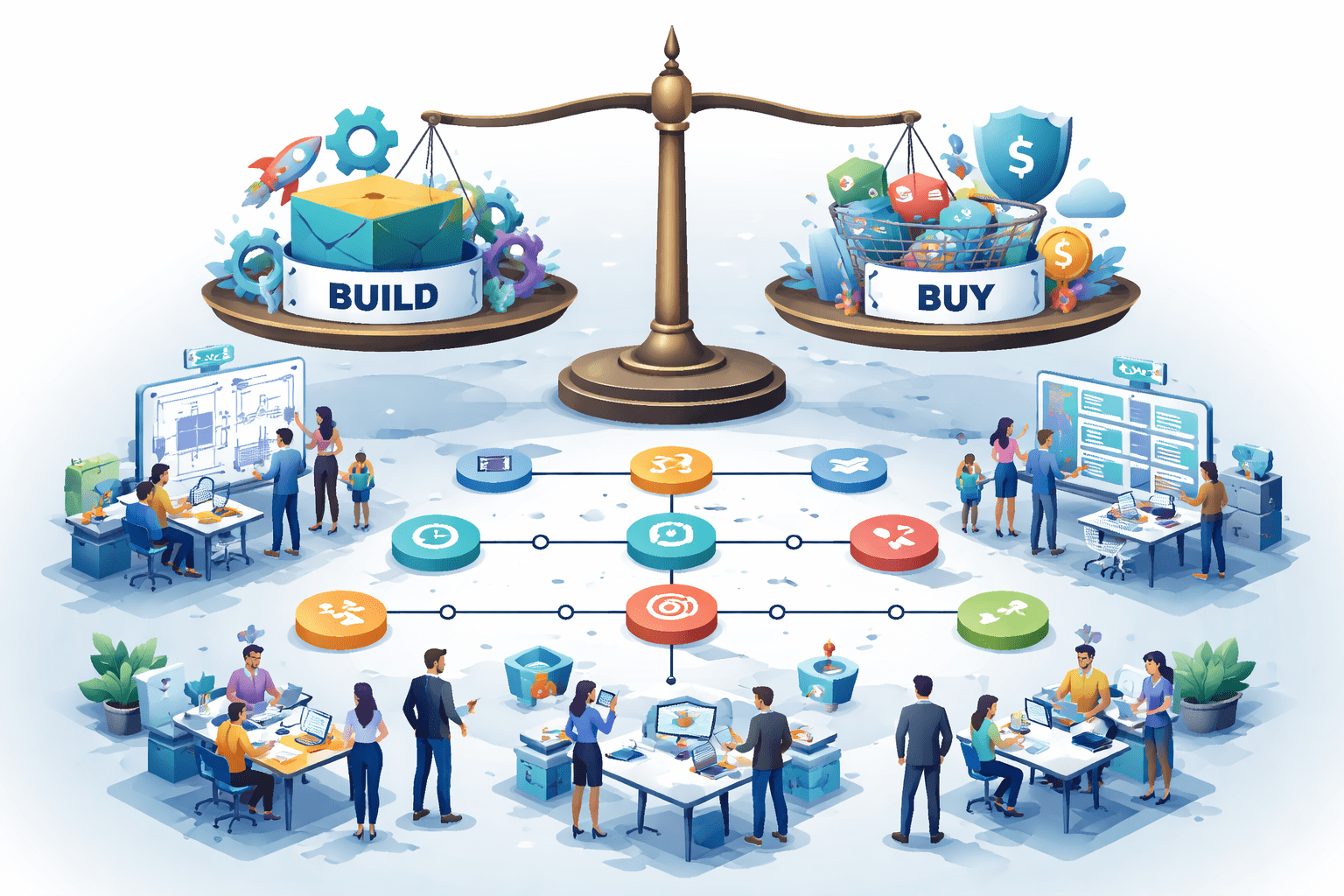
Choosing whether to build or buy software is one of the most critical strategic decisions organizations face. The outcome affects cost structures, operational efficiency, scalability, security, and long-term competitiveness. Poor decisions can lead to wasted budgets, delayed implementations, technical debt, or vendor lock-in, while well-informed choices can accelerate growth and innovation.
When evaluating whether to build or buy software, a structured framework not only clarifies priorities but aligns with strategic frameworks recommended by industry experts such as those featured in Forbes’ guide to build-versus-buy decisions.
This article provides a professional, expert-level decision framework for evaluating build vs buy software decisions. It is designed to help business leaders, IT managers, and product owners make defensible, data-driven choices that align with organizational goals and governance standards.
Understanding the Build vs Buy Software Decision
At its core, the build vs buy software decision evaluates two options:
- Build: Develop custom software internally or with a dedicated development partner.
- Buy: Purchase off-the-shelf or SaaS software from a third-party vendor.
Neither option is universally superior. The right choice depends on strategic priorities, internal capabilities, timelines, risk tolerance, and long-term vision.
A structured decision framework ensures the choice is not driven by emotion, habit, or short-term cost alone.
Why Decision Frameworks Matter?
Organizations that rely on ad hoc reasoning often underestimate hidden costs and long-term implications. A formal decision framework provides:
- Consistency across projects and departments
- Transparency for stakeholders and leadership
- Risk mitigation through structured evaluation
- Alignment with business and technology strategy
Decision frameworks are especially important when software directly supports core business processes, customer experience, or revenue generation.
Key Factors in Build vs Buy Software Decisions
1. Strategic Importance to the Business
The first question should always be: Is this software core to our competitive advantage?
- Build is often preferred when software enables unique processes, proprietary workflows, or differentiation.
- Buy is usually better for standardized functions such as accounting, payroll, HR management, or CRM.
If the software defines how your business competes, customization and control may outweigh convenience.
2. Total Cost of Ownership (TCO)
Initial price tags can be misleading. A proper build vs buy software decision must consider total cost of ownership, including:
- Development or licensing costs
- Maintenance and support
- Infrastructure and hosting
- Security and compliance requirements
- Training and change management
Building may have higher upfront costs but lower long-term licensing fees. Buying often offers predictable subscription pricing but can become expensive as user counts and feature needs grow.
3. Time to Market
Speed is a decisive factor in many industries.
- Buy typically enables faster deployment, especially with mature SaaS solutions.
- Build requires time for design, development, testing, and iteration.
If rapid implementation is critical to capturing market opportunity or meeting regulatory deadlines, buying may be the safer option.
4. Customization and Flexibility
Off-the-shelf software is designed for the average customer. Custom software is designed for you.
- Build allows full control over features, workflows, integrations, and user experience.
- Buy may limit customization or require costly upgrades and add-ons.
If your processes are highly specialized or evolving rapidly, a custom build may provide long-term flexibility.
5. Internal Capabilities and Resources
A realistic assessment of internal expertise is essential.
Ask:
- Do we have experienced developers and architects?
- Can we maintain this system long-term?
- Do we have governance and documentation standards?
If internal capacity is limited or stretched, buying a well-supported solution may reduce operational risk.
6. Scalability and Performance Requirements
Software must grow with the business.
- Build allows architecture tailored for specific scalability, performance, or regional needs.
- Buy relies on the vendor’s roadmap and infrastructure decisions.
Organizations with complex scalability demands or global operations may benefit from custom solutions designed to their exact requirements.
7. Security, Compliance, and Data Control
Security and compliance are non-negotiable in modern software decisions.
- Build offers full control over data handling, encryption, and compliance standards.
- Buy requires trust in vendor security practices, audits, and certifications.
Industries such as finance, healthcare, and government often favor building or heavily vetting vendors due to regulatory obligations.
8. Vendor Lock-In and Long-Term Risk
Buying software introduces dependency.
Risks include:
- Vendor price increases
- Product discontinuation
- Limited export or migration options
A strong decision framework weighs short-term convenience against long-term autonomy.
A Practical Build vs Buy Decision Framework
To simplify evaluation, many organizations use a weighted scoring model:
- Define evaluation criteria (cost, time, customization, risk, scalability).
- Assign weights based on business priorities.
- Score build and buy options objectively.
- Review results with technical and business stakeholders.
This approach transforms subjective debates into measurable comparisons and supports executive decision-making.
Common Build vs Buy Mistakes to Avoid
- Focusing only on upfront cost
- Ignoring long-term maintenance
- Underestimating change management
- Overestimating internal development capacity
- Assuming vendor solutions will “just adapt”
Avoiding these pitfalls improves the success rate of software investments.
When a Hybrid Approach Makes Sense?
In many cases, the best answer is neither fully build nor fully buy.
Examples include:
- Buying a core platform and building custom extensions
- Using SaaS tools integrated with proprietary systems
- Building critical components while outsourcing non-core functions
Hybrid approaches balance speed, control, and cost when executed with a clear architecture strategy.
Governance and Documentation Best Practices
Regardless of the decision, strong governance ensures long-term success:
- Document decision rationale and assumptions
- Define ownership and accountability
- Establish performance and review metrics
- Plan exit strategies for vendor solutions
This level of discipline aligns with enterprise architecture and audit standards.
Conclusion: Making Confident Build vs Buy Software Decisions
The build vs buy software decision is not a one-size-fits-all choice. It is a strategic evaluation that must balance cost, control, speed, risk, and long-term business value.
By applying a structured decision framework, organizations can move beyond intuition and make confident, defensible choices that support sustainable growth. Whether building custom software, buying proven solutions, or combining both, the key is alignment with business strategy and operational reality.
When decision frameworks are applied consistently, software investments become enablers of success rather than sources of complexity.