


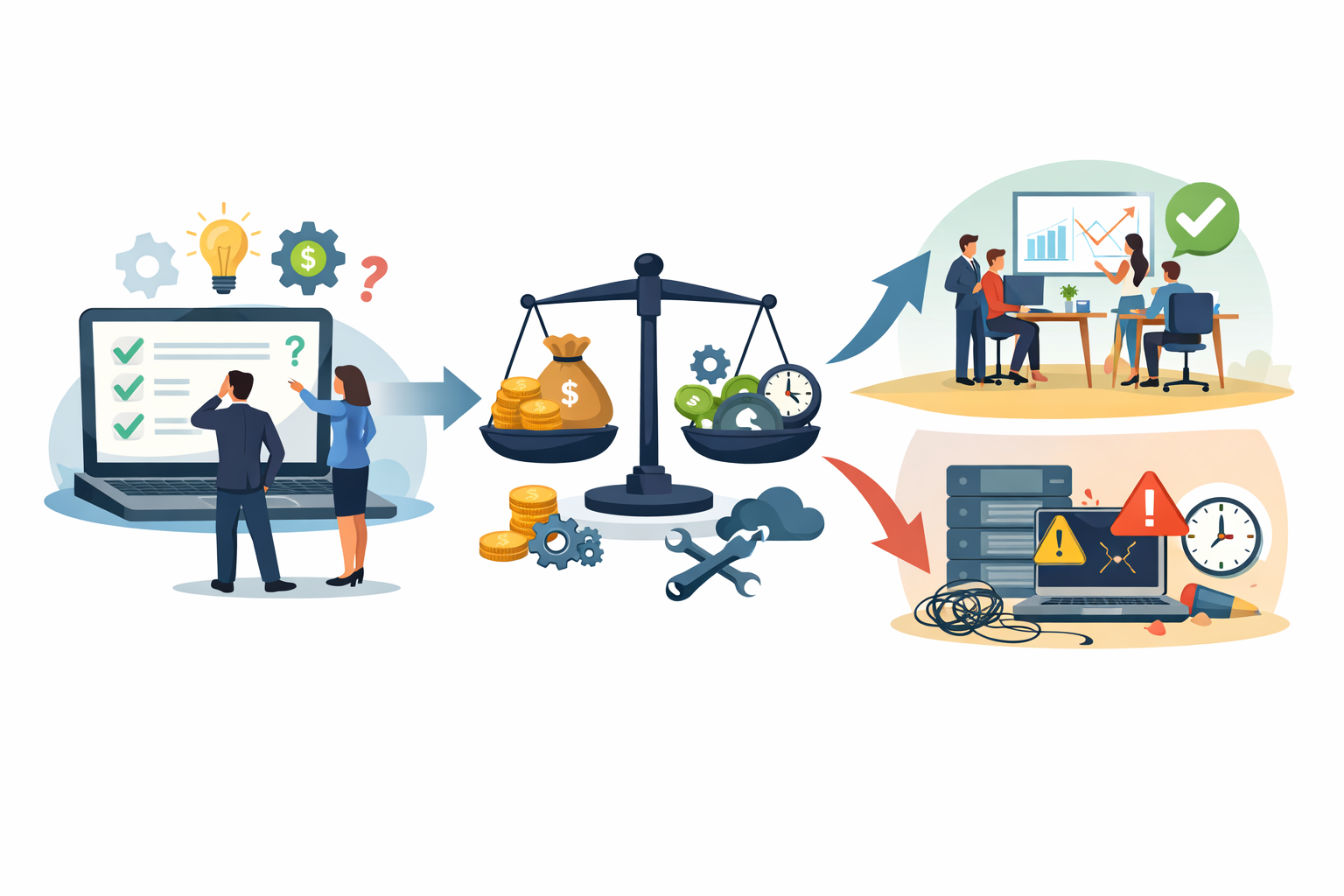
Total cost of ownership in software is one of the most misunderstood yet critical concepts in technology decision-making. Many organizations focus on upfront licensing or development costs while underestimating the long-term financial impact of implementation, maintenance, upgrades, and operational risk. This narrow view often leads to budget overruns, underperforming systems, and costly replatforming initiatives.
What Is Total Cost of Ownership in Software?
Total cost of ownership (TCO) in software refers to the complete lifecycle cost of acquiring, implementing, operating, maintaining, and retiring a software system. Unlike purchase price or subscription fees, TCO captures the true economic impact of software over time.
A proper TCO analysis answers a fundamental question: What will this software actually cost us over three to five years?
Understanding total cost of ownership in software requires looking beyond the initial purchase price to the full lifecycle of costs — from acquisition and implementation to maintenance and retirement — an approach that industry leaders like IBM explain in their TCO overview.
Why Total Cost of Ownership Matters?
Organizations that ignore total cost of ownership often face:
- Unexpected operational expenses
- Budget overruns after implementation
- Reduced ROI from technology investments
- Technical debt and system replacement costs
A structured TCO decision framework ensures software investments are financially sustainable, strategically aligned, and transparent to stakeholders.
Core Principles of a TCO Decision Framework
An effective total cost of ownership framework should be:
- Comprehensive – Covers the full software lifecycle
- Comparable – Enables fair evaluation between options
- Predictive – Estimates future costs, not just current spend
- Actionable – Supports clear decision-making
These principles prevent cost blind spots and improve long-term outcomes.
Key Cost Components in Total Cost of Ownership
1. Acquisition and Licensing Costs
This is the most visible cost category and often the only one considered.
Includes:
- Software licenses or subscriptions
- Initial purchase fees
- Contract negotiation costs
While important, acquisition costs typically represent only a fraction of total cost of ownership in software.
2. Implementation and Deployment Costs
Implementation costs can rival or exceed licensing fees.
Common expenses include:
- System configuration and customization
- Data migration
- Integration with existing systems
- Project management and testing
Underestimating implementation is one of the most common TCO mistakes.
3. Infrastructure and Hosting Costs
Software rarely operates in isolation.
Consider:
- Cloud hosting or on-premise infrastructure
- Storage, networking, and backup systems
- Performance and redundancy requirements
Infrastructure choices significantly influence long-term TCO.
4. Training and Change Management
User adoption directly impacts value realization.
Costs include:
- End-user training programs
- Documentation and knowledge transfer
- Productivity loss during transition
Training is often treated as optional, yet it is essential to reducing long-term inefficiencies.
5. Ongoing Support and Maintenance
Recurring costs accumulate over time.
These may include:
- Vendor support contracts
- Internal support staff
- Bug fixes and patches
- System monitoring and administration
Maintenance is a major driver of total cost of ownership in software.
6. Upgrades and Enhancements
Software must evolve to remain useful.
Account for:
- Version upgrades
- Feature enhancements
- Compatibility updates
Failure to plan for upgrades can result in costly system replacements later.
7. Security, Compliance, and Risk Costs
Security incidents and compliance failures have real financial impact.
Consider:
- Security tools and audits
- Regulatory compliance requirements
- Downtime and incident response costs
Risk-related costs are often overlooked but can dwarf other TCO components.
8. Exit and Replacement Costs
All software eventually reaches end-of-life.
Include:
- Data extraction and migration
- Contract termination fees
- Transition to replacement systems
Exit costs complete the full TCO lifecycle view.
A Step-by-Step TCO Decision Framework
Step 1: Define the Evaluation Horizon
Choose a realistic time frame, typically three to five years, to capture recurring and future costs.
Step 2: Identify All Cost Categories
Use standardized categories to ensure consistency across software options. Avoid relying on vendor-provided estimates alone.
Step 3: Quantify Costs Conservatively
When uncertain, use conservative assumptions. Optimistic projections distort total cost of ownership analysis.
Step 4: Compare Scenarios
Evaluate:
- Best-case
- Expected-case
- Worst-case
Scenario analysis strengthens decision confidence.
Step 5: Align Costs with Business Value
TCO should not be evaluated in isolation. Compare cost against expected outcomes such as efficiency gains, revenue growth, or risk reduction.
Step 6: Validate with Stakeholders
Finance, IT, operations, and leadership should all review assumptions and results. Transparency improves adoption and accountability.
Common Mistakes in TCO Analysis
- Focusing only on license or subscription costs
- Ignoring internal labor and productivity impact
- Underestimating integration complexity
- Failing to account for exit and replacement costs
Avoiding these mistakes significantly improves software investment outcomes.
TCO and Decision Frameworks in Practice
Total cost of ownership frameworks are most effective when embedded into broader decision-making processes. Organizations that standardize TCO analysis across all software purchases achieve:
- More predictable budgets
- Better vendor negotiations
- Reduced technical debt
- Higher long-term ROI
Consistency is key.
Balancing TCO with Strategic Value
Lowest TCO does not always mean best decision.
High-value systems may justify higher costs if they:
- Enable differentiation
- Reduce operational risk
- Support long-term growth
A strong decision framework balances cost, value, and risk.
Governance and Continuous Review
TCO should be reviewed periodically after implementation.
Track:
- Actual vs projected costs
- Usage and adoption rates
- Maintenance and support trends
Post-implementation review strengthens future evaluations and improves forecasting accuracy.
Conclusion
Total cost of ownership in software is not a finance-only concept—it is a strategic decision-making tool. By applying a structured TCO decision framework, organizations can move beyond upfront pricing and understand the true cost of software over its entire lifecycle.
When evaluated correctly, TCO enables smarter investments, stronger governance, and long-term technology success. Done well, it transforms software purchasing from a reactive expense into a strategic advantage.