


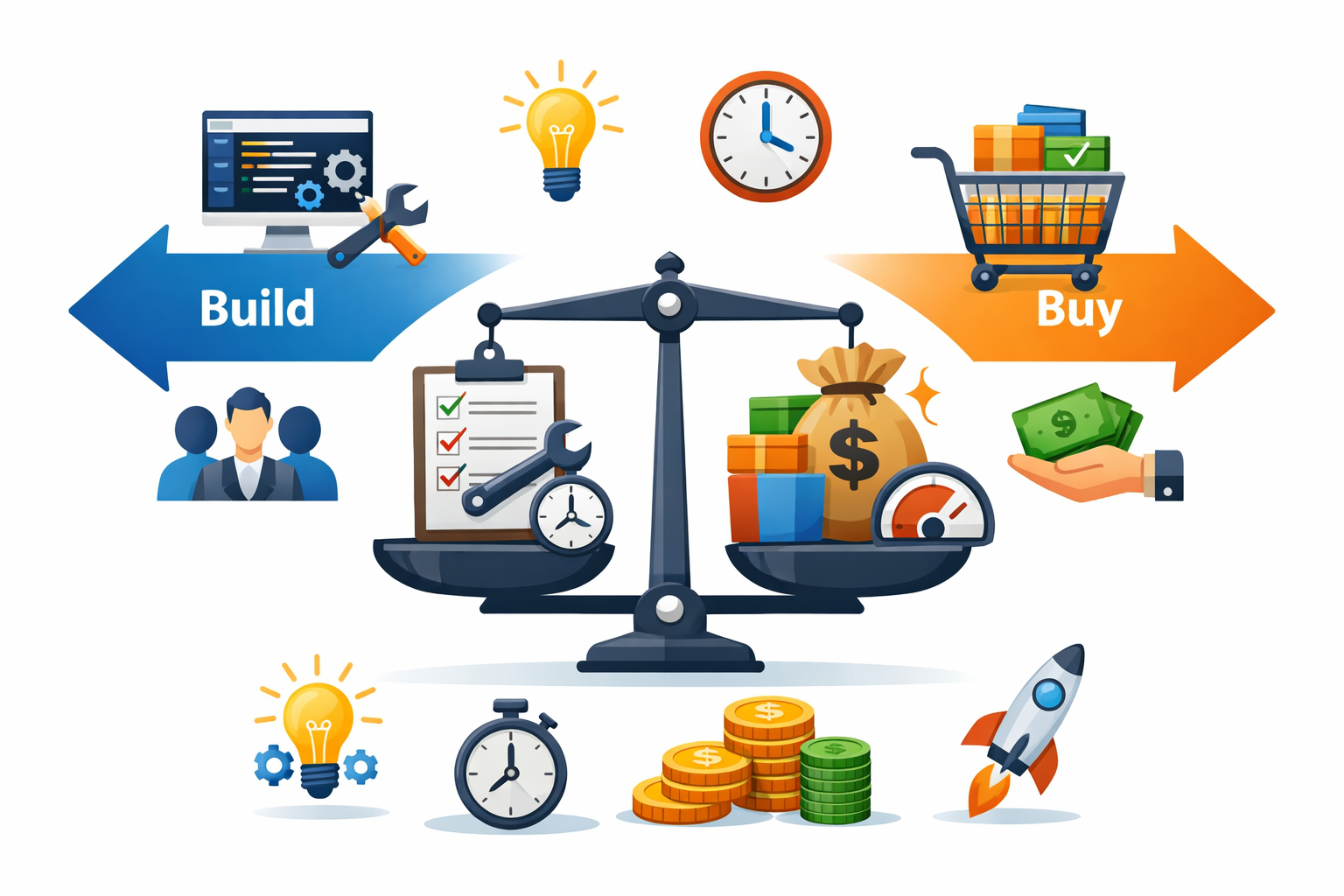
Build vs buy software decisions are among the most critical strategic choices organizations face today. Whether you are a startup selecting your first core system or an enterprise modernizing legacy platforms, choosing between building custom software or buying an off-the-shelf solution directly impacts cost, scalability, speed, and long-term competitiveness.
Understanding Build vs Buy Software Decisions
At its core, the build vs buy software decision evaluates two paths:
- Build – Develop a custom software solution tailored to specific business needs.
- Buy – Purchase or subscribe to an existing commercial or SaaS solution.
Neither option is universally better. The right choice depends on strategy, resources, timelines, and the role the software plays in the organization.
Why a Decision Framework Is Essential?
Decision frameworks help avoid costly mistakes by enforcing structured evaluation criteria — an approach championed in industry frameworks such as the Forbes Tech Council’s build versus buy decision guide.
Many failed software initiatives stem from poorly structured decisions. A decision framework ensures that build vs buy software decisions are:
- Objective rather than emotional
- Aligned with business strategy
- Financially sound
- Sustainable over the long term
Using a structured framework reduces risk and improves stakeholder alignment.
Core Factors in Build vs Buy Software Decisions
1. Strategic Importance of the Software
Ask a foundational question: Is this software a competitive differentiator or a support function?
- Build when the software directly enables unique value, proprietary processes, or innovation.
- Buy when the software supports standard operations such as payroll, accounting, or basic CRM.
If the software defines how you compete, building may justify the investment.
2. Total Cost of Ownership (TCO)
Upfront price alone is misleading. Effective build vs buy software decisions evaluate total cost of ownership, including:
- Development or licensing costs
- Infrastructure and hosting
- Maintenance and upgrades
- Security and compliance
- Staffing or vendor support
Custom-built software often has higher initial costs but lower long-term licensing fees. Bought software may appear cheaper upfront but can accumulate costs over time.
3. Time to Market
Speed is often a decisive factor.
- Buy when rapid deployment is critical.
- Build when timelines are flexible and long-term value outweighs short-term speed.
If missing a market opportunity costs more than customization benefits, buying is usually the smarter option.
4. Customization and Flexibility Requirements
One of the most cited reasons for build vs buy software decisions is flexibility.
- Build if workflows are complex, unique, or constantly evolving.
- Buy if processes align well with industry standards.
Excessive customization of purchased software can increase costs and complexity, sometimes negating its benefits.
5. Scalability and Future Growth
Consider where the business will be in three to five years.
- Will user volume grow rapidly?
- Will new features or integrations be required?
- Will geographic or regulatory expansion occur?
Custom-built solutions can scale precisely to your needs, while purchased solutions rely on vendor roadmaps.
6. Internal Capabilities and Resources
A realistic assessment of internal skills is essential in build vs buy software decisions.
- Build only if you have (or can sustain) experienced developers, architects, and product managers.
- Buy if software development is not a core organizational strength.
Underestimating the effort required to maintain custom software is a common pitfall.
7. Risk Management and Reliability
Risk tolerance varies by organization.
- Purchased software often comes with proven reliability, support SLAs, and compliance certifications.
- Built software carries higher execution risk but greater control.
In regulated industries, vendor compliance may heavily influence the decision.
A Step-by-Step Build vs Buy Decision Framework
Step 1: Define Business Objectives
Clearly articulate what the software must achieve. Tie requirements directly to measurable business outcomes.
Step 2: Classify the Software’s Role
Determine whether the software is:
- Core to competitive advantage
- Mission-critical but non-differentiating
- Supportive or administrative
This classification often points strongly toward build or buy.
Step 3: Evaluate Cost Scenarios
Model costs over a 3–5 year horizon for both options. Include best-case and worst-case scenarios to support informed decision-making.
Step 4: Assess Technical and Operational Fit
Compare how well each option:
- Integrates with existing systems
- Supports security requirements
- Adapts to future needs
A technically weak fit is a red flag, regardless of cost.
Step 5: Analyze Risks and Dependencies
Identify:
- Vendor lock-in risks
- Knowledge concentration risks
- Maintenance and continuity concerns
Balanced build vs buy software decisions account for both operational and strategic risk.
Step 6: Make a Data-Driven Recommendation
Document findings, assumptions, and trade-offs. This transparency builds executive confidence and alignment.
Common Build vs Buy Decision Mistakes
- Choosing to build without long-term funding commitment
- Buying software that requires excessive customization
- Ignoring internal change management costs
- Failing to plan for post-implementation maintenance
Avoiding these mistakes significantly improves outcomes.
When Hybrid Approaches Make Sense
In practice, many organizations adopt a hybrid approach:
- Buy a core platform
- Build custom extensions or integrations
This strategy balances speed, cost control, and differentiation, and is increasingly common in modern software ecosystems.
Governance and Continuous Review
Build vs buy software decisions are not one-time events. As markets, technologies, and strategies evolve, decisions should be revisited.
Establish governance practices that:
- Periodically reassess software value
- Monitor vendor performance
- Evaluate technical debt and scalability
Continuous review ensures long-term alignment.
Conclusion
Build vs buy software decisions require more than intuition or habit. They demand a structured decision framework that evaluates strategy, cost, risk, and capability. By applying a disciplined approach, organizations can avoid costly missteps and invest in software that truly supports their mission.
When done correctly, build vs buy decisions become a strategic advantage—enabling faster growth, stronger differentiation, and sustainable success.