


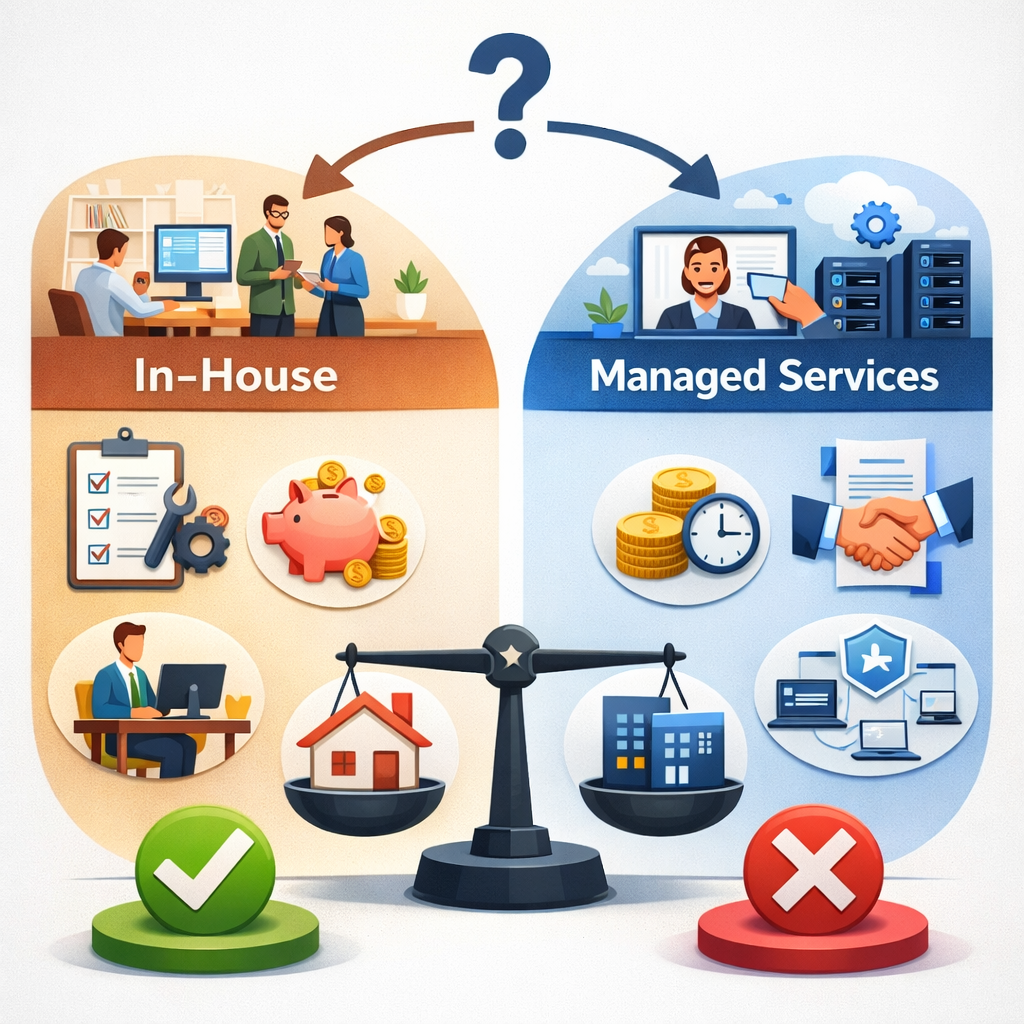
Choosing between in-house vs managed services is a strategic decision that directly affects cost efficiency, operational resilience, scalability, and long-term business performance. As organizations face increasing complexity, talent shortages, and rapid technology change, leaders must decide whether to build and retain internal teams or rely on external managed service providers.
Understanding In-House vs Managed Services
Before applying a decision framework, it is important to define both models clearly.
In-house services rely on internal employees who manage systems, operations, or functions directly. This model emphasizes control, institutional knowledge, and direct oversight.
Managed services involve outsourcing specific functions or systems to specialized third-party providers under defined service-level agreements (SLAs). This approach emphasizes scalability, expertise, and predictable costs.
The optimal choice depends on business context rather than preference.
Why a Decision Framework Is Critical?
Experts emphasize evaluating strategic goals and operational flexibility when choosing between in-house vs managed services, as highlighted in the NetSuite analysis of in-house vs outsourcing approaches.
Many organizations choose in-house or managed services reactively—often driven by short-term cost pressure or staffing gaps. Without a structured decision framework, this can lead to:
- Rising operational costs
- Skill gaps and burnout
- Vendor dependency without governance
- Poor service quality or accountability
A formal framework ensures that in-house vs managed services decisions are strategic, measurable, and aligned with long-term goals.
Key Factors in In-House vs Managed Services Decisions
1. Strategic Importance of the Function
Start by determining whether the function is core to competitive advantage.
- In-house services are best when the function directly supports proprietary processes, intellectual property, or customer experience differentiation.
- Managed services are better suited for standardized or non-core functions.
If the function defines how your organization competes, internal ownership may be essential.
2. Cost Structure and Total Cost of Ownership
Cost comparison should go beyond salaries or contract fees.
For in-house services, consider:
- Salaries and benefits
- Recruitment and retention
- Training and certifications
- Management overhead
- Tools and infrastructure
For managed services, consider:
- Monthly or annual service fees
- Transition and onboarding costs
- Change request fees
- Contract escalation clauses
A proper total cost of ownership (TCO) analysis over three to five years provides clarity.
3. Access to Skills and Expertise
Skill availability is one of the most common drivers of in-house vs managed services decisions.
- In-house teams provide deep institutional knowledge but may struggle to keep pace with evolving technologies.
- Managed services offer immediate access to specialized expertise and best practices across multiple clients.
In fast-changing or highly technical domains, managed services often reduce skill risk.
4. Scalability and Flexibility
Organizations rarely remain static.
- In-house services scale slowly due to hiring cycles, training, and budget approvals.
- Managed services scale faster, often allowing on-demand increases or reductions in service levels.
If demand is volatile or growth is uncertain, managed services provide greater flexibility.
5. Control, Visibility, and Governance
Control is a critical consideration.
- In-house models offer direct oversight, cultural alignment, and faster decision-making.
- Managed services require formal governance structures, SLAs, and performance monitoring.
Organizations with strong vendor management capabilities can maintain control even in outsourced models.
6. Risk Management and Business Continuity
Evaluate operational risk carefully.
- In-house services concentrate risk in key personnel and internal systems.
- Managed services distribute risk but introduce dependency on third parties.
Assess redundancy, disaster recovery, compliance, and security practices under both models.
7. Time to Value
Speed matters in competitive environments.
- In-house teams often require time to recruit, onboard, and mature.
- Managed services can deliver immediate operational capability.
When speed to implementation is critical, managed services often offer a clear advantage.
A Step-by-Step Decision Framework
Step 1: Define Business Objectives
Clearly articulate what success looks like. Objectives may include cost optimization, service quality, scalability, compliance, or innovation.
Step 2: Classify the Function
Determine whether the function is:
- Core and differentiating
- Mission-critical but standardized
- Supportive or administrative
This classification often points strongly toward in-house or managed services.
Step 3: Map Service Requirements
Document:
- Required service levels
- Availability and response times
- Compliance and security needs
- Reporting and governance expectations
Clear requirements prevent misalignment later.
Step 4: Model Cost and Risk Scenarios
Compare best-case and worst-case scenarios for both models over multiple years. Include transition and exit costs.
Step 5: Assess Organizational Readiness
Evaluate internal maturity in:
- Vendor management
- Process documentation
- Performance measurement
- Change management
Weak governance increases outsourcing risk.
Step 6: Validate with Stakeholders
Engage leadership, finance, legal, and operational teams. Adoption and accountability are critical for success.
Common Mistakes to Avoid
- Outsourcing without defined SLAs and KPIs
- Retaining in-house teams without sufficient skill investment
- Failing to plan transition and knowledge transfer
- Ignoring long-term dependency and exit strategies
Avoiding these mistakes significantly improves outcomes.
When Hybrid Models Make Sense
Many organizations adopt hybrid approaches, combining both models:
- In-house teams retain strategic control and governance
- Managed services handle operational execution or specialized tasks
This balance often delivers cost efficiency without sacrificing control.
Governance and Continuous Review
In-house vs managed services decisions should not be permanent. As technology, market conditions, and organizational capabilities evolve, periodic reassessment is essential.
Strong governance includes:
- Regular performance reviews
- Cost and value reassessment
- Risk and compliance audits
Continuous review ensures sustained alignment and ROI.
Conclusion
Choosing between in-house vs managed services requires more than intuition or cost comparison. A structured decision framework helps organizations evaluate strategy, cost, risk, scalability, and control in a disciplined way.
When applied consistently, this framework enables leaders to make confident, defensible decisions that support long-term growth and operational excellence. Done right, in-house vs managed services decisions become a strategic advantage—not a recurring challenge.