


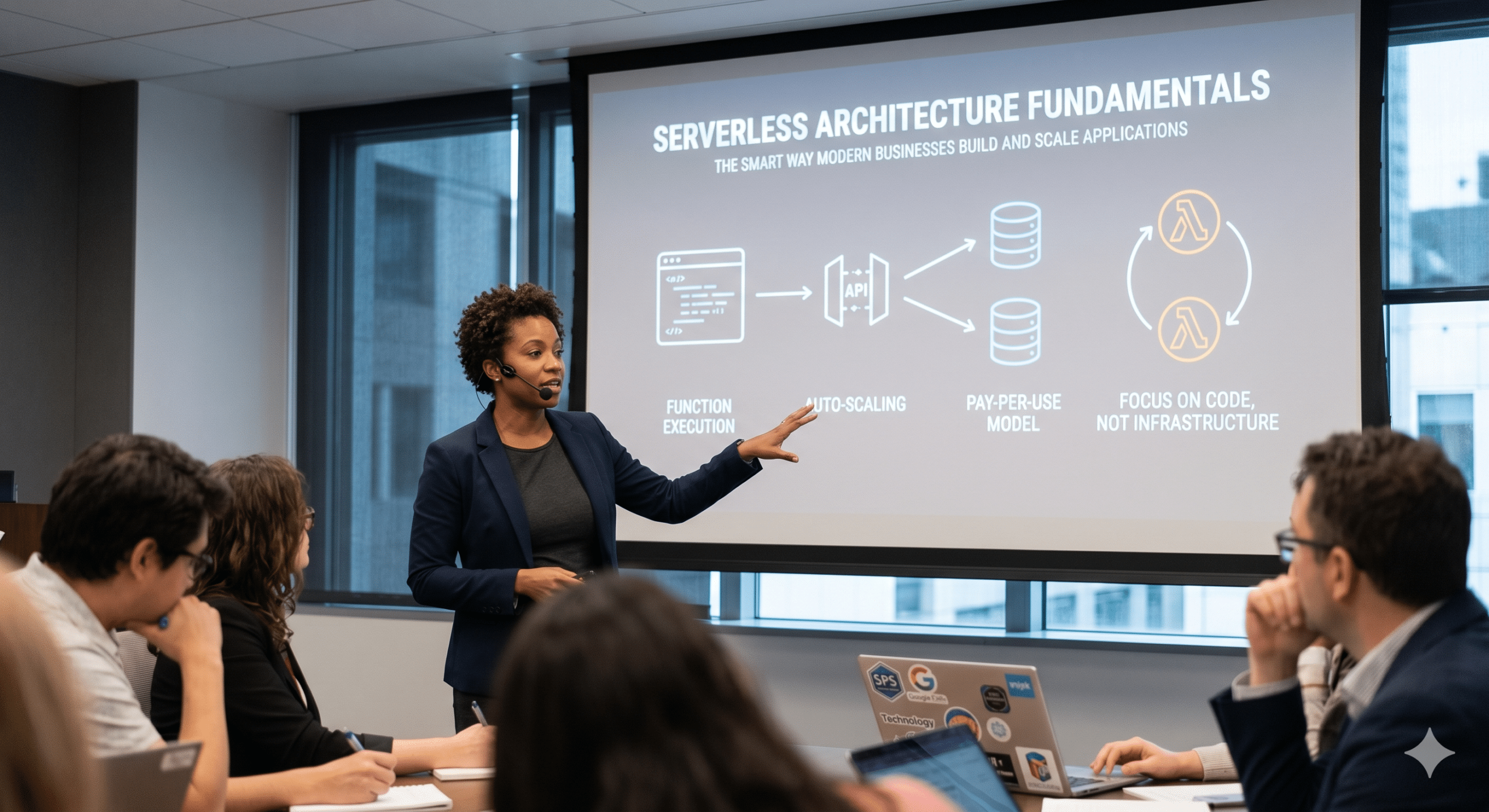
Technology has always evolved in cycles. First came massive on-premises data centers. Then cloud computing transformed the way businesses accessed computing resources. Today, another major shift is reshaping software development and digital transformation: serverless architecture.
As a Chief Technology Officer, I have seen organizations spend countless hours managing servers, applying security patches, planning infrastructure upgrades, and troubleshooting performance issues. While these tasks are important, they rarely create direct value for customers. Customers care about fast applications, seamless experiences, and innovative features—not the servers running behind the scenes.
This is exactly why serverless architecture has gained tremendous momentum. It allows businesses to focus on building products and solving problems rather than maintaining infrastructure. Instead of worrying about servers, developers can concentrate on writing code, improving customer experiences, and accelerating innovation.
Despite its growing popularity, many people misunderstand what serverless actually means. Some assume it eliminates servers entirely, while others believe it is only suitable for startups or small applications. Neither assumption is accurate. Understanding serverless architecture fundamentals is essential for anyone involved in modern software development, cloud computing, or digital transformation.
In this guide, we’ll explore what serverless architecture is, how it works, why businesses are adopting it, its advantages and limitations, and how it is shaping the future of technology.
What Is Serverless Architecture?
Serverless architecture is a cloud computing model that allows developers to build and run applications without managing the underlying servers. The servers still exist, but the cloud provider handles infrastructure provisioning, maintenance, scaling, updates, and availability automatically.
The term “serverless” often creates confusion because applications still run on physical machines somewhere in the cloud. The difference is that developers no longer need to interact directly with those machines. Instead, they deploy code to a cloud platform, and the platform takes care of everything else.
Imagine driving a car. Most drivers don’t need to understand how fuel injection systems work or how transmissions are engineered. They simply want reliable transportation. Serverless computing works in a similar way. Businesses consume computing resources without needing to manage the infrastructure that powers them.
This approach allows organizations to move faster, reduce operational complexity, and allocate more resources toward innovation rather than maintenance.
The Evolution from Traditional Infrastructure to Serverless Computing
To fully appreciate serverless architecture, it helps to understand how software infrastructure has evolved over the years.
Not long ago, organizations operated their own physical servers inside company-owned data centers. These environments required significant investments in hardware, cooling systems, networking equipment, security measures, and dedicated IT personnel.
As cloud computing matured, virtual machines became the preferred solution. Companies could rent computing resources from cloud providers rather than purchasing hardware themselves. While this reduced costs and improved flexibility, organizations still needed to manage operating systems, configure servers, install updates, and monitor performance.
Containers introduced another layer of efficiency by allowing applications to run in isolated environments. Yet even with containers, teams remained responsible for infrastructure management and orchestration.
Serverless architecture represents the next stage of this evolution. Rather than managing servers or containers, developers deploy code directly to the cloud. The cloud provider automatically allocates resources whenever the application needs them and removes those resources when they are no longer required.
The result is a more agile, scalable, and efficient approach to application development.
How Serverless Architecture Works
At its core, serverless architecture operates using an event-driven model. Instead of continuously running servers waiting for requests, computing resources are activated only when specific events occur.
Consider a simple example involving an online retailer. A customer places an order through a website. That action generates an event. The event triggers a serverless function responsible for validating payment information. Once payment is confirmed, another function updates inventory records. A separate function sends an order confirmation email, while another initiates shipping notifications.
Each function executes independently, performs its assigned task, and then stops running.
This process happens within seconds and often without the customer realizing the complexity occurring behind the scenes.
Because resources are only consumed when needed, serverless computing can be significantly more efficient than traditional architectures that require servers to remain operational around the clock.
The Key Components of Serverless Architecture
Understanding serverless architecture fundamentals requires familiarity with several core components that work together to create a complete application environment.
One of the most important elements is the serverless function. Functions are small, focused pieces of code designed to perform specific tasks. Unlike traditional applications that run continuously, these functions execute only when triggered by an event. This design promotes efficiency, scalability, and easier maintenance because each function is responsible for a single business process.
Another critical component is the API gateway. The API gateway acts as the entry point for requests coming from websites, mobile applications, or external systems. It receives incoming requests and routes them to the appropriate serverless functions. In many ways, the API gateway serves as the traffic controller for the entire application.
Data storage remains essential in serverless environments. Most applications rely on managed cloud databases that automatically handle backups, replication, and scaling. Developers can focus on working with data rather than managing database servers.
Event sources are equally important because they trigger the execution of serverless functions. Events may originate from user actions, database changes, file uploads, scheduled tasks, IoT devices, payment systems, or numerous other sources. The ability to respond dynamically to events is one of the defining characteristics of serverless architecture.
Monitoring and observability tools complete the ecosystem. Since serverless applications often consist of numerous interconnected functions, organizations need visibility into performance, errors, and usage patterns. Effective monitoring ensures that applications remain reliable and efficient as they grow.
Why Businesses Are Adopting Serverless Architecture
The rapid growth of serverless computing is driven by tangible business benefits rather than technological hype.
One of the most compelling advantages is the reduction in operational overhead. Traditional infrastructure requires ongoing management, including server maintenance, operating system updates, capacity planning, and security patching. These activities consume valuable resources but do not directly contribute to customer satisfaction or revenue generation.
Serverless platforms eliminate much of this burden. Infrastructure management becomes the responsibility of the cloud provider, allowing development teams to focus on creating products and services that drive business growth.
Scalability is another major advantage. In traditional environments, organizations must estimate future demand and provision resources accordingly. If traffic exceeds expectations, applications may experience performance issues. If traffic falls below expectations, companies end up paying for unused resources.
Serverless architecture removes this challenge by automatically scaling resources up or down based on demand. Whether an application serves a hundred users or a million users, the platform dynamically adjusts capacity without requiring manual intervention.
Speed is equally important. Modern businesses compete in rapidly changing markets where agility can determine success or failure. Serverless development enables teams to release new features more quickly because they spend less time managing infrastructure and more time building solutions.
Cost efficiency also plays a significant role. Unlike traditional servers that incur expenses regardless of utilization, serverless platforms typically charge based on actual usage. Organizations pay only for the computing resources consumed during execution, making serverless particularly attractive for applications with unpredictable traffic patterns.
Real-World Applications of Serverless Computing
Serverless architecture is no longer an experimental technology reserved for startups. It is widely used across industries and powers many of the digital experiences people rely on every day.
E-commerce platforms frequently leverage serverless functions to process orders, manage inventory, calculate taxes, generate invoices, and send customer notifications. Because shopping activity often fluctuates dramatically during promotions and holiday seasons, automatic scalability becomes a valuable asset.
Media and entertainment companies use serverless technology to process videos, optimize images, and deliver content to users worldwide. When millions of users upload and consume media simultaneously, serverless platforms provide the flexibility needed to handle changing demand efficiently.
Financial institutions increasingly depend on serverless architecture for fraud detection, transaction processing, risk analysis, and customer communications. Real-time event processing allows banks and payment providers to respond quickly to potential threats while maintaining smooth customer experiences.
Healthcare organizations are using serverless solutions to automate administrative processes, manage patient data, schedule appointments, and support telehealth services. The ability to scale rapidly while maintaining reliability is especially valuable in healthcare environments where service availability is critical.
Mobile applications represent another major use case. Many modern apps rely on serverless backends for authentication, push notifications, data synchronization, and content management. This allows development teams to focus on creating exceptional user experiences rather than maintaining infrastructure.
Serverless Architecture Versus Traditional Architecture
Comparing serverless architecture with traditional infrastructure helps highlight the differences in operational models.
In traditional environments, servers typically run continuously whether they are actively processing requests or sitting idle. Organizations must monitor capacity, plan upgrades, and manage hardware or virtual machines.
Serverless environments operate differently. Resources are allocated only when needed and released immediately after execution. This dynamic approach improves resource utilization and reduces unnecessary expenses.
Traditional systems often require extensive capacity planning because organizations must anticipate future demand. Serverless platforms handle scaling automatically, reducing the risk of performance bottlenecks during periods of rapid growth.
Maintenance responsibilities also differ significantly. Traditional architectures place infrastructure management on internal IT teams. Serverless architectures shift much of that responsibility to cloud providers, allowing organizations to focus on business objectives rather than operational tasks.
Neither approach is universally superior. The best choice depends on application requirements, performance expectations, budget considerations, and organizational goals.
Challenges and Limitations of Serverless Architecture
While serverless computing offers substantial benefits, it is important to understand its limitations.
One commonly discussed challenge is cold starts. When a serverless function has not been used recently, the cloud platform may need time to initialize resources before executing the function. Although these delays are often minimal, they can impact applications that require extremely fast response times.
Vendor lock-in represents another concern. Many serverless applications rely heavily on cloud-provider-specific services and integrations. Migrating such applications to a different platform may require significant redevelopment efforts.
Monitoring complexity can also increase as applications grow. A traditional application might operate on a handful of servers, while a serverless solution could involve hundreds of independent functions. Understanding interactions between these components requires sophisticated monitoring and observability tools.
Execution limits are another consideration. Most serverless platforms impose restrictions on execution duration, memory allocation, and resource usage. Long-running workloads may not be ideal candidates for serverless deployment.
Organizations should evaluate these challenges carefully when designing cloud strategies and selecting appropriate workloads for serverless environments.
Security in Serverless Environments
Security remains a critical responsibility regardless of architectural style.
While cloud providers secure the underlying infrastructure, organizations remain responsible for protecting their applications, data, and users. This shared responsibility model is an essential concept in cloud computing.
Strong authentication mechanisms help ensure that only authorized users can access resources. Encryption protects sensitive information both during transmission and while stored. Proper access controls limit permissions so that functions can interact only with the resources necessary to perform their tasks.
Developers must also follow secure coding practices to prevent vulnerabilities such as injection attacks, misconfigurations, and unauthorized access.
One advantage of serverless architecture is that the reduced infrastructure footprint can decrease the number of systems organizations must manage directly. However, security should never be assumed; it must be designed into every aspect of the application lifecycle.
Best Practices for Building Successful Serverless Applications
Organizations that achieve the greatest success with serverless architecture typically follow several common principles.
The first is simplicity. Functions should remain focused on specific tasks rather than attempting to perform multiple responsibilities. Smaller functions are easier to maintain, test, secure, and scale.
Event-driven design is equally important. Applications should be structured around events and workflows rather than tightly coupled components. This approach aligns naturally with the strengths of serverless computing.
Observability should be treated as a priority from the beginning. Comprehensive logging, monitoring, tracing, and alerting help teams identify issues quickly and maintain reliable performance.
Businesses should also take advantage of managed services whenever possible. The more operational responsibilities delegated to cloud providers, the greater the benefits of serverless architecture.
Finally, organizations should evaluate workload suitability carefully. Not every application belongs in a serverless environment. Understanding requirements and selecting appropriate use cases leads to better outcomes and stronger return on investment.
The Future of Serverless Architecture
The future of serverless computing appears exceptionally promising.
Artificial intelligence, machine learning, edge computing, and Internet of Things applications are increasingly leveraging serverless technologies to improve scalability and responsiveness. Cloud providers continue investing heavily in performance improvements, security enhancements, and developer productivity tools.
As digital transformation initiatives accelerate worldwide, businesses are seeking ways to innovate faster while controlling costs. Serverless architecture aligns closely with these objectives by reducing operational complexity and enabling rapid development.
Over time, the distinction between traditional cloud services and serverless services may become less noticeable as cloud platforms continue evolving toward greater automation. What remains clear is that serverless architecture will play an increasingly important role in the future of software development.
Conclusion
Understanding serverless architecture fundamentals is becoming essential for modern technology professionals and business leaders alike. The shift from infrastructure management to innovation-focused development represents one of the most significant transformations in cloud computing.
By eliminating much of the complexity associated with server management, serverless platforms allow organizations to build applications faster, scale more efficiently, and align technology investments more closely with business outcomes.
While serverless architecture is not the perfect solution for every workload, its advantages in scalability, agility, and operational efficiency make it a compelling option for a wide range of applications. From startups launching new digital products to enterprises modernizing legacy systems, organizations across industries are discovering the value of focusing less on servers and more on delivering exceptional customer experiences.
The future belongs to businesses that can innovate rapidly, adapt to changing demands, and leverage technology strategically. Serverless architecture provides a powerful foundation for achieving those goals.
Frequently Asked Questions
What is serverless architecture?
Serverless architecture is a cloud computing model that allows developers to build and run applications without managing the underlying servers. The cloud provider automatically handles infrastructure management, scaling, and maintenance.
Does serverless mean there are no servers?
No. Servers still exist, but they are managed entirely by the cloud provider. Developers interact with cloud services rather than directly managing server infrastructure.
What are the benefits of serverless computing?
The primary benefits include automatic scaling, reduced operational overhead, faster development cycles, improved agility, and cost efficiency through pay-per-use pricing.
What is a serverless function?
A serverless function is a piece of code that executes in response to specific events. It performs a designated task and then stops running until triggered again.
Is serverless architecture secure?
Yes, when implemented properly. Security depends on strong authentication, encryption, access controls, monitoring, and secure development practices.
What is a cold start?
A cold start occurs when a cloud provider must initialize resources before executing an inactive function. This can create a slight delay in response time.
Which cloud providers offer serverless services?
The most popular providers include Amazon Web Services (AWS Lambda), Microsoft Azure Functions, and Google Cloud Functions.
References and Further Reading
- AWS Lambda Serverless Architecture Guide
- Google Cloud Serverless Architecture Overview
- Microsoft Azure Functions Documentation
- Serverless Framework Documenation
- Cloud Security Alliance Serverless Security Guide