

In today’s technology-driven world, organizations are constantly searching for ways to improve efficiency, reduce costs, and deliver better experiences to customers. Whether it is a website serving thousands of visitors every day, a cloud platform supporting business applications, a manufacturing facility producing goods, or a healthcare organization managing patient services, performance plays a critical role in determining success. When systems operate efficiently, businesses become more productive, customers remain satisfied, and operational costs stay under control. When performance suffers, the consequences can quickly affect revenue, reputation, and long-term growth.
As an IT Engineer, I have witnessed many situations where companies believed their performance issues could only be solved by purchasing additional hardware, upgrading infrastructure, or increasing budgets. While investing in technology can sometimes be necessary, it is often not the most effective solution. In many cases, organizations already possess the resources they need but fail to utilize them efficiently. The real challenge is understanding how resources are being consumed, identifying bottlenecks, and making informed decisions that improve overall performance.
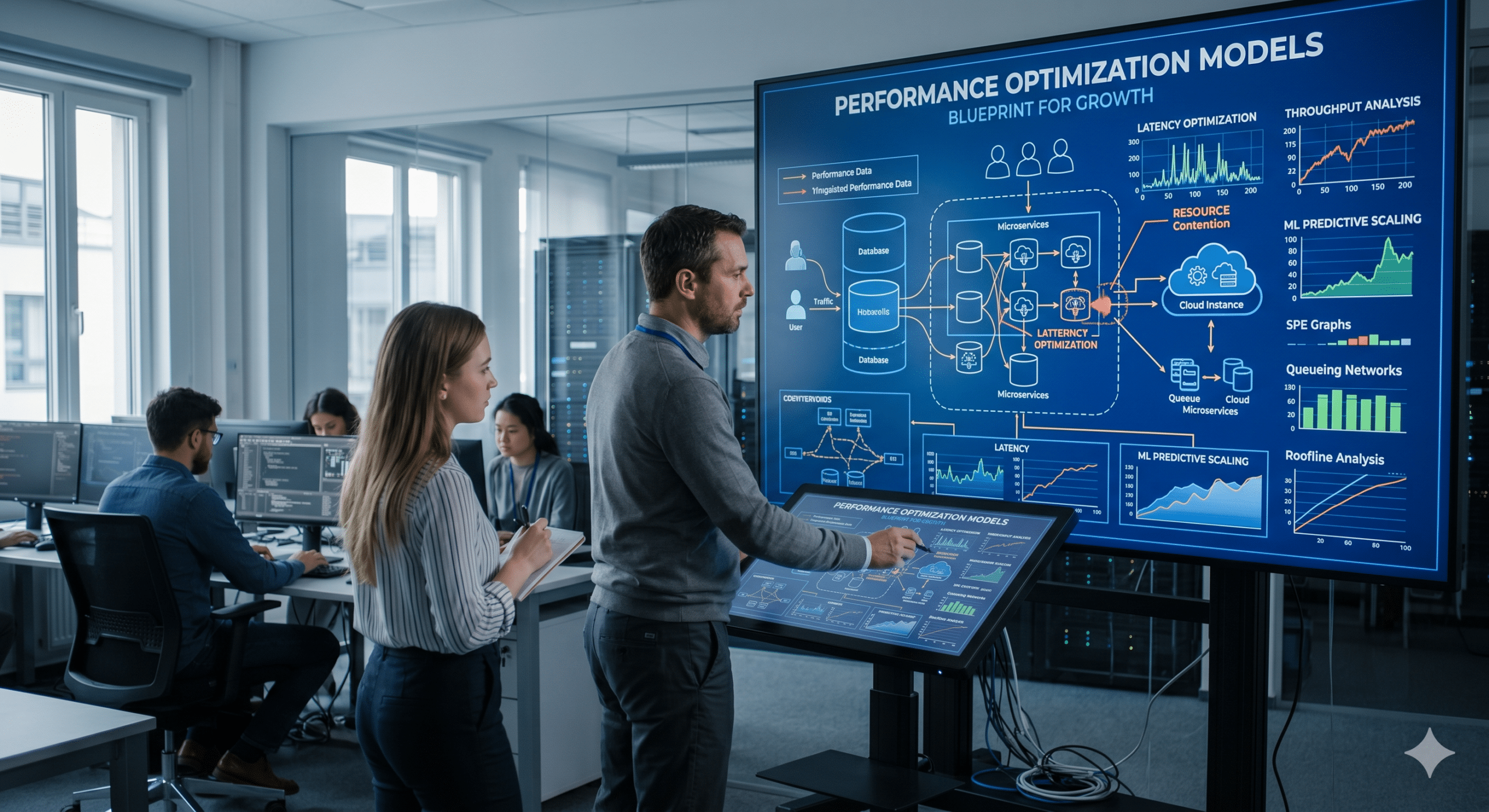
This is where Performance Optimization Models become invaluable. These models provide a structured approach to analyzing systems, processes, and resources to determine the most efficient way to achieve desired outcomes. Rather than relying on assumptions or trial and error, optimization models use measurable data and proven methodologies to guide decision-making. They help organizations maximize value while minimizing waste, creating a balance between performance, cost, scalability, reliability, and user satisfaction.
As businesses continue to embrace cloud computing, artificial intelligence, digital transformation, and data-driven operations, performance optimization has become more important than ever. Organizations that understand how to optimize their systems gain a competitive advantage, while those that ignore optimization often struggle with inefficiencies that limit growth and profitability.
Understanding Performance Optimization Models
A performance optimization model is a systematic framework designed to improve the efficiency and effectiveness of a system, process, or operation. The goal is not simply to make something faster. Instead, optimization focuses on achieving the best possible results using available resources while working within defined constraints.
One of the easiest ways to understand optimization is to think about a modern transportation system. A city may have roads, bridges, traffic signals, public transportation, and thousands of vehicles operating simultaneously. If traffic congestion becomes a problem, building additional roads is not always the answer. City planners first analyze traffic patterns, identify bottlenecks, examine traffic signal timing, and evaluate how resources are being utilized. By understanding the underlying causes of congestion, they can implement targeted improvements that produce better results without unnecessary spending.
Performance optimization models work in a similar manner. They analyze how systems behave, identify inefficiencies, and determine the most effective way to improve performance. These models can be applied to virtually any environment, including software applications, cloud infrastructure, manufacturing operations, logistics networks, healthcare systems, and business processes.
The primary purpose of a performance optimization model is to ensure that resources are being used efficiently while supporting organizational objectives. Instead of focusing solely on speed, optimization seeks a balance between multiple factors, including cost, quality, reliability, scalability, and user experience.
Why Performance Optimization Models Matter in Modern Organizations
The complexity of modern technology environments has increased dramatically over the past decade. Organizations now rely on interconnected systems that include cloud services, mobile applications, remote work environments, databases, APIs, artificial intelligence platforms, and cybersecurity tools. Every component affects overall performance, and even a small inefficiency can create a ripple effect throughout the organization.
At the same time, customer expectations continue to rise. Users expect websites to load instantly, applications to respond without delay, and services to remain available around the clock. Employees expect internal systems to support productivity rather than create frustration. Business leaders expect technology investments to deliver measurable returns.
These expectations create pressure on organizations to continuously improve performance while controlling costs. Simply adding more infrastructure is rarely a sustainable solution because additional resources often increase expenses without addressing the root causes of inefficiency.
Performance optimization models help organizations address these challenges by providing visibility into how systems operate. They allow decision-makers to identify bottlenecks, evaluate alternatives, and implement improvements that generate measurable results. Companies that invest in optimization often experience higher productivity, lower operational costs, improved customer satisfaction, and greater business agility.
In a highly competitive environment, the ability to optimize performance can become a significant differentiator. Organizations that operate efficiently are better positioned to adapt to changing market conditions, scale their operations, and maintain profitability over the long term.
The Core Components of Performance Optimization Models
Every performance optimization model is built upon a few fundamental principles. Understanding these principles is essential because they form the foundation of effective optimization strategies.
The first component is the objective. Every optimization effort begins with a clear understanding of what the organization wants to achieve. An objective may involve reducing costs, improving response times, increasing production output, maximizing resource utilization, or enhancing customer satisfaction. Without a clearly defined objective, optimization efforts often lack direction and fail to produce meaningful results.
The second component involves constraints. Every organization operates within certain limitations. These limitations may include budgets, staffing levels, hardware capacity, regulatory requirements, available time, or physical resources. Effective optimization models recognize these constraints and seek solutions that work within them rather than ignoring them.
The third component consists of decision variables. These are the elements that can be adjusted to improve outcomes. In an IT environment, decision variables may include server configurations, database settings, resource allocation policies, or network architecture. In a business environment, they may involve staffing schedules, workflow designs, inventory levels, or operational procedures.
By analyzing objectives, constraints, and decision variables together, organizations can identify the most efficient path toward achieving their goals.
Linear Optimization Models and Their Business Applications
One of the most widely used forms of optimization is the linear optimization model. Linear optimization, often referred to as linear programming, is designed to solve problems where relationships between variables can be represented using linear equations.
Although the mathematical foundations can be complex, the practical application is relatively straightforward. Imagine a manufacturing company that produces multiple products using limited labor, equipment, and raw materials. Management wants to determine how resources should be allocated to maximize profit while staying within production constraints. A linear optimization model can analyze these factors and identify the most profitable production strategy.
In information technology, linear optimization models are frequently used for capacity planning, network design, infrastructure management, and budget allocation. Organizations use these models to determine how resources should be distributed to achieve the greatest benefit.
The popularity of linear optimization stems from its simplicity and effectiveness. Many business challenges can be modeled using linear relationships, making it an accessible and practical tool for decision-makers across industries.
Nonlinear Optimization Models for Complex Systems
While linear models are useful, real-world systems often behave in ways that are far more complex. Performance does not always improve or decline at a predictable rate. As workloads increase, systems may experience sudden bottlenecks, unexpected delays, or resource contention that cannot be accurately represented using linear relationships.
Nonlinear optimization models are designed to address these complexities. They account for relationships that change dynamically and allow organizations to model real-world conditions more accurately.
Modern machine learning systems provide a good example of nonlinear optimization in action. Artificial intelligence algorithms often involve thousands or even millions of variables interacting in complex ways. Nonlinear models help determine how these variables should be adjusted to achieve desired outcomes.
Telecommunications networks, financial forecasting systems, engineering simulations, and advanced analytics platforms also rely heavily on nonlinear optimization techniques. Although these models require more computational power, they often provide more realistic and valuable insights when dealing with complex environments.
As organizations increasingly adopt artificial intelligence and advanced analytics, the importance of nonlinear optimization continues to grow.
Simulation-Based Optimization Models
In many situations, organizations need to evaluate potential changes before implementing them in a live environment. This is where simulation-based optimization becomes extremely valuable.
Simulation involves creating a virtual representation of a system and testing different scenarios to predict outcomes. Rather than making changes directly and hoping for the best, organizations can evaluate potential strategies in a controlled environment.
For example, an e-commerce company preparing for a major holiday shopping season may use simulations to predict how increased traffic will affect website performance. Engineers can test various infrastructure configurations, identify weaknesses, and make improvements before customers encounter problems.
Simulation-based optimization is widely used in manufacturing, logistics, healthcare, transportation, and cloud computing. By allowing organizations to test decisions before implementation, simulation reduces risk and improves confidence in the chosen strategy.
This approach is especially valuable in environments where mistakes can be costly or disruptive.
Heuristic Optimization Models and Practical Decision-Making
Not every problem can be solved perfectly. Some optimization challenges are so large and complex that finding the absolute best solution would require excessive time and computational resources.
Heuristic optimization models address this challenge by focusing on finding highly effective solutions within a reasonable timeframe. Instead of pursuing perfection, heuristics seek practical answers that deliver strong results quickly.
A logistics company managing thousands of daily deliveries provides a good example. Determining the mathematically perfect route for every vehicle under constantly changing traffic conditions may be unrealistic. Heuristic models generate routes that are highly efficient and can be updated rapidly as conditions change.
The same approach is used in cloud resource management, workforce scheduling, inventory planning, and network optimization. In many cases, a solution that is ninety-eight percent optimal and available immediately is far more valuable than a perfect solution that takes hours or days to calculate.
Performance Optimization in Software and Cloud Environments
Software applications represent one of the most visible areas where performance optimization models are applied. Users often form opinions about an application within seconds, and even minor delays can negatively affect engagement, satisfaction, and revenue.
Performance engineers typically focus on metrics such as response time, throughput, latency, scalability, and resource utilization. These metrics provide insight into how efficiently a system is operating and where improvements may be needed.
Cloud computing introduces additional optimization opportunities and challenges. While cloud platforms provide flexibility and scalability, they can also lead to excessive spending when resources are not managed effectively. Many organizations discover that they are paying for infrastructure they do not fully utilize.
Optimization models help businesses determine the most efficient cloud configurations, identify opportunities to reduce costs, and ensure that resources align with actual demand. By continuously monitoring performance and adjusting configurations, organizations can maintain high levels of service while controlling expenses.
The Role of Data and Continuous Improvement
Data is the foundation of every successful performance optimization initiative. Without reliable data, organizations are forced to make decisions based on assumptions rather than evidence.
Modern optimization relies on monitoring tools, analytics platforms, performance dashboards, and business intelligence systems that provide visibility into system behavior. These tools allow organizations to identify trends, measure performance, and evaluate the impact of changes.
One of the most important lessons in performance optimization is that improvement should never be viewed as a one-time project. Technology environments evolve constantly. Customer expectations change, workloads fluctuate, and business requirements continue to grow.
Organizations that embrace continuous optimization are better equipped to adapt to these changes. Regular monitoring, proactive planning, and ongoing analysis help ensure that systems remain efficient over time.
The most successful organizations understand that optimization is not about achieving perfection. It is about creating a culture of continuous improvement where performance is regularly evaluated and refined.
The Future of Performance Optimization Models
The future of performance optimization will be shaped by automation, artificial intelligence, predictive analytics, and real-time decision-making. Organizations are increasingly moving toward self-optimizing environments where systems can monitor performance, identify issues, and implement corrective actions automatically.
Artificial intelligence is already transforming how optimization is performed. AI-powered platforms can analyze enormous volumes of data, predict future workloads, detect anomalies, and recommend improvements faster than human teams could accomplish manually.
Emerging technologies such as digital twins, advanced observability platforms, and autonomous infrastructure management will further enhance optimization capabilities. Instead of reacting to performance problems after they occur, organizations will be able to prevent many issues before users are even aware of them.
As technology becomes more sophisticated, performance optimization models will become even more critical for maintaining efficiency, scalability, and competitiveness.
Conclusion
Performance Optimization Models are among the most valuable tools available to modern organizations. They provide a structured framework for improving efficiency, reducing costs, eliminating bottlenecks, and maximizing the value of available resources. Whether applied to software applications, cloud infrastructure, manufacturing operations, logistics networks, or business processes, optimization models help organizations achieve better results through smarter decision-making.
As an IT Engineer, I have consistently found that the greatest performance improvements rarely come from simply adding more technology. Instead, they come from understanding how systems operate, identifying inefficiencies, and implementing targeted improvements based on reliable data. Organizations that embrace optimization gain a significant advantage because they are able to accomplish more with the resources they already possess.
In an increasingly competitive and technology-driven world, performance optimization is no longer optional. It has become a fundamental requirement for organizations that want to improve efficiency, enhance customer experiences, control costs, and achieve sustainable growth. The businesses that invest in optimization today will be better prepared to meet the challenges and opportunities of tomorrow.
Frequently Asked Questions (FAQ)
What are Performance Optimization Models?
Performance Optimization Models are structured frameworks used to analyze, improve, and maximize the efficiency of systems, processes, applications, and business operations.
Why are Performance Optimization Models important?
They help organizations reduce costs, improve productivity, eliminate bottlenecks, enhance customer experiences, and maximize resource utilization.
What industries use Performance Optimization Models?
These models are widely used in information technology, manufacturing, healthcare, finance, logistics, telecommunications, retail, and many other industries.
How do optimization models improve business performance?
Optimization models identify inefficiencies and provide data-driven recommendations that help organizations achieve better outcomes with available resources.
What role does artificial intelligence play in optimization?
Artificial intelligence helps automate analysis, predict future workloads, detect anomalies, and recommend performance improvements in real time.
Is optimization a one-time activity?
No. Performance optimization is an ongoing process that requires continuous monitoring, measurement, and improvement as business and technology environments evolve.
What is the primary goal of a Performance Optimization Model?
The primary goal is to achieve the best possible balance between efficiency, cost, reliability, scalability, and overall performance.
References and Further Reading
- IBM – Optimization Modeling
- ProcessMaker – Process Optimization Explained
- Gurobi – Optimization and Decision Intelligence Resources
- Coursera – Business Optimization Fundamentals
- Blue Prism – Business Process Optimization Guide
- Manifestly – Business Process Optimization Strategies and Examples