


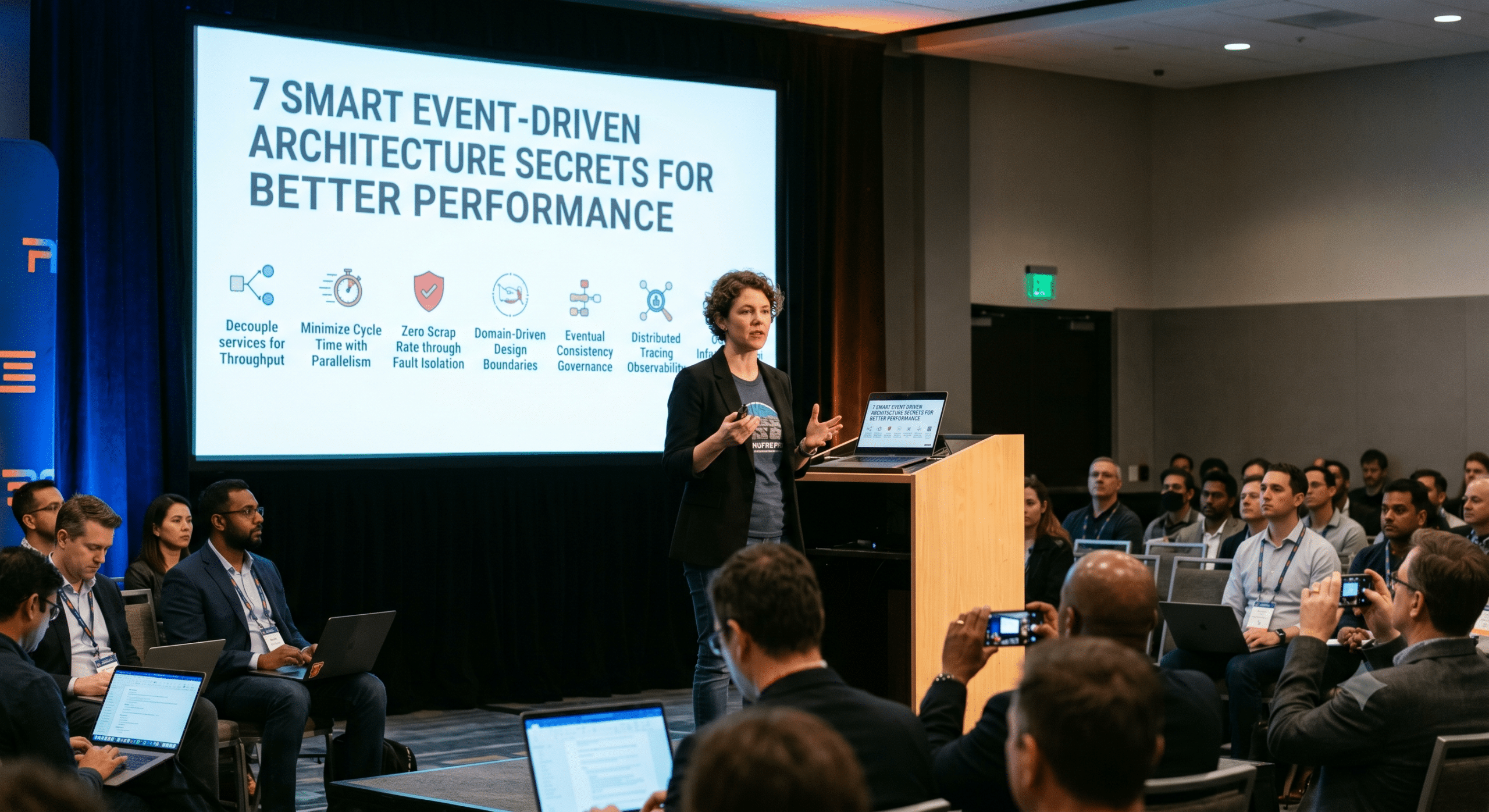
Modern software systems are under constant pressure. Users expect real-time updates. Customers demand instant transactions. Business leaders want faster releases, better scalability, and fewer production incidents. At the same time, development teams are trying to manage increasingly complex applications that must integrate with dozens of systems, services, APIs, databases, and third-party platforms.
This is where Event-driven architecture has become one of the most important architectural approaches in modern enterprise software design.
As a Technical Architect and Enterprise Architect, I have seen organizations struggle with tightly coupled applications that become slower, harder to maintain, and increasingly fragile as they grow. A simple change in one application can trigger unexpected failures across multiple systems. Development cycles become longer. Deployment risks increase. Operational costs rise.
The challenge is remarkably similar to what manufacturers face on a production floor.
In manufacturing, throughput suffers when workstations depend too heavily on each other. A delay in one station creates delays everywhere else. Cycle times increase. Defects accumulate. Scrap rises.
Software systems behave the same way.
When applications are tightly connected through synchronous communication, every dependency becomes a potential bottleneck. Every service call introduces latency. Every outage can create a chain reaction across the enterprise.
Event-driven architecture addresses this problem by allowing systems to communicate through events rather than direct dependencies. This approach enables greater scalability, faster processing, improved resilience, and reduced operational friction. Instead of waiting for one system to complete a task before another can continue, events allow work to happen asynchronously and independently. (martinfowler.com)
In this article, we will examine seven powerful Event-driven architecture strategies through the lens of maximizing throughput, reducing cycle time, and minimizing software “scrap” in the form of failed transactions, defects, downtime, and technical debt.
Understanding Event-Driven Architecture
Before exploring the strategies, it is important to understand what an event actually represents.
An event is simply a meaningful change in state.
A customer places an order.
A payment is approved.
An inventory level changes.
A shipment leaves a warehouse.
A user logs into an application.
Each of these actions generates information that other systems may need to know about. Instead of calling every system directly, the originating application publishes an event. Other systems consume the event and react accordingly. (Wikipedia)
This creates a loosely coupled environment where applications can evolve independently while still collaborating effectively.
The result is often improved scalability, better fault tolerance, and faster responsiveness across the enterprise. (Wikipedia)
Strategy 1: Replace Synchronous Bottlenecks with Asynchronous Processing
One of the biggest performance killers in enterprise software is excessive synchronous communication.
Imagine an e-commerce platform processing an order.
The order service calls the inventory service.
The inventory service calls the warehouse service.
The warehouse service calls the shipping service.
The shipping service calls the billing service.
Every service waits for the previous one to complete.
The entire workflow becomes vulnerable to delays at any point.
In manufacturing terms, this resembles a production line where every workstation must wait for the previous station before starting work.
Event-driven architecture removes this dependency.
When an order is created, the order service publishes an event.
Inventory, shipping, analytics, customer notification, and billing systems process the event independently.
Work occurs simultaneously rather than sequentially.
This dramatically improves throughput because multiple systems can execute in parallel rather than waiting in line. It also reduces cycle time because downstream activities begin immediately after an event is published. (Wikipedia)
Organizations frequently discover that asynchronous processing delivers some of the most noticeable performance improvements during modernization initiatives.
Strategy 2: Design Around Business Events Instead of Technical Functions
Many architectures are organized around technical components.
Developers create services based on databases, APIs, or application layers.
While technically logical, this often creates unnecessary complexity.
A better approach is organizing architecture around business events.
Examples include:
Order Created
Payment Received
Customer Registered
Invoice Generated
Shipment Delivered
These events represent actual business activities that stakeholders understand.
When architecture aligns with business events, communication becomes clearer, ownership becomes easier, and systems become more adaptable.
Martin Fowler describes several event-driven patterns including event notification and event-carried state transfer that help applications collaborate around business events rather than direct dependencies. (martinfowler.com)
This reduces architectural waste because teams spend less time building custom integrations and more time delivering business value.
From a throughput perspective, work moves through the enterprise faster because systems understand what happened rather than needing to ask multiple services for clarification.
Strategy 3: Eliminate Data Silos Through Event Streams
Data silos create significant operational inefficiencies.
Different departments often maintain separate systems that store similar information.
Customer records exist in CRM systems.
Order data exists in ERP platforms.
Billing information resides elsewhere.
Reporting teams continuously reconcile inconsistencies.
This creates software scrap.
Teams waste effort correcting errors, synchronizing data, and resolving conflicting information.
Event-driven architecture addresses this through continuous event streams.
Whenever a business event occurs, interested systems receive updates automatically.
Instead of repeatedly requesting information, systems subscribe to events and maintain their own relevant views of the data. This pattern is commonly known as event-carried state transfer. (martinfowler.com)
The result is reduced integration complexity and improved data consistency.
More importantly, systems spend less time waiting for information and more time processing valuable work.
That translates directly into higher throughput across the organization.
Strategy 4: Build Resilience by Decoupling Services
In tightly coupled architectures, failures spread rapidly.
A database outage affects one service.
That service affects another.
Soon the entire application becomes unavailable.
This resembles a manufacturing line where one machine failure stops every downstream operation.
Event-driven architecture introduces natural buffering between systems.
Messages can remain in queues or event streams until consumers become available again.
If one service experiences problems, other systems continue operating.
Events are processed once the affected component recovers.
This design significantly improves reliability and fault tolerance. Event-driven systems are widely recognized for their ability to support scalable and resilient distributed environments. (Wikipedia)
Reducing outages effectively minimizes software scrap because fewer transactions fail and fewer customer interactions are interrupted.
For enterprises operating at scale, resilience often becomes one of the strongest arguments for adopting Event-driven architecture.
Strategy 5: Use Event Streaming to Accelerate Real-Time Decision Making
Traditional reporting systems often suffer from delays.
Data is collected.
Stored.
Processed overnight.
Published the next day.
By the time decision-makers review reports, the information may already be outdated.
Event-driven architecture enables real-time visibility.
As events occur, analytics platforms consume and process them immediately.
Inventory changes can trigger replenishment alerts.
Fraud systems can detect suspicious behavior instantly.
Operations teams can monitor performance in real time.
This capability is known as event stream processing and is commonly used to support rapid decision-making across modern enterprises. (Wikipedia)
From a throughput perspective, faster decisions reduce operational delays.
From a cycle-time perspective, problems are identified sooner.
From a scrap-reduction perspective, issues are corrected before they become widespread failures.
Strategy 6: Reduce Deployment Risk Through Independent Services
Large monolithic applications often create deployment challenges.
A small feature update may require deploying an entire system.
Testing becomes extensive.
Release windows become longer.
Risk increases.
Event-driven architecture supports loosely coupled services that evolve independently.
Teams can deploy changes to one service without disrupting unrelated systems.
This accelerates development throughput while reducing release cycle times.
Microservice architectures often leverage event-driven communication to achieve this level of independence and scalability. (microservices.io)
From an operational standpoint, fewer deployment dependencies mean fewer production incidents.
From a business perspective, innovation reaches customers faster.
From a quality perspective, software scrap decreases because changes are isolated and easier to validate.
Strategy 7: Treat Events as Strategic Enterprise Assets
Many organizations view events merely as technical messages.
This mindset limits the value of Event-driven architecture.
A more mature approach treats events as enterprise assets.
Events become the authoritative record of what occurred across the business.
Teams can replay events.
Analyze historical activity.
Audit transactions.
Investigate failures.
Build new applications using existing event streams.
This concept forms the foundation of event sourcing, where events become the primary system record rather than simply notifications. (martinfowler.com)
When implemented carefully, event sourcing can dramatically improve traceability, compliance, and system transparency.
Organizations gain a clearer understanding of operational behavior and can continuously improve performance using actual business events rather than assumptions.
This creates a feedback loop that steadily improves throughput, reduces cycle time, and minimizes software waste.
Common Mistakes That Undermine Event-Driven Architecture
Although Event-driven architecture offers substantial benefits, it is not a universal solution.
One common mistake is generating too many events.
Excessive event creation increases complexity and makes systems harder to understand and maintain. (Wikipedia)
Another mistake is poor schema management.
Events effectively become APIs. If event formats change without governance, downstream consumers can fail unexpectedly. (YouTube)
Organizations also underestimate monitoring requirements.
Because processing occurs asynchronously, visibility becomes essential.
Without proper observability, identifying failures becomes difficult.
Finally, some teams adopt Event-driven architecture solely because it is popular.
Architectural decisions should solve business problems, not follow trends.
The best architectures align with operational requirements, scalability goals, and organizational maturity.
The Future of Application Architecture
The software industry continues moving toward increasingly distributed systems.
Cloud-native platforms.
Microservices.
Real-time analytics.
AI-powered applications.
Internet of Things ecosystems.
Digital platforms.
All of these environments benefit from the flexibility and scalability that Event-driven architecture provides.
Organizations seeking higher throughput, faster response times, and greater operational resilience are increasingly adopting event-centric approaches.
As enterprise ecosystems grow more complex, the ability to communicate through events rather than rigid dependencies becomes a competitive advantage.
The future of application architecture is not merely about building software.
It is about designing systems that can evolve, scale, and adapt without creating operational bottlenecks.
Event-driven architecture provides a proven framework for achieving that goal. (martinfowler.com)
Conclusion
Event-driven architecture is far more than a technical design pattern.
It is an operational strategy for improving enterprise software performance.
When viewed through the lens of throughput, cycle time, and scrap reduction, its value becomes remarkably clear.
By replacing synchronous bottlenecks with asynchronous processing, organizations accelerate workflow execution. By organizing systems around business events, they reduce complexity. By eliminating data silos, improving resilience, enabling real-time decisions, supporting independent deployments, and treating events as strategic assets, enterprises create software ecosystems that are faster, more reliable, and easier to scale.
The most successful organizations understand that architecture is not simply about technology choices.
It is about creating systems that allow information to move efficiently, teams to innovate rapidly, and businesses to respond effectively to change.
That is precisely why Event-driven architecture continues to be one of the most influential architectural patterns in modern enterprise software development.
Frequently Asked Questions
What is Event-driven architecture?
Event-driven architecture is a software architecture pattern where applications communicate through events. An event represents a meaningful change in state, such as a customer placing an order or a payment being completed. Systems react to events rather than relying solely on direct service-to-service communication. (Wikipedia)
How does Event-driven architecture improve scalability?
Because systems are loosely coupled and communicate asynchronously, workloads can be distributed more efficiently. Services can process events independently without waiting for other systems to complete tasks. (Wikipedia)
Is Event-driven architecture the same as microservices?
No. Microservices and Event-driven architecture are different concepts. However, many microservice environments use event-driven communication because it reduces dependencies between services and improves scalability. (microservices.io)
What are the biggest benefits of Event-driven architecture?
The primary benefits include higher scalability, improved resilience, reduced system coupling, faster processing, real-time responsiveness, and greater flexibility for future growth. (Wikipedia)
What technologies are commonly used for Event-driven architecture?
Popular technologies include Apache Kafka, RabbitMQ, Amazon EventBridge, Amazon Kinesis, Apache Pulsar, and other event streaming and messaging platforms. (Confluent)
When should organizations avoid Event-driven architecture?
Organizations should avoid it when system complexity does not justify the additional operational overhead. Simple applications with limited integration requirements may benefit more from straightforward synchronous architectures. (YouTube)
References and Further Reading
For readers who want to deepen their understanding of Event-driven architecture, these high-authority resources are widely respected within the software architecture community:
- Martin Fowler – What Do You Mean by Event-Driven?
- Martin Fowler – Event Architecture Resources
- Confluent – Apache Kafka as an Event-Driven Backbone for Service Architectures
- Chris Richardson – Microservices Architecture Patterns
- VMware Tanzu – Introduction to Event-Driven Architecture and Apache Kafka
- Martin Fowler GOTO Talk – The Many Meanings of Event-Driven Architecture
- AWS Event-Driven Architecture Resources
Referenced within AWS event-driven architecture guidance and implementation patterns.