


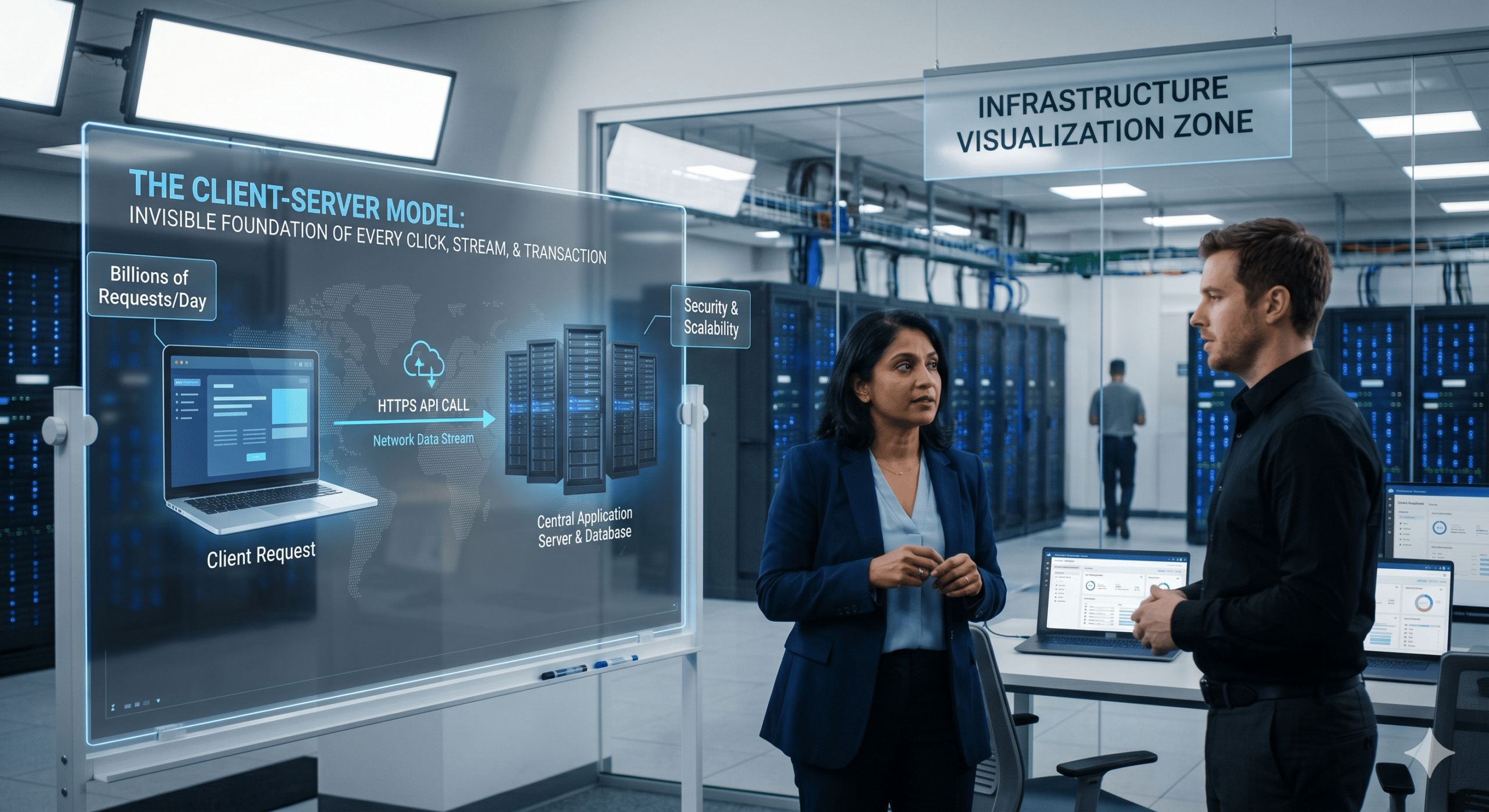
Client-Server Model Breakdown is one of the most important concepts in modern computing, yet most people use it every day without realizing it. Every time you visit a website, stream a movie, send an email, or log into an online account, your device is communicating with powerful systems behind the scenes. Understanding a Client-Server Model Breakdown helps explain how these interactions happen and why this architecture remains the foundation of the internet, cloud computing, business applications, and digital services used around the world.
When people think about technology, they usually focus on what they can see. They think about websites, mobile apps, online banking platforms, streaming services, social media networks, and cloud applications. What most users never see is the powerful system working behind the scenes that makes all these digital experiences possible.
Every time you open a website, check your email, watch a video online, or log into an application, your device is communicating with another computer somewhere else in the world. This constant exchange of information happens billions of times every day and serves as the foundation of the modern internet.
At the heart of this communication is something known as the Client-Server Model Breakdown, a concept that explains how devices and servers work together to deliver digital services.
As a Chief Technology Officer who has spent years designing enterprise systems, leading digital transformation initiatives, and helping organizations modernize their technology infrastructure, I often explain the client-server model as the engine that powers the digital world. Most people don’t need to understand every technical detail, but having a basic understanding of how it works can provide valuable insight into why technology behaves the way it does.
The client-server model is not a new concept. In fact, it has been around for decades. Yet despite the rise of cloud computing, artificial intelligence, edge computing, and countless technological innovations, the fundamental principles behind the client-server model remain as important today as ever.
This article breaks down the client-server model in simple, practical terms, helping everyday readers understand one of the most influential concepts in computing.
Understanding the Client-Server Model in Simple Terms
The easiest way to understand the client-server model is to think about a restaurant.
Imagine you’re sitting at a table and looking at a menu. When you’re ready to eat, you place an order. The kitchen receives your request, prepares the meal, and sends it back to your table. You receive the food without needing to know how the kitchen operates.
The client-server model works in much the same way.
In this scenario, you are the client because you are making the request. The kitchen acts as the server because it receives the request, processes it, and delivers a response.
In the digital world, your smartphone, laptop, tablet, or web browser acts as the client. The server is a computer system designed to store information, process requests, and deliver responses back to users.
Every time you visit a website, your browser requests information from a server. The server receives the request, gathers the necessary data, and sends it back to your device, which displays the information on your screen.
The entire process often happens in less than a second, making the experience feel seamless and instantaneous.
Why the Client-Server Model Became the Foundation of Modern Computing
The client-server model became popular because it solved a major challenge in computing: how to efficiently share resources among many users.
Before networking became widespread, computers often operated independently. Data and applications were stored locally, limiting collaboration and creating inefficiencies. Organizations quickly realized that maintaining separate copies of data on every computer was difficult, expensive, and prone to errors.
The client-server model introduced a better approach. Instead of storing everything on individual devices, critical information could be stored on centralized servers and accessed by authorized users whenever needed.
This approach transformed computing.
Businesses could manage data more effectively, employees could collaborate more easily, and software could be updated from a central location instead of requiring installation on every workstation.
Today, nearly every major technology platform relies on some variation of the client-server model.
The Three Essential Components of a Client-Server System
Although modern technology systems can be incredibly sophisticated, the client-server model is built upon three basic components: the client, the server, and the network.
The client is the device or application that initiates communication. This could be a web browser, a mobile app, a desktop application, a smart television, or even an Internet of Things (IoT) device. The client’s primary role is to interact with the user and send requests when information or services are needed.
The server serves as the processing center. It receives incoming requests, performs the necessary actions, retrieves data, and sends responses back to clients. Servers are specifically designed to handle multiple requests simultaneously and are often far more powerful than standard personal computers.
Connecting the client and server is the network. Whether it’s the internet, a corporate network, or a wireless connection, the network enables communication between the two systems. Without this communication pathway, the client and server would be unable to exchange information.
These three components work together continuously to deliver the digital experiences we rely on every day.
What Happens When You Visit a Website?
One of the best ways to understand the client-server model is to follow a real-world example.
Suppose you want to visit an online news website.
You open your browser and type the website address into the address bar. At that moment, your browser generates a request asking for the website’s homepage.
The request travels across the internet and reaches the server hosting the website. Once the server receives the request, it begins processing it. The server identifies which webpage is being requested and gathers the necessary files, including text, images, scripts, and other content.
After assembling the information, the server sends a response back through the network to your browser.
Your browser then interprets the data and displays the webpage on your screen.
Although this entire process may seem simple, dozens of interactions may occur behind the scenes. The server might access a database, verify user information, retrieve advertisements, load multimedia content, and execute various application functions before delivering the final result.
All of these activities happen within milliseconds, creating the smooth experience users expect.
Everyday Examples of the Client-Server Model
The client-server model is so deeply embedded in modern life that most people interact with it hundreds of times each day without realizing it.
Consider email services. When you send an email, your email application acts as the client. The message is transmitted to a mail server, which processes and routes it to the recipient’s mail server. When the recipient opens their inbox, another client-server interaction occurs.
Online banking operates in a similar way. Your banking application sends requests to the bank’s servers whenever you check balances, transfer funds, or review transaction history. The server verifies your identity, retrieves account information, and securely delivers the requested data.
Streaming platforms also rely heavily on client-server architecture. When you watch a movie online, your device continuously requests video data from servers that store and distribute content. The server responds by sending video segments to ensure uninterrupted playback.
Social media platforms, cloud applications, e-commerce websites, video conferencing systems, and online gaming networks all depend on the same fundamental principle: clients request services, and servers provide them.
Why Businesses Prefer Client-Server Architecture
From an enterprise technology perspective, the client-server model offers several strategic advantages.
One of the most important benefits is centralized management. Rather than storing data across hundreds or thousands of individual devices, organizations can maintain information in centralized locations. This simplifies administration, reduces duplication, and improves consistency across the business.
Security also becomes easier to manage. Sensitive information remains on protected servers rather than being scattered across employee devices. Administrators can implement authentication systems, encryption standards, monitoring tools, and access controls from a central point.
Scalability is another major advantage. As organizations grow, additional servers can be deployed to accommodate increased demand. This flexibility allows businesses to expand their operations without completely redesigning their infrastructure.
Maintenance becomes significantly more efficient as well. Software updates, security patches, and system improvements can often be applied directly to servers, reducing the need for extensive manual intervention across numerous client devices.
For organizations seeking reliability, efficiency, and long-term growth, the client-server model continues to provide a proven foundation.
Different Types of Client-Server Architectures
Although the basic concept remains the same, client-server systems can be designed in several ways depending on business requirements.
The simplest approach is known as a two-tier architecture. In this model, clients communicate directly with servers. Smaller applications and departmental systems often use this design because it is relatively straightforward to implement and manage.
As organizations grow, they often adopt a three-tier architecture. This approach introduces an additional application layer between clients and databases. Instead of communicating directly with data storage systems, clients interact with application servers that process business logic and manage data requests.
Large enterprises frequently utilize multi-tier architectures that incorporate additional components such as load balancers, caching servers, API gateways, security services, and database clusters. These architectures improve performance, increase reliability, and support large-scale operations involving millions of users.
The architecture chosen depends largely on organizational goals, expected workloads, and operational complexity.
Challenges and Limitations of the Client-Server Model
Despite its many strengths, the client-server model is not without challenges.
One common concern is server dependency. Because servers provide critical services, any disruption can impact large numbers of users. If a server experiences hardware failure, software issues, or network outages, clients may lose access to important applications and data.
Organizations address this risk through redundancy strategies, backup systems, and disaster recovery planning. Modern cloud environments often distribute workloads across multiple servers to minimize downtime.
Performance bottlenecks can also occur when demand exceeds server capacity. During peak traffic periods, servers may struggle to process requests quickly enough, resulting in slower response times.
Security presents another ongoing challenge. Because servers often store valuable information, they become attractive targets for cybercriminals. Organizations must continuously invest in cybersecurity measures to protect sensitive data and maintain customer trust.
Additionally, infrastructure costs can become significant, particularly for businesses managing large-scale systems. Hardware, software licensing, maintenance, security, monitoring, and staffing all contribute to operational expenses.
Despite these challenges, the advantages of the client-server model generally outweigh its limitations for most organizations.
How Cloud Computing Changed the Client-Server Model
Many people assume cloud computing replaced traditional client-server architecture. In reality, cloud computing is simply an evolution of the same concept.
The underlying relationship remains unchanged. Clients continue to request services, and servers continue to provide them.
The primary difference lies in where the servers are located and how they are managed.
In traditional environments, organizations owned and maintained their own physical servers within company facilities or private data centers. Cloud computing shifted these resources to large-scale provider-operated data centers.
Cloud providers offer businesses access to computing power, storage, networking resources, and software services without requiring organizations to purchase and manage physical infrastructure themselves.
This shift has enabled unprecedented scalability, flexibility, and cost efficiency while preserving the fundamental principles of client-server communication.
The Future of the Client-Server Model
Some technologies receive enormous attention in today’s technology landscape. Artificial intelligence, edge computing, quantum computing, and serverless architectures often dominate industry conversations.
Yet beneath many of these innovations, client-server principles continue to operate.
Artificial intelligence applications process user requests through servers that host machine learning models. Cloud platforms deliver services through distributed server infrastructures. Edge computing extends server capabilities closer to users while maintaining client-server interactions.
Rather than disappearing, the client-server model continues to evolve.
Modern architectures may look very different from those used decades ago, but the fundamental concept remains remarkably resilient. Clients still request services, and servers still provide them.
As long as digital systems require communication, processing, and information exchange, the client-server model will remain a cornerstone of computing.
Final Thoughts
The client-server model is one of the most influential concepts in information technology, yet it often operates entirely behind the scenes.
Every website visit, online purchase, social media interaction, email exchange, cloud application session, and video stream depends on this architecture in some form.
Its success comes from its simplicity and effectiveness. By separating users from the systems that process information, organizations can create scalable, secure, and manageable technology environments.
From a CTO’s perspective, understanding the client-server model is valuable not only for technology professionals but also for business leaders, entrepreneurs, and anyone seeking to better understand the digital world.
Technology will continue to evolve. New innovations will emerge. Infrastructure will become more sophisticated.
A thorough Client-Server Model Breakdown demonstrates why this architecture continues to power modern computing. By understanding a Client-Server Model Breakdown, readers gain valuable insight into the systems that support websites, mobile applications, cloud services, and enterprise software. As technology evolves, the principles explained in this Client-Server Model Breakdown will remain relevant for years to come.
However, the basic relationship between clients and servers remains one of the most enduring and important foundations of modern computing, quietly powering nearly every digital experience we enjoy today.
Frequently Asked Questions
What is a Client-Server Model Breakdown?
A Client-Server Model Breakdown explains how a client device requests information or services from a server, which processes the request and returns a response. Understanding a Client-Server Model Breakdown helps readers see how modern applications, websites, and digital services function behind the scenes.
What is a real-world example of a Client-Server Model Breakdown?
One of the most common examples of a Client-Server Model Breakdown is a web browser accessing a website. The browser acts as the client, while the web server hosts, processes, and delivers the requested content to the user.
Why is a Client-Server Model Breakdown important?
A Client-Server Model Breakdown is important because it demonstrates how centralized management, security, scalability, and resource sharing work together in modern computing environments. Businesses rely on these principles to support websites, cloud platforms, and enterprise applications.
Is cloud computing part of a Client-Server Model Breakdown?
Yes. A Client-Server Model Breakdown remains relevant in cloud computing because cloud services still rely on clients communicating with servers. The primary difference is that cloud servers are hosted in remote data centers rather than on-premises infrastructure.
What are the disadvantages highlighted in a Client-Server Model Breakdown?
A Client-Server Model Breakdown reveals several potential challenges, including server dependency, infrastructure costs, security risks, and performance bottlenecks. Organizations address these issues through redundancy, monitoring, cybersecurity measures, and scalable infrastructure design.
What is the difference between a Client-Server Model Breakdown and peer-to-peer networking?
A Client-Server Model Breakdown focuses on a centralized architecture where servers manage resources and respond to client requests. In contrast, peer-to-peer networking allows devices to communicate directly with one another without relying on a dedicated central server.
Further Reading and References
For readers interested in expanding their understanding of networking, enterprise architecture, and modern computing infrastructure, the following resources provide valuable insights:
- IBM Think – Cloud Computing Fundamentals
- Coursera – Understanding Client-Server Architecture
- ServerWatch – Client-Server Model Explained
- Redmond Magazine – Client-Server Architecture Guide
- Cisco Networking Academy – Networking Fundamentals
- Microsoft Learn – Network Architecture Concepts
- Amazon Web Services – Networking and Cloud Infrastructure
- Cloudflare Learning Center – Networking and Internet Infrastructure
- Oracle – Understanding Enterprise Architecture
- IBM Think – Modern IT Infrastructure and Architecture